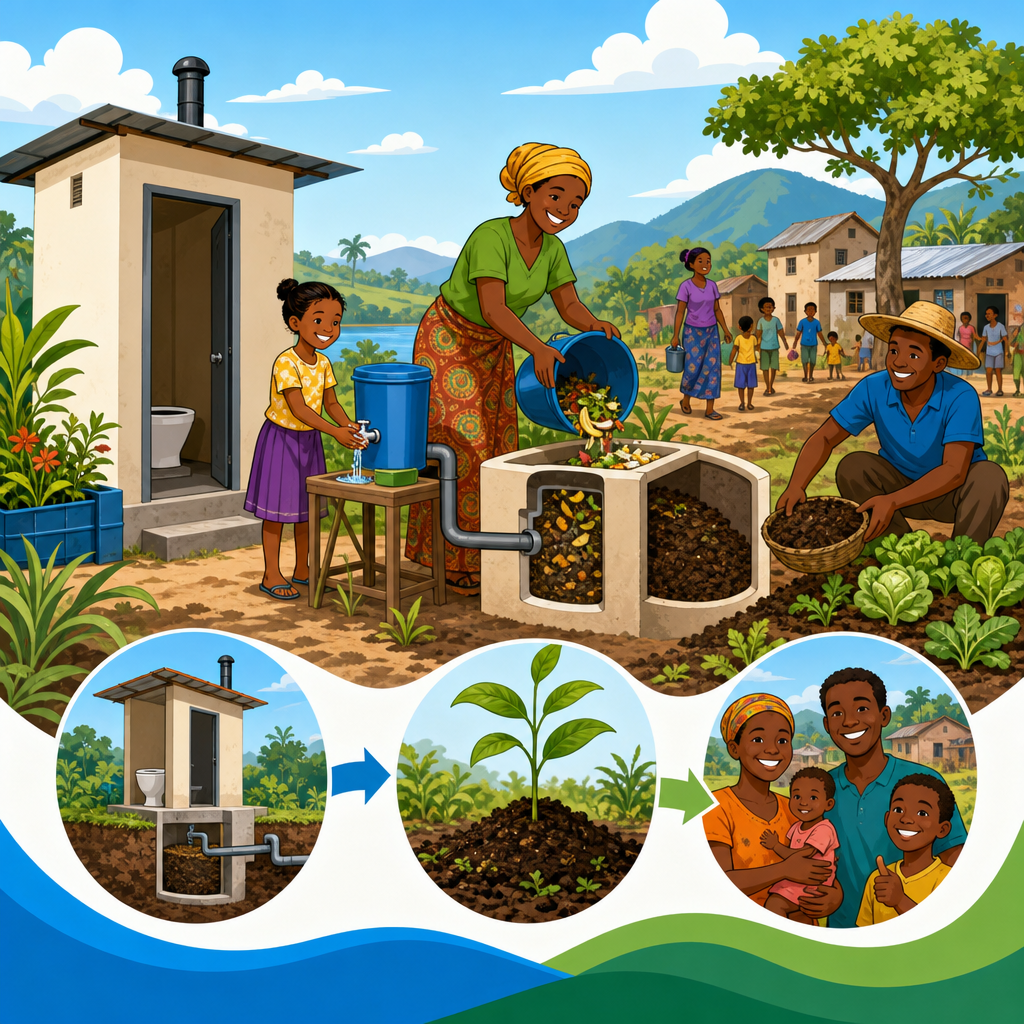
Community-led sanitation has become one of the most important public health and development strategies in Africa because it shifts sanitation from a donor-built infrastructure problem to a locally owned behavior, governance, and resource management system. In practice, community-led sanitation means villages, peri-urban settlements, schools, and local governments organize to end open defecation, improve hygiene, manage waste safely, and maintain facilities through collective decisions rather than one-off construction projects. Within that broad field, ecological sanitation, commonly shortened to EcoSan, focuses on safely separating, treating, and reusing human waste as a resource, usually through urine-diverting dry toilets, composting systems, and soil improvement practices. I have seen sanitation programs fail when latrines were delivered without community buy-in, and I have seen modest projects outperform expensive ones when local leaders, women’s groups, masons, and farmers all understood the system and benefited from it. That is why success stories from African nations matter: they show what actually works under pressure from water scarcity, rapid urbanization, fragile municipal services, and tight household budgets. They also reveal a crucial lesson for this case-study hub: EcoSan succeeds not because a toilet design is clever, but because communities trust the model, institutions support safe reuse, and households see practical value in sanitation investments.
What community-led sanitation and EcoSan achieve in real settings
Community-led sanitation programs aim to stop open defecation, reduce fecal contamination, and build local accountability for hygiene. EcoSan adds a circular economy logic to that goal. Instead of treating excreta only as waste, EcoSan systems recover nutrients such as nitrogen, phosphorus, and potassium, which can support agriculture when treatment and handling are done correctly. In water-stressed areas, dry or low-water systems also reduce pressure on scarce supplies. Across African settings, these approaches are most effective where they are tied to local habits, land use, and governance structures. A farming community may value compost and urine reuse, while a dense settlement may prioritize container-based collection, odor control, and safer emptying services.
The strongest programs answer practical questions early. Who pays for construction and maintenance? Who empties vaults or containers? What training do households need to separate urine and feces correctly? Which crops can use treated outputs, and under what safeguards? How do local bylaws support adoption? When implementers ignore these questions, systems are abandoned. When they address them, sanitation coverage and user satisfaction improve together. This is the core lesson running through African sanitation case studies: success depends on the full service chain, from behavior change and toilet choice to treatment, reuse, financing, and monitoring.
Lessons from Uganda and Ethiopia: linking sanitation to farming value
Uganda and Ethiopia offer some of the clearest lessons on EcoSan adoption in rural and small-town contexts. In parts of Uganda, urine-diverting dry toilets gained traction where projects worked directly with farmers and demonstration plots. Households could see that treated urine diluted with water supported crops such as maize, bananas, and vegetables, while composted fecal matter improved soil structure. In these projects, uptake rose when extension workers explained application rates, storage periods, pathogen risks, and handwashing protocols in plain language. The toilet was no longer sold as a health lecture alone; it became part of household productivity.
Ethiopia’s experience similarly shows that sanitation gains are stronger when agricultural ministries, health extension workers, and local administrations work together. In drought-prone areas, dry sanitation options can be more realistic than flush systems that depend on unreliable water access and costly sewer expansion. However, social acceptance remains decisive. Communities often need repeated engagement before they are comfortable handling treated products derived from excreta. The programs that progressed best used respected local champions, women’s groups, and farmer field schools to normalize safe reuse. They also adapted designs for local construction materials, which reduced costs and made repairs easier. The lesson from both countries is straightforward: if EcoSan is framed only as a toilet project, adoption is limited; if it is integrated with livelihoods, extension services, and practical demonstrations, households are far more likely to maintain it.
Southern Africa case studies: Zimbabwe and Zambia on resilience and maintenance
Zimbabwe is frequently cited in discussions of EcoSan because long periods of water stress and infrastructure decline forced communities and institutions to consider alternatives to conventional sewerage. In schools and rural districts, double-vault urine-diverting toilets proved useful where water for flushing was unreliable. The strongest outcomes came from programs that invested in caretaker training, clear cleaning routines, ash use, and scheduled vault switching. Where these management practices were weak, odor, insect problems, and misuse quickly reduced confidence. Where they were consistent, facilities remained functional and communities developed local technical knowledge.
Zambia provides another important lesson: sanitation hardware must match settlement patterns and service capacity. In peri-urban areas, projects sometimes struggled because households had limited space and tenants did not control long-term improvements. Yet in institutions, farms, and lower-density communities, EcoSan designs delivered better durability and lower water demand than pit latrines vulnerable to collapse or flooding. Programs improved outcomes by training local masons, standardizing core components, and creating simple maintenance checklists. I have found that this local supply-side work is often underestimated. Even highly motivated communities cannot sustain a sanitation model if spare parts, slab repairs, vent pipes, or trained builders are unavailable. Zimbabwe and Zambia both show that resilience comes from maintenance systems as much as from initial construction.
West African experience: Burkina Faso and Mali on scaling behavior change
Burkina Faso and Mali demonstrate how community-led sanitation can scale when triggering, local leadership, and sanitation marketing reinforce one another. Community-led total sanitation approaches in West Africa have often focused first on ending open defecation through collective realization of contamination pathways. That approach can produce rapid behavior change, but long-term success depends on what happens next. Households need access to affordable, acceptable, and durable sanitation options. EcoSan entered this landscape where soil conditions, water scarcity, and agricultural livelihoods made resource recovery attractive.
In Burkina Faso, successful initiatives combined social mobilization with targeted technical support. Rather than prescribing a single toilet design, implementers assessed whether households could manage urine separation, ash addition, and periodic emptying. Some communities embraced the model because compost use aligned with existing farming practices. Others preferred improved pit latrines because the reuse component faced cultural resistance. That distinction matters. A credible sanitation program does not force EcoSan where it is unsuitable. It identifies where the approach provides a real advantage and where another technology fits better.
Mali’s experience reinforces the role of trusted intermediaries. Local artisans, health agents, and village committees often mattered more than outside consultants once projects entered the maintenance phase. Programs that trained these actors to explain pathogen reduction, storage time, and safe agricultural application built stronger confidence. The broad lesson from West Africa is that community-led sanitation cannot rely on shame, subsidy, or technology alone. It requires sequenced behavior change, local market development, and realistic choices for households at different income levels.
Urban and peri-urban lessons: why density changes the sanitation equation
Many celebrated rural sanitation models perform poorly when copied into dense informal settlements. Shared compounds, high tenancy, limited space, flood risk, and weak municipal collection systems all complicate EcoSan in urban and peri-urban Africa. I have worked on sanitation assessments where a technically sound urine-diverting toilet was the wrong choice simply because no one had authority to manage shared use or empty stored material safely. In these settings, success often depends less on the toilet interface and more on the service model behind it.
Across cities in East and Southern Africa, sanitation providers have learned that dense areas need clear responsibility, regular collection, and pricing that households understand. EcoSan principles still matter because nutrient recovery and low water use remain valuable, but designs must fit the realities of rental housing and small plots. Container-based sanitation, scheduled emptying, and franchised maintenance services can complement or outperform static household systems in these environments. The key lesson for this hub topic is that community leadership still matters in cities, but it must be connected to municipal regulation, private operators, and land tenure realities. Sanitation systems fail in urban areas when community ownership is expected to solve structural service gaps on its own.
Common implementation patterns and the lessons they reveal
Looking across African EcoSan case studies, the same implementation patterns appear repeatedly. The projects that endure are not necessarily the most funded. They are the ones that align technology, training, incentives, and governance from the beginning.
| Implementation factor | What successful programs did | What happened when neglected |
|---|---|---|
| Community engagement | Used local leaders, demonstrations, and household follow-up | Low adoption, confusion, and rapid abandonment |
| Design fit | Matched toilets to water access, soil, density, and user preferences | Misuse, odor complaints, and poor durability |
| Safe reuse training | Explained storage, handling, crop use, and protective practices clearly | Health concerns and resistance to recovered products |
| Supply chains | Trained masons and ensured parts and repair skills were local | Broken facilities stayed out of service |
| Institutional support | Linked health, agriculture, schools, and local government | Projects ended when donor support ended |
| Monitoring | Tracked use, cleanliness, emptying, and satisfaction after construction | Coverage figures looked good while functionality declined |
These patterns help explain why some sanitation case studies are genuinely replicable and others are not. Replication is not copying a toilet blueprint from one country to another. It is transferring decision rules: assess context, build local ownership, verify the service chain, and monitor whether use continues after the launch event. That is the standard serious practitioners now use.
What schools, clinics, and local governments teach about long-term adoption
Institutional settings often reveal the strengths and weaknesses of EcoSan faster than household pilots do. In schools, for example, toilets must withstand high user volumes, changing supervision, and uneven cleaning routines. Successful school EcoSan systems in countries such as Zimbabwe and Uganda typically had designated caretakers, budget lines for supplies, separate facilities for girls and boys, and handwashing stations that remained operational. Where school management committees were engaged, students learned hygiene practices that influenced household demand. Where schools lacked oversight, even well-built systems deteriorated quickly.
Clinics and health posts face a different standard because infection prevention is central. Here, sanitation design must support cleanliness, accessibility, and predictable maintenance. EcoSan is not automatically the best choice, but where it is used, protocols must be stricter than in household settings. Local governments also play a decisive role. District bylaws, inspection routines, and sanitation budgets often determine whether successful pilots become district-wide practice. The most credible case studies are the ones where local authorities absorbed lessons into procurement standards, mason training, or agricultural extension guidance. That institutional uptake is the difference between a promising project and a durable public system.
How to apply these lessons across the case-study hub
As a hub for lessons from EcoSan implementations, this page points to one overarching conclusion: sanitation success is cumulative. Communities need motivation, but motivation alone does not keep facilities functional. Good designs matter, but design alone does not create safe reuse or reliable maintenance. Funding helps, but money alone does not create trust. The best African sanitation success stories combine community mobilization, fit-for-purpose technology, practical training, and institutional follow-through. They also accept tradeoffs. EcoSan is especially valuable where water is scarce, soils benefit from nutrient recovery, and households or institutions can manage separation and treatment. It is less suitable where density, tenancy, or weak service chains make safe handling unrealistic.
For readers exploring related case studies, the most useful lens is comparative rather than promotional. Ask which problem each program was solving, what assumptions it made about users, who maintained the system after the project team left, and whether households saw a direct benefit. Those questions consistently separate durable sanitation gains from short-lived pilots. If you are planning a program, funding one, or studying implementation, use these African examples as working evidence. Build from the lessons, test them in local conditions, and prioritize systems communities can actually sustain.
Frequently Asked Questions
What is community-led sanitation, and why has it been so effective in African nations?
Community-led sanitation is an approach that helps communities take direct responsibility for ending open defecation, improving hygiene practices, managing waste safely, and maintaining sanitation facilities over the long term. Instead of relying only on outside organizations to build toilets or install short-term infrastructure, the model focuses on local decision-making, shared responsibility, behavior change, and practical action led by residents themselves. In many African nations, this has been especially effective because sanitation challenges are often closely tied to everyday habits, social norms, land use patterns, water access, local leadership, and household finances. When communities analyze these realities together and agree on solutions, sanitation improvements are far more likely to be accepted, used, and sustained.
The success of this approach also comes from the fact that it treats sanitation as a public health and community governance issue, not just a construction project. Villages and neighborhoods often create their own rules, monitoring systems, maintenance plans, and accountability structures. Local leaders, teachers, health workers, women’s groups, and youth organizations frequently play central roles in encouraging participation and reinforcing standards. Across different African settings, from rural villages to peri-urban settlements, this collective ownership has helped communities move from isolated household efforts to coordinated action that protects everyone. That is why community-led sanitation is widely seen as one of the most promising and durable strategies for improving health, dignity, and environmental safety.
What are some notable success stories of community-led sanitation in Africa?
A number of African nations have demonstrated how powerful community-led sanitation can be when it is supported by local leadership, public health systems, and consistent follow-up. In countries such as Ethiopia, Zambia, Malawi, Rwanda, and Ghana, community-based sanitation programs have helped large numbers of communities reduce or eliminate open defecation, increase household latrine construction, and improve handwashing and waste management practices. While the details differ by country, a common pattern appears again and again: residents are mobilized to assess sanitation risks, communities commit to collective action, local authorities provide facilitation and verification, and visible progress builds momentum.
In some places, success has come through strong village-level organization, with communities setting clear sanitation targets and regularly checking whether households are meeting them. In others, schools have become important drivers of change by teaching children hygiene practices that spread to families and the wider community. There are also success stories where district governments, traditional leaders, and community health workers have worked together to certify open-defecation-free communities and support the transition from basic sanitation to more durable and safely managed services. These examples matter because they show that success is not limited to one country, one culture, or one funding model. Rather, the most effective results have come when communities themselves are treated as the primary agents of change and when sanitation gains are reinforced through ongoing local systems instead of one-time interventions.
How does community-led sanitation improve public health and daily life?
The public health benefits of community-led sanitation are significant and immediate. When open defecation is reduced and waste is managed more safely, communities are better protected from fecal contamination in water, soil, food, and shared living areas. This can lower exposure to diarrheal diseases, intestinal parasites, and other sanitation-related illnesses that disproportionately affect children, older adults, and households with limited access to healthcare. Better sanitation is also closely connected to improved nutrition, child growth, school attendance, and overall resilience, because repeated illness can weaken families economically and physically.
Beyond disease prevention, the daily-life impact is just as important. Safe, accessible sanitation gives people greater privacy, dignity, and personal security, especially women, girls, older persons, and people with disabilities. It can reduce the risks associated with traveling long distances to relieve oneself, particularly at night or during bad weather. In schools, better sanitation and hygiene facilities help create healthier learning environments and can improve attendance, especially for girls. At the household and community levels, cleaner surroundings often strengthen pride, cooperation, and local confidence. In that sense, community-led sanitation does more than improve infrastructure; it improves the quality of life, supports social wellbeing, and helps communities build healthier environments that they can manage and protect over time.
What makes a community-led sanitation program sustainable over the long term?
Long-term sustainability depends on much more than the initial construction of toilets or the launch of a hygiene campaign. The strongest community-led sanitation programs are sustained by behavior change, local ownership, regular monitoring, and the ability of communities to solve problems after the first phase of support ends. This means households must not only build facilities, but also consistently use, clean, repair, and upgrade them. It also means communities need ways to include renters, low-income households, people with disabilities, and families facing land or water constraints, so progress does not stall or leave vulnerable groups behind.
Another key factor is the presence of supportive local systems. Successful programs often involve trained facilitators, active local government engagement, public health outreach, school participation, and practical supply chains for sanitation materials and services. In many African contexts, sustainability improves when communities have clear criteria for reaching and maintaining open-defecation-free status, when verification is transparent, and when follow-up continues after certification. Programs are also stronger when they move beyond basic latrine coverage to address handwashing, fecal sludge management, drainage, solid waste handling, and climate resilience. In short, sustainability happens when sanitation becomes part of everyday governance and community life rather than a temporary project objective.
What challenges do African communities face in community-led sanitation, and how are they overcoming them?
Despite many success stories, community-led sanitation efforts still face serious challenges. Poverty can make it difficult for households to afford durable toilets or hygiene supplies. In flood-prone, densely populated, or water-scarce areas, standard sanitation solutions may not work well without adaptation. Some communities struggle with weak follow-up after the initial mobilization phase, which can lead to slippage back into open defecation. There may also be barriers related to tenancy, disability access, social exclusion, population growth, or limited municipal capacity in peri-urban and informal settlements. These challenges are real, and they explain why sanitation progress is not always linear or evenly distributed.
What is encouraging, however, is that many communities and local institutions are finding practical ways to respond. Some have introduced locally affordable toilet designs using available materials, while others have created savings groups, community support systems, or targeted assistance for the poorest households. In areas with difficult terrain or high water tables, sanitation options are being adapted to local environmental conditions. Governments and development partners are increasingly recognizing that peri-urban sanitation requires different planning, stronger regulation, and better service delivery than rural villages. At the same time, many successful programs are placing greater emphasis on inclusion, post-certification monitoring, sanitation marketing, and links to local enterprises that can provide materials, emptying services, and repairs. These adaptations show that community-led sanitation is not a fixed model but a flexible framework that grows stronger when communities, governments, and partners learn from experience and respond to local realities.