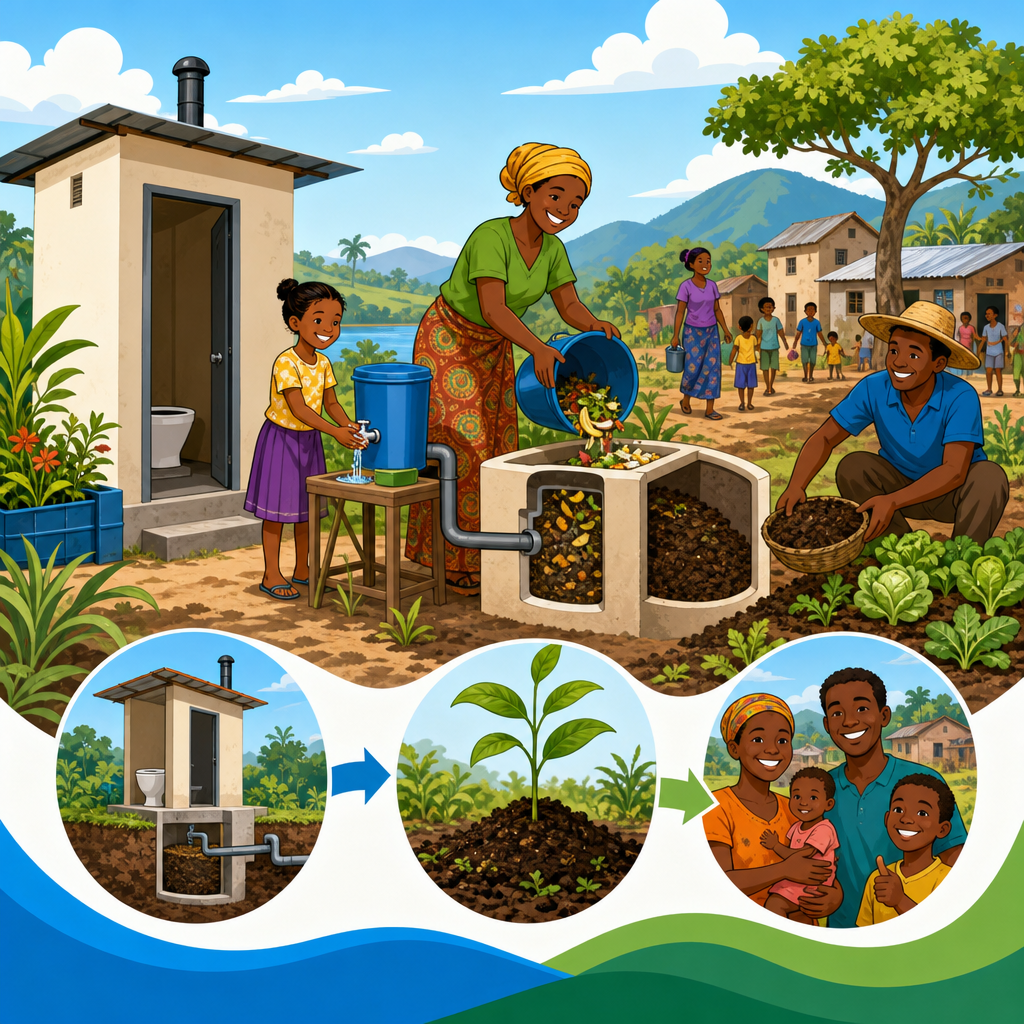
Tanzania’s approach to integrating sanitation with local norms offers one of the clearest lessons in why infrastructure alone does not change public health outcomes. In rural villages, peri-urban settlements, and dense informal neighborhoods, toilets succeed when they fit daily habits, land patterns, beliefs about purity, and the economics of households that build incrementally. That is why lessons from EcoSan implementations in Tanzania matter far beyond East Africa. They show how ecological sanitation can move from being a technical concept to a practical community system when design, messaging, and governance align with local life.
EcoSan, short for ecological sanitation, refers to sanitation systems designed to safely contain, treat, and often reuse human waste as a resource, typically through dehydration, composting, urine diversion, or nutrient recovery. In practice, Tanzanian EcoSan projects have included urine-diverting dry toilets, improved pit systems with reuse components, school sanitation blocks, and community pilots linked to agriculture. The central idea is simple: sanitation should protect health, conserve water, and recover value. The difficult part is implementation. Over years of reviewing and working with sanitation programs, I have seen technically sound systems fail because households disliked ash handling, feared emptying chambers, or rejected reuse practices as socially inappropriate.
Tanzania provides a strong case study because sanitation policy has had to navigate wide regional variation. Coastal Muslim communities, highland farming districts, pastoral areas, lakeside settlements, and rapidly growing urban wards each bring different expectations around privacy, gender separation, cleansing practices, and acceptable maintenance tasks. At the same time, the country has pursued national sanitation campaigns, school WASH improvements, and market-based approaches that seek scalable solutions rather than isolated pilots. The result is a body of experience that reveals what works, what stalls, and what must be adapted when EcoSan is introduced in culturally rooted settings.
For a sub-pillar hub on lessons from EcoSan implementations, Tanzania is especially useful because it connects technical performance with behavior change, local government capacity, and livelihood incentives. The key lesson is not that one toilet model fits all. It is that successful sanitation programs start by understanding social norms as design constraints and adoption drivers, then build systems people can afford, maintain, and explain to neighbors without embarrassment or resistance.
Why local norms determine sanitation adoption
Sanitation choices are never purely technical. In Tanzania, household adoption often depends on whether a toilet respects norms of modesty, household hierarchy, and ideas about contamination. In many communities, sharing a latrine with in-laws, opposite sexes beyond childhood, or visitors can be sensitive. A sanitation design that ignores these realities may be used inconsistently even if it is structurally sound. EcoSan implementations taught practitioners that privacy features, door orientation, bathing arrangements, and cleaning expectations influence uptake as much as slab quality or venting.
Cleansing norms are another decisive factor. In areas where anal washing with water is standard, a dry toilet can appear impractical unless the design safely handles wash water or offers an adjacent washing strategy. Programs that promoted urine-diverting dry toilets without adapting for water-based cleansing often ran into user frustration. By contrast, projects that explained how to separate liquids, keep vaults dry, and manage wash water through a soakaway or modified pan had better acceptance. This is a repeated lesson from field implementation: a small mismatch between design assumptions and daily practice can undermine the entire sanitation chain.
There is also the issue of status. In several Tanzanian districts, a toilet is not only a health facility but a marker of household dignity. Households may aspire to cement finishes, lockable doors, tiled floors, or roofing that signals progress. EcoSan units perceived as temporary, strange, or associated with poverty face slower uptake. Where implementers framed them as modern, durable, and productive because they support gardens or reduce pit rebuilding costs, acceptance improved. People do not adopt sanitation only because engineers say it is safe. They adopt it when it fits identity, convenience, and aspiration.
How EcoSan was adapted in Tanzanian communities
EcoSan implementation in Tanzania has generally worked best when introduced through adaptation rather than rigid replication. Urine-diverting dry toilets, for example, require regular ash or dry soil addition, careful separation of urine, and confidence in handling treated material. Those requirements are manageable, but only if training is repeated and responsibilities are clear. In school settings, maintenance often failed when no caretaker owned the process. In households, systems performed better when one or two trained members understood vault switching, moisture control, and safe storage periods.
Programs also learned to simplify the user experience. Where pans clogged, urine pipes crystallized, or instructions were too complex, families reverted to old habits or abandoned the system. The strongest projects reduced moving parts, used locally repairable components, and trained local masons rather than relying on external contractors. This mattered because sanitation is a long-term service, not a one-time installation. If a urine-diverting pedestal cracks and a replacement is unavailable in the district market, the household is left with an unusable asset. Local supply chains are therefore part of cultural fit, not separate from it.
Agricultural integration helped in farming areas, but messaging had to be precise. Many communities were interested in the nutrient value of urine and composted fecal matter when demonstrations showed visible crop benefits on bananas, maize, or vegetable plots. However, acceptance rose only when programs distinguished clearly between untreated waste and sanitized end products. Farmers needed practical guidance on storage periods, application methods, and crop types. Without that clarity, rumors spread quickly. The lesson is that reuse should be framed as controlled nutrient management, grounded in health safeguards and local farming economics.
| Implementation factor | Common challenge | Tanzanian lesson |
|---|---|---|
| Toilet design | Mismatch with washing practices | Modify layouts for water-based cleansing and moisture control |
| User training | Incorrect ash use or vault switching | Provide repeat coaching and assign clear household responsibility |
| Supply chain | Broken specialized parts | Use locally available materials and train local masons |
| Reuse component | Discomfort with handling treated waste | Demonstrate safe storage, treatment, and agricultural benefits |
| Community perception | Viewed as strange or low status | Position units as durable, private, and economically useful |
Behavior change, trust, and the role of community leadership
No sanitation intervention in Tanzania scales on hardware alone. Village executive officers, ward health officers, teachers, religious leaders, and respected farmers frequently determine whether a new approach is trusted. EcoSan is a good example because it asks users to accept practices that may initially feel unfamiliar, especially reuse. Where leaders publicly endorsed the technology, visited demonstration units, and answered concerns in local language, the social risk of adoption dropped. Households could point to someone credible and say, this is accepted here.
Trust also depends on how programs communicate health protection. Communities are right to be cautious when asked to transform waste into a resource. The most effective messaging I have seen in Tanzanian settings avoided abstract environmental language and instead explained direct benefits: fewer overflowing pits in high water table areas, less smell when managed correctly, lower need for rebuilding, and fertilizer value after proper treatment. Practical explanations beat slogans. If users understand exactly why a vault must stay dry or why urine should be diluted before crop application, compliance improves.
Community-led approaches have been particularly important where open defecation reduction campaigns overlap with improved sanitation promotion. Tanzania’s sanitation gains have often relied on collective pressure, public commitments, and visible progress at village level. EcoSan can fit within that environment, but only when it is not presented as an elite experiment. Demonstration households, schools, or farmer groups should be selected carefully so neighbors can observe real use over time. Nothing builds confidence like a facility that remains clean, odor-controlled, and functional through more than one rainy season.
Institutional support, financing, and long-term operation
One of the clearest lessons from EcoSan implementations is that sustained use requires institutional backing beyond the pilot phase. Local government authorities, public health teams, and school administrators need defined roles in inspection, technical support, and follow-up. Too many sanitation pilots across Africa have ended when donor funding closed, leaving households without spare parts, refresher training, or guidance on pit or vault management. Tanzania’s stronger examples linked sanitation promotion to district systems and existing health outreach rather than treating EcoSan as a standalone project.
Financing remains a major constraint. EcoSan units often have higher upfront costs than basic pit latrines because of superstructure requirements, diversion components, masonry quality, and training needs. For low-income households, even a beneficial design may be unaffordable without phased construction, targeted subsidy, savings groups, or sanitation marketing that allows incremental upgrades. Programs that ignored affordability frequently saw interest without conversion. The better strategy was to let households start with a durable core and improve finishes later while preserving the essential technical functions.
Operation and maintenance planning is equally important. Every sanitation system has a maintenance burden; EcoSan simply makes it more visible. Users must know who empties chambers, where treated products are stored, what protective equipment is needed, and what to do if separation fails. Schools need custodial budgets and supervision routines. Urban landlords need incentives to maintain shared facilities. In my experience, projects succeed when maintenance is treated as part of service design from day one. When it is treated as an afterthought, abandonment becomes likely even if initial construction quality is high.
What Tanzania teaches other sanitation programs
Tanzania’s experience shows that sanitation interventions should be designed around lived routines, not around idealized user behavior. That principle applies whether the system is a urine-diverting dry toilet, a ventilated improved pit latrine, a septic solution, or a container-based service. Start with user realities: cleansing method, available space, groundwater conditions, tenancy, farming practices, and local beliefs about handling excreta. Then choose or adapt the technology. This sequence is the opposite of many failed pilots, where agencies selected a model first and looked for communities second.
A second lesson is that demonstration matters more than persuasion. Communities rarely adopt unfamiliar sanitation technologies because of brochures. They adopt after seeing a neighbor use the system successfully, hearing that it does not smell, observing that children can use it safely, and noticing that maintenance is manageable. This is why hub content on lessons from EcoSan implementations should always emphasize proof over promotion. Field credibility is built through visible performance, transparent discussion of problems, and iterative improvement.
Third, reuse should never be oversold. Nutrient recovery is real, and in water-scarce or fertilizer-constrained settings it can be valuable, but not every household wants to handle treated outputs or has land to use them. Programs should present reuse as an option with safeguards, not a moral obligation. Public health protection remains the nonnegotiable purpose of sanitation. Tanzania’s practical experience makes that hierarchy clear: if a system is culturally accepted, safely managed, and consistently used, it delivers value even when reuse is limited.
Finally, successful scale depends on blending engineering, public health, and social insight. Masons need technical specifications. Health officers need communication tools. Community leaders need credible examples. Households need affordable choices. When those elements align, EcoSan can work in difficult settings and contribute to broader sanitation resilience. When they do not, even well-funded installations can fail quietly. That is the central case study lesson Tanzania offers.
Tanzania’s approach to integrating sanitation with local norms demonstrates that durable progress comes from respectful adaptation, not one-size-fits-all promotion. EcoSan implementations have shown the value of designing for actual washing practices, privacy expectations, social status concerns, agricultural interest, and maintenance capacity. They have also shown the limits of technical optimism. A toilet that performs well on paper can still be rejected if users find it inconvenient, embarrassing, expensive, or unsupported after construction.
For practitioners, policymakers, and researchers, the main takeaway is straightforward: begin with community realities, build trusted demonstrations, support local supply chains, and plan for operation over the full life of the system. Tanzania’s sanitation experience is important because it turns that principle into evidence. It shows how culturally informed design can improve adoption, protect health, and create more resilient sanitation services in both rural and urban contexts.
Use this hub as a starting point for deeper exploration of EcoSan case studies, implementation barriers, and successful adaptation strategies. The more closely sanitation solutions reflect how people actually live, the more likely they are to last.
Frequently Asked Questions
Why does Tanzania’s sanitation strategy place so much emphasis on local norms instead of only building more toilets?
Tanzania’s experience shows that sanitation adoption is not just an engineering issue; it is a social, cultural, and economic one. A toilet can be technically sound and still go unused if it conflicts with how households organize daily life, how compounds are shared, what people believe about cleanliness and impurity, or what families can realistically afford to build over time. In many Tanzanian communities, sanitation decisions are shaped by land tenure, seasonal flooding, soil conditions, family size, privacy expectations, gender roles, and long-standing habits around where and how people relieve themselves. When sanitation programs ignore those realities, infrastructure may be installed but behavior often does not change in durable ways.
That is why Tanzania’s more effective sanitation efforts align design and messaging with local practice. Instead of treating communities as passive recipients of technology, successful approaches start by asking practical questions: Who will use the toilet? Who will clean it? Is there enough space in the compound? Will older family members accept it? Can the household upgrade gradually as income allows? These questions matter because toilets are embedded in everyday routines. A sanitation system that respects local norms is more likely to be maintained, used consistently, and improved over time. In public health terms, that consistency is what reduces exposure to pathogens and creates meaningful long-term impact.
What do EcoSan implementations in Tanzania teach about connecting sanitation to culture and household realities?
EcoSan, or ecological sanitation, has been especially important in Tanzania because it highlights the need to design sanitation systems around both environmental conditions and social acceptance. At its core, EcoSan promotes the safe management, treatment, and possible reuse of human waste, often through urine-diverting dry toilets or other systems that reduce water use and support nutrient recovery. But Tanzania’s experience makes clear that the technical promise of EcoSan is only realized when the system is introduced in a way that fits local beliefs, labor patterns, and ideas about dignity and hygiene.
In practical terms, this means communities need more than installation. They need explanation, trust-building, and adaptation. For example, if a technology requires users to separate waste streams, add ash, or manage composted material, the system will only succeed if those tasks feel understandable and acceptable within daily life. Some households may appreciate EcoSan because it works in water-scarce areas, on difficult soils, or where pit emptying is expensive or impractical. Others may hesitate because of concerns about smell, status, handling treated waste, or departures from what they consider a “normal” toilet. Programs that succeed are the ones that openly address those concerns, demonstrate the health and cost benefits, and work with local leaders and households to normalize the system. The lesson is not that one model fits everyone; it is that sustainable sanitation depends on aligning technology with the values and routines of the people expected to use it.
How do poverty, incremental homebuilding, and informal settlement patterns affect sanitation choices in Tanzania?
For many Tanzanian households, sanitation is not purchased as a complete, one-time investment. It is built incrementally, much like housing itself. Families may begin with a simple pit latrine, improve the slab later, add walls for privacy when resources become available, and eventually upgrade ventilation or superstructure materials. This incremental pattern is especially common in rural areas and dense informal settlements, where cash flow is uneven and households must prioritize spending across food, school fees, rent, transport, and building materials. Sanitation strategies that assume immediate adoption of a fully finished toilet often fail because they do not match how people actually finance home improvements.
Settlement patterns also matter enormously. In peri-urban and informal areas, plots may be small, drainage may be poor, and multiple households may share limited space. In such environments, conventional sanitation designs can be difficult to site, expensive to empty, or vulnerable to flooding. That means sanitation solutions must be flexible, compact, affordable, and compatible with the realities of shared compounds and unstable tenure. If households fear eviction or lack legal control over land, they may be reluctant to invest heavily in permanent facilities. Tanzania’s experience underscores that sanitation planning has to reflect these spatial and economic constraints. Programs work better when they offer upgrade pathways, support lower-cost but safer options, and recognize that households often improve sanitation step by step rather than all at once.
Why are beliefs about purity, privacy, and dignity so important in sanitation adoption?
Sanitation is deeply tied to social meaning. In Tanzania, as in many places, people’s willingness to adopt a toilet depends not only on function but also on whether it supports privacy, modesty, household respectability, and accepted ideas of cleanliness. Beliefs about what should be seen, touched, separated, or hidden can strongly shape how a facility is perceived. If a toilet is seen as exposing users to impurity, compromising dignity, or creating embarrassment for women, elders, or guests, households may resist it even if health professionals recommend it. These concerns are not secondary; they are central to whether sanitation becomes part of normal daily behavior.
Privacy also has a major gender and safety dimension. Women and girls may prioritize doors that lock, enclosed walls, appropriate placement near the home, and facilities that can be used safely at night or during menstruation. Older adults and people with disabilities may need features that improve accessibility and ease of use. Children may require designs that are less intimidating and easier to keep clean. When sanitation programs respect these lived realities, communities are more likely to view toilets as valuable household assets rather than external interventions. Tanzania’s broader lesson is that dignity is not a soft issue around sanitation; it is one of the main drivers of consistent use, maintenance, and social acceptance.
What can other countries learn from Tanzania about making sanitation programs more effective and lasting?
One of the strongest lessons from Tanzania is that sanitation success comes from combining infrastructure, behavior change, and local legitimacy. Governments, NGOs, and development agencies often focus heavily on construction targets, but Tanzania’s experience shows that usage, maintenance, and social fit are just as important as the number of toilets built. Programs are more durable when communities help shape the solution, when local leaders reinforce new norms, and when households understand not just what to build but why it matters for health, dignity, and long-term cost savings. Sanitation works best when it is treated as part of community life rather than as a stand-alone hardware delivery exercise.
Other countries can also learn from Tanzania’s attention to variation. Rural villages, fishing communities, peri-urban neighborhoods, and informal settlements do not face the same constraints, so they should not receive identical sanitation models or messaging. Effective policy allows for adaptation across geography, income levels, and cultural settings. It also supports practical service systems such as supply chains for materials, trained local masons, safe fecal sludge management, and financing options for gradual household upgrades. The broader implication is clear: lasting sanitation improvement depends on building systems that people can afford, accept, maintain, and integrate into daily life. Tanzania’s approach is compelling because it recognizes that public health advances happen not when infrastructure is merely present, but when it becomes socially normal and practically sustainable.