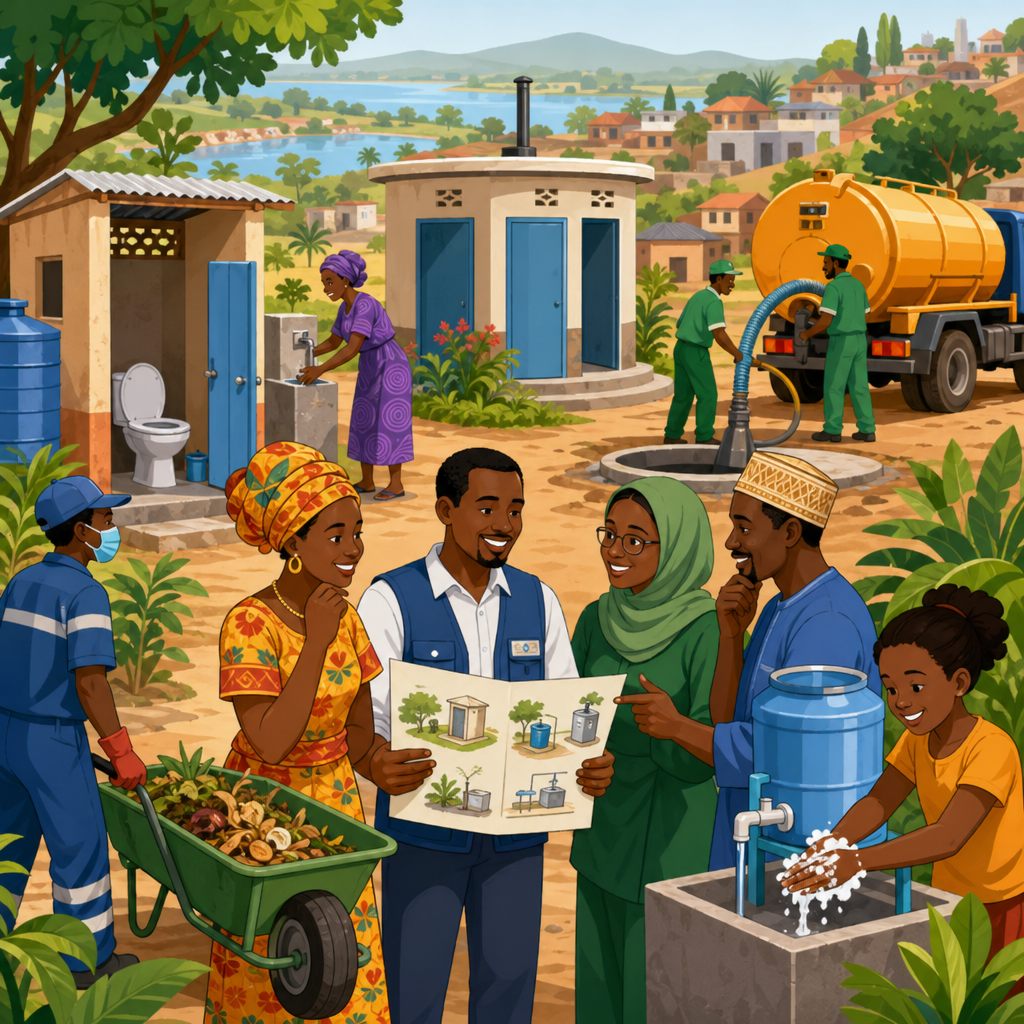
Sanitation strategies in Africa are increasingly defined by practical adaptation: cities, towns, and rural districts are combining infrastructure, behavior change, financing, and ecological sanitation to solve problems that conventional sewer expansion alone has not fixed. In this context, ecological sanitation, often shortened to EcoSan, refers to approaches that safely separate, treat, and reuse human waste and wastewater as resources, especially nutrients, water, and energy. I have worked on sanitation content and program reviews across low-income and rapidly urbanizing settings, and one lesson is consistent: systems succeed when they match local settlement patterns, governance capacity, climate pressures, and household economics. That is why African case studies matter. They show how container-based sanitation can work in dense informal settlements, how urine-diverting dry toilets can reduce water demand in arid zones, how fecal sludge management can turn a failing pit latrine market into a service chain, and how reuse models can support agriculture and circular economies. This hub article showcases global EcoSan successes through African examples because the continent contains some of the clearest demonstrations of innovation under constraint. It also links the sanitation conversation to public health, school attendance, water security, women’s safety, flood resilience, and urban planning. The common question is not whether one toilet technology is best. The real question is which sanitation strategy can safely deliver access, affordability, dignity, and long-term service in a specific place.
Why African sanitation case studies matter for EcoSan learning
African sanitation case studies are valuable because they reveal implementation realities that broad policy statements often miss. The sanitation challenge is large: according to joint international monitoring, hundreds of millions of people across sub-Saharan Africa still lack safely managed sanitation, and open defecation remains a serious issue in several countries despite progress. Yet the region is also where many of the most instructive EcoSan and non-sewered sanitation experiments have matured. In dense neighborhoods of Nairobi, Durban, Kampala, and Antananarivo, for example, planners have had to work around high water tables, limited road access, weak drainage, insecure tenure, and uneven utility coverage. Those conditions make standard sewer models expensive and slow to scale. They also create a test bed for decentralized sanitation, scheduled desludging, urine diversion, composting, black soldier fly treatment, and service-based business models.
These case studies matter because they answer practical questions decision makers ask. Can dry sanitation be accepted by users? Yes, if maintenance is reliable and the design respects privacy, smell control, and menstrual hygiene needs. Can fecal sludge be safely reused? Yes, but only with controlled treatment that meets health standards and market demand for end products such as compost or fuel briquettes. Can sanitation businesses survive without endless subsidy? Sometimes, when tariffs, cross-subsidies, municipal contracts, and product sales are aligned. I have seen programs fail when they imported a design without a service plan, and succeed when they treated sanitation as a full chain: containment, emptying, transport, treatment, reuse, regulation, and customer support. That full-chain perspective is the central lesson from African EcoSan successes.
Urban EcoSan lessons from Kenya, Rwanda, and South Africa
Urban sanitation in Africa often fails at the interface between household toilets and citywide waste management. Kenya offers a clear example of why service design matters. In Nairobi’s informal settlements, where pits fill quickly and trucks cannot always enter narrow lanes, container-based sanitation models have demonstrated a workable alternative. Sanergy’s Fresh Life system popularized a franchised approach in which sealed containers are collected frequently and transported to centralized treatment. The innovation was not just the toilet unit. It was the predictable collection schedule, operator training, quality control, and downstream conversion of waste into useful products such as organic fertilizer and insect-based protein inputs. That model showed that sanitation in informal settlements can function as a managed service rather than a static household asset.
Rwanda provides a different lesson. Kigali has invested in improving fecal sludge management through regulated emptying and treatment, recognizing that most residents rely on on-site systems rather than sewers. EcoSan learning here comes from citywide planning: the municipality and partners studied sludge flows, mapped underserved areas, and linked containment standards to treatment capacity. This is essential because poorly built pits and septic tanks can leak into groundwater or overflow in rainy seasons. A city cannot claim sanitation progress if excreta simply moves from a toilet to an open drain. The Kigali experience reinforces that safe sanitation depends on institutional coordination as much as technology choice.
South Africa, especially eThekwini Municipality in Durban, remains one of the most cited African examples of urine-diverting dry toilets and decentralized sanitation policy. The municipality introduced urine-diversion systems in peri-urban and rural areas where conventional sewers were impractical, expensive, or water intensive. What made Durban important in global EcoSan discussions was its willingness to pair rollout with research, monitoring, and user feedback. Engineers examined vault performance, pathogen risks, and nutrient recovery potential. Social teams studied acceptance, cleaning burden, and gendered use patterns. The result was nuanced evidence: urine-diverting dry toilets can work well where water scarcity, settlement form, and budgets limit sewering, but they require sustained user education, spare parts, and a clear plan for vault emptying or conversion. That is a more credible success story than claiming any dry toilet is universally suitable.
Rural and peri-urban case studies: Malawi, Uganda, and Ethiopia
Rural EcoSan in Africa often succeeds when sanitation is tied directly to farming, soil restoration, and household economics. Malawi is frequently discussed for ecological sanitation programs that promoted urine-diverting toilets and the reuse of treated excreta in agriculture. In areas with depleted soils and costly chemical fertilizer, households responded to a practical proposition: sanitation could protect health while also producing a nutrient resource. Field programs documented higher acceptance where extension workers explained storage times, ash use, pathogen reduction, and crop application methods in plain language. Farmers are understandably skeptical of abstract environmental messaging. They are far more engaged when they can compare maize growth, soil texture, and input savings on demonstration plots.
Uganda has provided important lessons on school sanitation and peri-urban fecal sludge management. In several districts, school sanitation interventions moved beyond simply constructing latrines. The stronger programs addressed operation and maintenance, handwashing facilities, menstrual hygiene management, cleaning rosters, and budget responsibility. That matters because a school block that is unusable after one rainy season is not a sanitation success. Uganda has also seen private and social enterprises work on sludge emptying and treatment in urban centers, demonstrating that the sanitation economy can include small-scale operators if standards and market incentives are clear.
Ethiopia illustrates both the potential and the limits of behavior-led sanitation campaigns. Community mobilization has reduced open defecation in many areas, but durable progress depends on upgrading from basic pits to safer, more resilient containment. In drought-prone or water-stressed zones, dry and low-water systems have obvious appeal. However, the case studies show that behavior change without supply chains for slabs, vents, pit lining, and repair services eventually stalls. EcoSan succeeds when households can access not only a message but also materials, financing, and technical support. That implementation detail is often overlooked in global sanitation discussions, but African field experience makes it impossible to ignore.
What the strongest sanitation strategies have in common
The most successful sanitation strategies in Africa share a set of design principles that can be applied across countries, whether the system is ecological sanitation, decentralized wastewater treatment, or improved on-site containment. First, they treat sanitation as a service chain rather than a construction project. Second, they match technology to hydrogeology, density, water availability, and ability to pay. Third, they build institutions, not just toilets. Fourth, they account for user behavior from day one. Fifth, they create a viable financing model, even when public subsidy is necessary. In my experience reviewing sanitation programs, weak performance usually traces back to one broken link: pits no one can empty, treatment plants with no incoming supply contracts, toilets built without cleaning budgets, or reuse products produced without customers.
| Strategy element | What strong case studies do | Example from Africa |
|---|---|---|
| Technology fit | Select dry, low-water, sewered, or container systems based on density, soil, flood risk, and water access | Durban used urine-diversion where sewers were impractical |
| Service chain management | Plan containment, collection, transport, treatment, and reuse together | Nairobi container-based models linked toilets to regular collection |
| User support | Provide training, cleaning guidance, and responsive maintenance | Malawi EcoSan projects used farmer demonstrations and follow-up visits |
| Institutional coordination | Clarify roles for utilities, municipalities, health agencies, and private operators | Kigali strengthened citywide fecal sludge planning |
| Resource recovery | Convert treated waste into compost, energy products, or agricultural inputs when safe and marketable | Kenyan enterprises developed fertilizer and insect feed products |
Another common trait is realism about tradeoffs. EcoSan can lower water demand, recover nutrients, and expand access in places where sewers are unrealistic. It can also face resistance if designs are difficult to clean, if collection is inconsistent, or if communities are not involved in selecting options. Sewer systems can offer strong public health protection in dense formal areas, but they require very high capital investment, dependable water supply, pumping energy, and long-term utility management. Pit latrines are affordable and familiar, yet in crowded settlements they can become a public health hazard when emptying and treatment are poorly regulated. The best African case studies do not present a single winner. They show how cities and districts assemble mixed sanitation portfolios.
How circular economy thinking strengthens EcoSan outcomes
EcoSan becomes more durable when it is linked to a circular economy logic rather than treated solely as a sanitation hardware program. Human waste contains nitrogen, phosphorus, potassium, organic matter, and energy potential. Recovering those resources does not eliminate the need for strict health safeguards, but it can improve system economics and reduce waste. In Kenya, enterprises processing fecal sludge and organic waste have explored compost production, fuel briquettes, and black soldier fly larvae systems that transform waste streams into agricultural or energy products. In Uganda and South Africa, research and pilot programs have examined nutrient recovery from urine and sludge, as well as co-composting with market waste.
The crucial point is that reuse must be evidence-led. Not every product will have a market, and not every treatment process is sufficient for safe application. Standards from the World Health Organization and national regulators matter because pathogen reduction, helminth control, moisture content, and contaminant management determine whether reuse is safe and acceptable. I have seen resource recovery framed too optimistically, as if waste products will automatically pay for the whole sanitation chain. In reality, reuse revenue often supports only part of the cost. The real strategic benefit is broader: lower disposal burden, stronger environmental performance, local fertilizer substitution, and a more compelling value proposition for municipalities and investors. When communicated honestly, that is still a powerful advantage.
Policy, finance, and the next wave of sanitation success stories
African sanitation success stories are increasingly shaped by policy reform and blended finance rather than isolated pilot projects. The emerging standard is citywide inclusive sanitation, an approach that recognizes every resident needs safe service and that multiple technical pathways can contribute. This matters for EcoSan because it legitimizes non-sewered and decentralized systems within official planning frameworks. Governments and utilities are starting to use sanitation safety planning, fecal sludge flow diagrams, and performance-based contracts to identify risks and prioritize investment. Development finance institutions, climate funds, and philanthropic capital are also paying more attention to sanitation because of its links to resilience, public health, and economic productivity.
For the next generation of case studies, three priorities stand out. First, move from demonstration scale to regulated service markets. Second, improve data quality on functionality, emptying frequency, treatment efficiency, and user satisfaction. Third, build stronger connections between sanitation, housing, drainage, and solid waste management. Flooded neighborhoods do not experience sanitation failure in isolation; they experience compound infrastructure failure. African cities are already showing what integrated planning looks like, and those examples will shape global EcoSan practice for years.
This hub on sanitation strategies in Africa shows that the most valuable lessons come from diverse case studies rather than one-size-fits-all formulas. Kenya demonstrates the power of managed service models in informal settlements. Rwanda shows why citywide fecal sludge planning is indispensable. South Africa illustrates how rigorous research can strengthen urine-diverting and dry sanitation systems. Malawi, Uganda, and Ethiopia reveal how rural sanitation improves when agriculture, maintenance, and behavior support are built into the design. Across all of these examples, the central principle is clear: successful sanitation is not just about installing toilets. It is about creating reliable, safe, financially grounded systems that work for the realities people live with every day.
For readers exploring global EcoSan successes, Africa offers some of the most practical and transferable evidence available. The continent’s case studies show how to design for water scarcity, dense urban growth, agricultural reuse, and limited municipal budgets without lowering public health standards. They also show that progress depends on governance, accountability, and user trust as much as engineering. Use this page as your hub for deeper case study analysis, compare the models that fit your context, and focus on full-service sanitation strategies that can scale responsibly.
Frequently Asked Questions
What makes sanitation strategies in Africa different from conventional sewer-based approaches?
Sanitation strategies in Africa often differ from conventional sewer expansion because they are designed around highly varied local realities rather than a single centralized model. In many cities, peri-urban settlements, and rural districts, rapid population growth, informal land tenure, water scarcity, unreliable electricity, and limited public budgets make full sewer coverage difficult to deliver and maintain. As a result, many successful sanitation programs combine multiple solutions: improved pit latrines, decentralized wastewater treatment, fecal sludge management, behavior change campaigns, container-based sanitation, school and public toilet programs, and targeted drainage improvements. This practical mix is important because sanitation challenges are not only about building toilets; they also involve collection, treatment, safe disposal or reuse, user acceptance, and long-term financing.
A key lesson from diverse case studies is that effective sanitation planning starts with service chains, not just infrastructure assets. In other words, it asks what happens from containment all the way to emptying, transport, treatment, reuse, and regulation. Where sewers are feasible, they can play a strong role. But in many settings, on-site and decentralized systems are more affordable, more scalable in the short to medium term, and better suited to fragmented urban development patterns. This is why sanitation strategies across Africa increasingly emphasize adaptation, phased improvement, and local management capacity rather than trying to replicate high-cost systems developed under very different conditions.
How does ecological sanitation, or EcoSan, fit into sanitation planning in African contexts?
Ecological sanitation, commonly known as EcoSan, fits into sanitation planning by reframing human waste and wastewater as resources that can be safely recovered and reused instead of treated only as materials to be removed. In practice, EcoSan systems often separate urine, feces, and household wastewater so that nutrients, organic matter, water, and sometimes energy can be captured through safe treatment processes. This can include urine-diverting dry toilets, composting systems, biogas-linked sanitation, and decentralized treatment approaches that support agricultural reuse or soil restoration. In water-stressed environments, or in areas where fertilizer access is costly, this resource-oriented perspective can be especially valuable.
However, the strongest case studies show that EcoSan succeeds when it is introduced as part of a broader sanitation service system, not simply as a technology installation. Communities need clear guidance on operation and maintenance, safe handling practices, treatment timelines, and the intended use of recovered products. Farmers or households must see practical value in reuse, and local authorities need standards, monitoring, and public health oversight. EcoSan is not a universal replacement for all other sanitation methods, but it can be highly effective where there is support for user training, reuse markets, and reliable management. In that sense, EcoSan contributes both to sanitation access and to circular economy goals by connecting public health, environmental protection, and resource recovery.
What lessons do African case studies offer about combining infrastructure with behavior change?
One of the clearest lessons from sanitation case studies across Africa is that infrastructure alone rarely delivers lasting results. Toilets, treatment units, and drainage systems are essential, but their impact depends heavily on how people use, maintain, and value them. Programs that perform well over time usually invest in hygiene education, community engagement, household outreach, school-based promotion, and local leadership. This matters because sanitation behaviors are shaped by convenience, privacy, cultural norms, cost, gender roles, and perceptions of cleanliness and safety. Even technically sound facilities can fail if users do not trust them, cannot afford upkeep, or do not understand their purpose.
Behavior change also matters at the institutional level. Municipal staff, pit emptiers, landlords, schools, and health workers all influence sanitation outcomes. Case studies often show that improvements become more durable when sanitation campaigns include practical training, service standards, customer communication, and accountability mechanisms. For example, households may be more willing to invest in better containment if they know affordable emptying and treatment services exist. Likewise, communities may be more willing to adopt EcoSan or shared facilities when the systems are clean, reliable, and clearly managed. The broader lesson is simple but important: sanitation is a social service as much as an engineering challenge, and strategies work best when technical delivery and human behavior are addressed together.
Why are financing and service delivery models so important in sanitation improvement?
Financing and service delivery models are central because sanitation systems do not end with construction. They require regular operation, maintenance, pit emptying, transport, treatment, repairs, monitoring, and in many cases, user support. A common weakness in sanitation planning is that funding is available for capital expenditure but not for the recurring costs that keep systems functioning safely. African case studies repeatedly show that projects are more resilient when they include realistic business models, tariff structures, subsidies for low-income households, and clearly assigned responsibilities between public agencies, private operators, community groups, and regulators.
This is particularly important for non-sewered sanitation, where the service chain involves multiple actors. If containment is improved but emptying is unaffordable, sludge may still be dumped unsafely. If treatment plants are built but transport logistics are weak, the public health benefits remain limited. Strong programs therefore tend to align finance with the full sanitation chain. They may use blended approaches, such as public investment for treatment infrastructure, private sector participation for collection or emptying services, and targeted subsidies to reach vulnerable households. In some places, reuse models linked to compost, fertilizer substitutes, reclaimed water, or biogas can also improve financial sustainability. The takeaway is that sanitation must be treated as an ongoing public service with durable revenue and management systems, not as a one-time construction project.
What should policymakers and practitioners take away from diverse sanitation case studies in Africa?
Policymakers and practitioners should take away that there is no single sanitation solution that works everywhere, but there are clear principles that consistently improve outcomes. First, successful strategies are context-specific: they respond to settlement density, water availability, local governance capacity, soil conditions, affordability, and cultural preferences. Second, they focus on safely managed sanitation across the entire chain, from user access and containment to treatment and final disposal or reuse. Third, they recognize that inclusion matters. Women, children, people with disabilities, tenants, and residents of informal settlements often face the greatest sanitation barriers, so equitable design and service planning are essential.
Another major lesson is that innovation works best when paired with strong institutions. EcoSan, decentralized treatment, fecal sludge management, and hybrid urban sanitation models all have significant potential, but they require regulation, training, monitoring, and public trust. Case studies also emphasize the value of phased implementation: instead of waiting for ideal conditions, many successful programs start with realistic improvements and strengthen systems over time. For decision-makers, this means prioritizing practical, scalable interventions that protect health now while building toward more comprehensive coverage. For practitioners, it means working across engineering, public health, finance, community engagement, and environmental management. The most effective sanitation strategies in Africa are not defined by ideology or a single technology; they are defined by adaptability, safety, and the ability to deliver services that people can actually use and sustain.