3D printing in sanitation is moving from novelty to practical infrastructure, and it is reshaping how engineers, municipalities, and social enterprises think about toilets, waste treatment, and resource recovery. In this context, sanitation includes the full chain: capture, conveyance, treatment, safe reuse, and maintenance. EcoSan, short for ecological sanitation, refers to systems designed to protect health while recovering nutrients, water, energy, or materials from human waste. When additive manufacturing enters that picture, the result is a new design and delivery model for toilets, urine-diverting components, biodigester parts, repair tools, and decentralized treatment hardware.
I have worked on sanitation technology evaluations where the hardest problems were not theoretical treatment efficiency but cost, lead time, spare parts, and adaptation to local conditions. Conventional manufacturing often forces project teams to choose from fixed product catalogs, then accept compromises in fit, maintenance, or transport. Three-dimensional printing changes that equation by building parts layer by layer from digital files. That approach enables rapid prototyping, complex internal geometries, lightweight structures, and small-batch production close to the point of use. For sanitation projects serving dense informal settlements, remote rural schools, emergency camps, or climate-vulnerable communities, those advantages matter.
This topic matters because sanitation still lags badly worldwide. According to UNICEF and WHO Joint Monitoring Programme reporting, billions of people lack safely managed sanitation, and hundreds of millions still practice open defecation. At the same time, utilities face aging networks, rising material costs, and growing pressure to reduce emissions and conserve water. EcoSan technologies answer part of that challenge by separating waste streams, enabling composting or anaerobic digestion, and recovering phosphorus, nitrogen, and organic matter. 3D printing strengthens those systems by making them more modular, more customizable, and faster to deploy.
As a hub for exploring cutting-edge EcoSan technologies, this article explains where 3D printing fits, what it can realistically deliver, which materials and methods are proving useful, and where limits remain. It also connects the technology to circular economy goals, field maintenance, and public health standards. The key point is simple: additive manufacturing is not replacing sound sanitation engineering. It is giving sanitation professionals a more flexible toolkit for building resilient, repairable, and locally appropriate systems.
How 3D Printing Changes Sanitation Design and Delivery
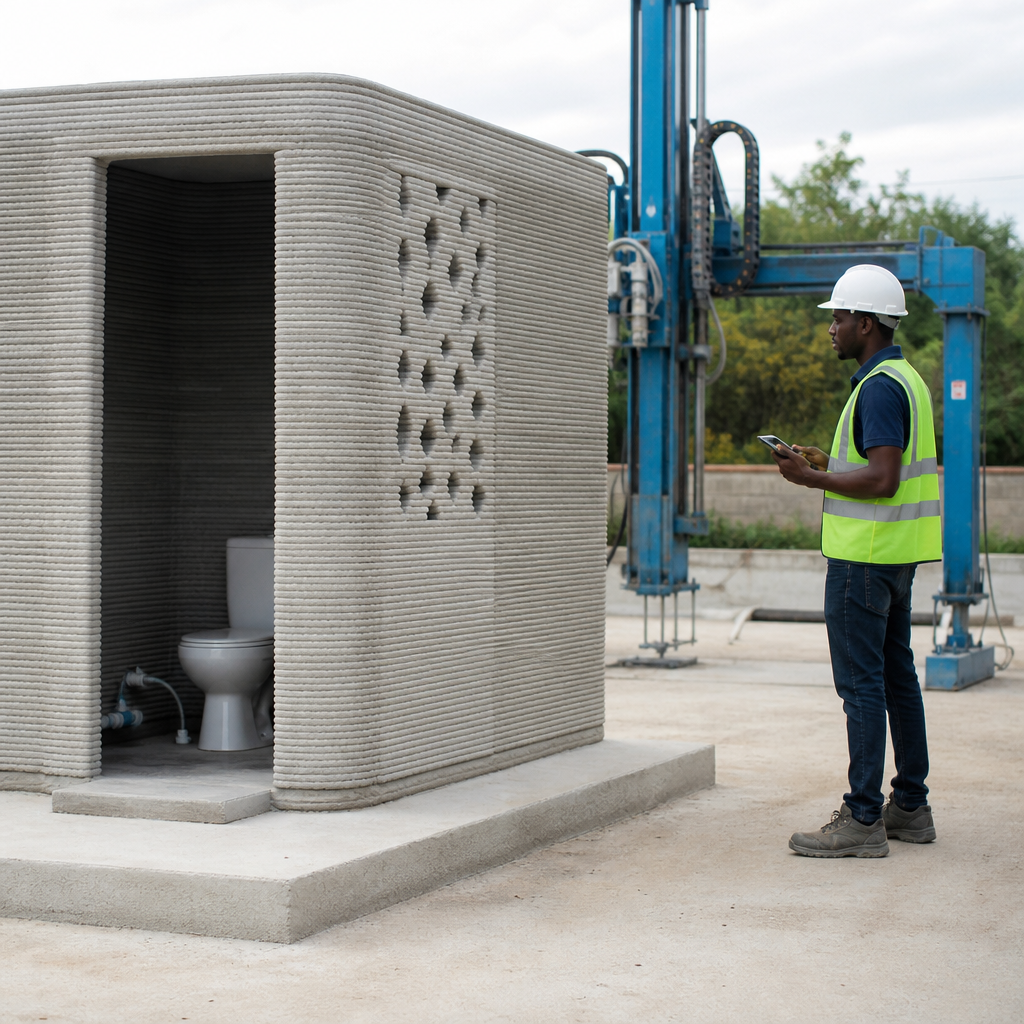
At its core, 3D printing converts a digital model into a physical object through layer-by-layer fabrication. In sanitation, the most relevant methods today are fused deposition modeling for thermoplastics, stereolithography for high-detail resin parts, selective laser sintering for durable polymer components, and concrete printing for larger structures. Each method suits different needs. Fused deposition modeling is common for toilet seats, valve housings, sensor mounts, soap dispenser brackets, and replacement knobs because printers are affordable and materials such as PETG, polypropylene, and ABS are widely available. Powder-based systems can produce tougher parts with better dimensional consistency. Concrete printing is attracting attention for latrine superstructures, wash stations, and small treatment enclosures.
The biggest operational advantage is customization without expensive tooling. A sanitation team can adjust dimensions for children, older adults, or users with disabilities, then print the revised part immediately. Urine-diverting toilet bowls are a good example. Separation performance depends on angle, lip design, splash control, and user posture. With additive manufacturing, those geometries can be refined quickly using field feedback. I have seen projects cut iteration time from months to days simply by revising a computer-aided design file, printing a new insert, and testing it again on site.
Speed also matters during breakdowns. In decentralized sanitation systems, a failed hinge, baffle, connector, or dosing clip can sideline the whole service chain. Instead of waiting weeks for a shipment, operators can print the needed part locally if they have a validated design library and the right material. This is especially valuable where roads are poor, customs clearance is slow, or demand volumes are too low for regular spare-parts stocking. The same principle supports schools and clinics, where restoring functionality quickly has direct hygiene benefits.
Another design benefit is geometric freedom. Additive manufacturing can create channels, lattices, textured surfaces, and nested assemblies that are difficult or uneconomical with injection molding or machining. For EcoSan systems, that opens opportunities for low-flush flow paths, optimized air movement in ventilated toilets, compact dosing mechanisms for bulking agents, and filtration housings tailored to specific media. However, geometric freedom must be balanced against sanitation realities: surfaces must be cleanable, joints must resist leakage, and crevices that trap organic matter should be minimized.
Practical EcoSan Applications Already Emerging
The most immediate use cases are not entire printed toilet systems but critical components within them. Urine-diversion inserts, vent caps, sealing rings, worm-compost tray spacers, pour-flush flow guides, cartridge housings for odor control media, and couplings for small-diameter piping are all feasible products. In container-based sanitation, printed latches, handles, liner retainers, and stackable crate separators can simplify collection logistics. In handwashing and menstrual hygiene installations, additive manufacturing supports faucet adapters, pedal mechanisms, soap tray supports, and compact enclosures for sensors or dosing pumps.
There is also momentum in printed molds and tooling. A project may not print the final ferrocement slab or ceramic pan directly, yet 3D printed molds can make local production faster and more consistent. That is an underappreciated pathway because it combines digital precision with familiar low-cost materials. In several low-resource manufacturing settings, printed jigs and templates have improved alignment, reduced waste, and lowered training time for small workshops producing sanitation hardware.
For treatment and resource recovery, additive manufacturing helps with small reactors and instrumentation. Teams are printing diffuser manifolds, sampling ports, dosing adapters, test fixtures, and sensor housings for pilot digesters or blackwater treatment systems. In research settings, custom lab-scale components allow engineers to compare flow behavior, gas capture, and solids separation under controlled conditions before scaling up. That accelerates innovation in ecological sanitation because treatment concepts can be tested more cheaply and repeatedly.
Emergency response is another strong fit. After floods, earthquakes, or conflict displacement, sanitation solutions must be deployed fast, often in difficult terrain. Shipping fully assembled hardware takes space and time. Shipping digital files and producing connectors, fittings, and replacement parts near the response zone can reduce delays. This is not a complete answer, since feedstock, power, and quality control still matter, but it adds resilience to humanitarian sanitation supply chains.
| Application | What 3D Printing Produces | Main Benefit | Key Limitation |
|---|---|---|---|
| Urine-diverting toilets | Custom bowls, inserts, splash guards | Better separation and user fit | Needs smooth, cleanable surfaces |
| Container-based sanitation | Latches, handles, liner retainers | Fast spare parts and easier servicing | Mechanical strength must be validated |
| Decentralized treatment pilots | Manifolds, sensor mounts, sample ports | Rapid experimentation and iteration | Chemical compatibility varies by material |
| Emergency sanitation | Connectors, adapters, repair parts | Local production during supply disruption | Requires printers, feedstock, and power |
| Local manufacturing | Molds, jigs, assembly templates | Improves consistency at low cost | May not replace mass production economics |
Materials, Methods, and Performance Requirements
Material selection determines whether a printed sanitation part succeeds or fails. For wet, dirty, chemically variable environments, PETG and polypropylene are often stronger choices than basic PLA. PLA is easy to print, but it softens at relatively low temperatures, can deform in hot climates, and is not ideal for repeated exposure to moisture and cleaning chemicals. PETG offers better moisture resistance and impact toughness. Polypropylene has excellent chemical resistance and a low surface energy that can reduce fouling, though it is harder to print reliably. Nylon can work for mechanical parts, but moisture absorption affects dimensional stability. For high-strength industrial components, selective laser sintering with PA12 is often preferred.
Surface finish is not cosmetic in sanitation; it is a hygiene issue. Layer lines can trap residue and make cleaning more difficult. That is why post-processing matters. Sanding, vapor smoothing where appropriate, food-safe or chemically resistant coatings, and design changes that reduce roughness all improve serviceability. Where parts contact waste directly, designers should avoid blind corners, unnecessary seams, and porous structures. If disinfection is required, the material must tolerate the chosen chemical, whether sodium hypochlorite, hydrogen peroxide, quaternary ammonium compounds, or simple detergent washing.
Structural performance must be tested, not assumed. Toilet components face repeated loading, torsion, and impact. A seat support that looks robust on screen may crack at layer boundaries if print orientation is wrong. In my experience, field failures often come from anisotropy, poor infill strategy, or underestimated creep under constant load. Good practice includes finite element analysis for critical parts, destructive testing of prototypes, and conservative safety factors. Relevant benchmarks may include ISO and ASTM methods for plastics and seating performance, while sanitation products also need to align with local building and public health requirements.
For larger printed structures, concrete mix design becomes central. Printable concrete must balance pumpability, extrudability, buildability, and curing behavior. Reinforcement remains a challenge, especially where structures must withstand transport, wind, or seismic loads. Printed latrine shelters can reduce formwork and speed construction, but they still require sound foundations, weather protection, and drainage design. Engineers should treat printed structures as civil works, not merely novel objects.
Public Health, Standards, and the Limits of the Technology
3D printing is powerful, but it does not suspend sanitation law, infection prevention, or user acceptance. Any component used in fecal sludge management or onsite sanitation must support safe containment and easy maintenance. If a printed joint leaks, if a urine-diversion channel splashes, or if a cleaning worker cannot disinfect a surface properly, the design has failed no matter how innovative it appears. This is why sanitation projects need validation protocols that include hydraulic performance, cleanability, durability, and user trials.
Standards help anchor those decisions. ISO 30500 for non-sewered sanitation systems provides performance expectations for systems intended to safely contain, treat, and recover resources. WHO sanitation and health guidelines frame broader public health objectives. NSF and ASTM standards may apply to materials, mechanical testing, and drinking-water-adjacent components in integrated wash facilities. In practice, project teams should map every printed part to a risk profile: direct waste contact, skin contact, structural duty, thermal exposure, and cleaning regime. The higher the risk, the stronger the case for formal testing and certification.
There are also economic limits. For high-volume standardized products, injection molding usually wins on unit cost and consistency after tooling is amortized. Additive manufacturing is strongest where volumes are low to medium, customization is valuable, logistics are difficult, or design iteration is ongoing. Energy use can also be significant per part, especially with inefficient print settings or high-temperature materials. Feedstock quality varies, and recycled filament, while attractive from a circular economy perspective, must be controlled for contamination and property drift.
User behavior matters as much as engineering. A technically elegant printed urine-diverting bowl can still fail if cleaning tools are unsuitable, instructions are unclear, or the shape conflicts with established habits. The best projects involve users early, observe real cleaning routines, and adjust the design accordingly. In sanitation, dignity and practicality are inseparable.
Why This Hub Matters for the Future of EcoSan Innovation
3D printing in sanitation is a game changer because it links digital design, local production, and ecological sanitation goals in one workflow. It helps organizations move from one-size-fits-all hardware toward context-specific systems that recover resources, reduce downtime, and adapt quickly to field realities. The strongest opportunities today are customized toilet interfaces, spare parts, treatment pilot components, humanitarian response hardware, and production tooling for local manufacturers. The biggest requirements are disciplined material selection, cleanable design, mechanical testing, and alignment with sanitation standards.
For anyone exploring cutting-edge EcoSan technologies, this hub provides the right starting point because additive manufacturing touches nearly every subtopic in the field: urine diversion, composting toilets, biodigesters, fecal sludge management, decentralized treatment, circular materials, and climate-resilient infrastructure. It is not a silver bullet, and it should never substitute for public health fundamentals. Used well, though, it shortens innovation cycles and makes ecological sanitation more practical at community scale.
The next step is straightforward: audit one sanitation product or pain point in your system, identify whether customization or spare-part delays are limiting performance, and evaluate whether a validated 3D printed component could solve it safely. Start small, test rigorously, and build from evidence. That is how this technology delivers lasting sanitation improvements.
Frequently Asked Questions
What does 3D printing actually change in sanitation infrastructure?
3D printing changes sanitation by making it possible to design and manufacture components with far more flexibility than traditional fabrication methods. Instead of relying only on standardized molds, cast parts, or imported hardware, engineers and sanitation providers can produce customized toilet components, urine-diverting inserts, fittings, maintenance tools, treatment modules, and replacement parts that better match local conditions. This matters because sanitation is rarely one-size-fits-all. Soil type, water availability, density, user preferences, maintenance capacity, transport logistics, and cultural expectations all influence whether a system succeeds.
In practical terms, additive manufacturing can shorten prototyping cycles, reduce the cost of testing new ideas, and help teams move from concept to field-ready hardware more quickly. A municipality or social enterprise can refine a design based on user feedback, print an updated version, and test it again without waiting for expensive tooling changes. That is especially valuable in EcoSan and decentralized sanitation, where systems often need to support source separation, nutrient recovery, easier cleaning, and more reliable operation in challenging environments.
It also changes how people think about maintenance and supply chains. If a hinge, nozzle, vent fitting, valve housing, or dosing component breaks, a replacement may be produced locally or regionally instead of waiting for overseas shipments. Over time, that can improve uptime and make sanitation systems more resilient. The biggest shift is not that 3D printing replaces all conventional construction, but that it adds a powerful new tool for customization, iteration, and distributed production across the full sanitation chain: capture, conveyance, treatment, safe reuse, and maintenance.
How is 3D printing used in EcoSan and resource recovery systems?
In EcoSan, the goal is not only to manage waste safely but also to recover value from it in the form of nutrients, water, energy, or usable materials. 3D printing supports this by enabling more precise and specialized parts for separation, collection, dosing, and treatment. For example, urine-diverting toilet interfaces can be shaped to improve user comfort while increasing separation efficiency. Printed components can also be used in small-scale reactors, composting aids, aeration devices, filter housings, dosing pumps, biochar-related assemblies, and fittings that connect collection containers to downstream treatment or reuse systems.
One major advantage is design complexity. Additive manufacturing can create internal geometries, channels, and features that are difficult or expensive to produce with conventional methods. That can be useful for optimizing fluid flow, reducing blockages, improving mixing, or integrating multiple functions into one part. In a sanitation setting, this may lead to better odor control, more efficient nutrient capture, easier emptying, and better compatibility with low-water or dry toilet systems.
There is also a strong innovation benefit. Researchers and practitioners working on fecal sludge treatment, blackwater processing, or nutrient recovery often need to test equipment at small scale before deployment. 3D printing allows rapid experimentation with reactor internals, separator geometries, test fixtures, and monitoring accessories. For social enterprises, it can help bridge the gap between laboratory concepts and field-ready products. The result is a more adaptable path toward circular sanitation systems that protect public health while turning waste streams into useful outputs such as fertilizer inputs, recovered water, or energy-related products.
Can 3D-printed sanitation products be durable, safe, and suitable for real-world use?
Yes, but suitability depends on the application, the material, the print process, and the operating environment. Not every sanitation component should be 3D printed, and not every printed part is ready for field deployment without testing. Durability concerns include mechanical stress, exposure to sunlight, heat, moisture, cleaning chemicals, abrasion, biological activity, and contact with corrosive waste streams. A part used in a protected indoor mechanism has very different requirements from a fitting exposed to outdoor weather, high temperatures, and repeated cleaning.
When designed properly, however, 3D-printed parts can be highly effective. Engineers can select materials based on chemical resistance, strength, flexibility, and hygienic performance. Surface finish also matters in sanitation, because rough surfaces may trap waste, support fouling, or complicate cleaning. That means designers often need to think beyond printability and consider sealing, coatings, post-processing, and geometry choices that support sanitation performance. In some cases, printed parts work best as molds, jigs, patterns, or non-contact components rather than direct-contact waste interfaces.
Safety and compliance are equally important. Sanitation hardware should be tested for structural integrity, leak prevention, cleanability, and long-term reliability. If components are involved in treatment, pressure handling, or public-facing toilet systems, quality control becomes critical. The best approach is to treat 3D printing as an engineering method, not a shortcut. With proper validation, it can deliver robust and field-appropriate solutions. Without validation, it can create fragile prototypes that fail under real conditions. For municipalities and implementers, the key question is not simply whether a part can be printed, but whether it can perform consistently and safely throughout its intended life cycle.
What are the biggest benefits of 3D printing for municipalities, engineers, and social enterprises?
The biggest benefit is speed combined with customization. Municipalities and utilities often face sanitation challenges that are highly specific to certain neighborhoods, facilities, or service models. Engineers need tools that let them solve those problems without waiting months for custom manufacturing or paying for expensive low-volume production runs. 3D printing makes it easier to prototype quickly, tailor components to site conditions, and refine designs based on operational feedback.
For social enterprises, the value can be even greater. Many sanitation ventures operate in markets where affordability, local adaptability, and maintenance simplicity determine whether a product succeeds. Additive manufacturing can reduce barriers to experimentation, support small-batch production, and enable modular product development. A company can test different toilet interfaces, container systems, venting strategies, hand-tool designs, or treatment accessories without committing to high upfront tooling costs. That flexibility is especially useful when serving informal settlements, schools, emergency contexts, peri-urban communities, or remote locations.
Another major benefit is distributed manufacturing and spare-part availability. In sanitation, downtime has public health consequences. If a critical component fails and replacements are difficult to source, systems can quickly become unusable. Being able to produce replacement parts closer to the point of use can improve service continuity and reduce dependence on fragile supply chains. There is also a training and collaboration benefit: digital design files can be shared across teams, adapted for local needs, and improved over time. That creates a more iterative and responsive sanitation ecosystem, where innovation is not limited to large manufacturers but can also come from local fabricators, NGOs, universities, and maintenance providers.
What are the limitations and future outlook for 3D printing in sanitation?
3D printing is promising, but it is not a universal solution. Large structural elements, high-volume commodity items, and components requiring very low per-unit cost may still be better served by conventional manufacturing. Print speed, material availability, quality consistency, and equipment maintenance can also be limiting factors, particularly in low-resource settings. In addition, sanitation systems operate in harsh environments, so the long-term performance of printed components must be carefully evaluated before scaling deployment.
There are also economic and organizational constraints. A successful 3D-printing strategy depends on more than owning a printer. It requires design expertise, quality assurance, appropriate materials, repair workflows, and access to digital files that are properly documented and version-controlled. Municipal adoption may also depend on procurement rules, standards, and confidence that printed parts can meet regulatory and operational requirements. In that sense, the bottleneck is often implementation capacity rather than the printing technology itself.
Looking ahead, the outlook is strong because the sanitation sector increasingly values modularity, resilience, and circular design. As materials improve and printers become more reliable, additive manufacturing is likely to play a larger role in toilet hardware, decentralized treatment units, sensor housings, repair kits, molds for local production, and components that support resource recovery. Its greatest impact will probably come where customization and iteration matter most: adapting systems to local realities, accelerating innovation in EcoSan, and strengthening maintenance networks. Rather than replacing traditional sanitation infrastructure, 3D printing is poised to complement it by making systems more adaptable, repairable, and responsive to the health, environmental, and operational demands of modern sanitation.