Next-gen urine diversion is redefining ecological sanitation by turning a high-volume waste stream into a concentrated source of plant nutrients, process water savings, and lower-emission sanitation infrastructure. In practical terms, urine diversion means collecting urine separately from feces at the toilet or urinal so it can be treated, stored, and reused with far greater efficiency than mixed sewage allows. Resource recovery refers to capturing useful outputs from sanitation systems, especially nitrogen, phosphorus, potassium, and sometimes clean water, instead of losing them through dilution, sewer conveyance, and energy-intensive wastewater treatment. As cities face fertilizer volatility, water scarcity, aging sewers, and tighter nutrient discharge limits, urine diversion has moved from fringe pilot concept to serious engineering strategy.
I have worked on sanitation and circular resource planning projects where the basic math changed minds quickly: although urine makes up roughly 1 percent of domestic wastewater volume, it typically carries most of the nitrogen and a large share of the phosphorus entering municipal treatment plants. That imbalance is why source separation matters. If the richest nutrient stream is captured before dilution, downstream treatment becomes easier and the nutrients are more economically recoverable. For building owners, utilities, universities, and off-grid developments, the appeal is no longer only environmental. Properly designed systems can cut flush water demand, reduce pipe scaling and overload risks in some settings, and create local fertilizer products that offset imported inputs.
This hub article on exploring cutting-edge EcoSan technologies explains the technologies, design choices, treatment pathways, and implementation realities behind next-generation urine diversion. It also connects the topic to the broader technological innovations and research landscape, where membrane concentration, electrochemical treatment, nutrient crystallization, sensor controls, and product standardization are rapidly improving feasibility. If you need a clear answer to what urine diversion is, how it works, which technologies are most promising, and what limits adoption, the sections below provide the essentials in plain terms.
Why urine diversion matters for circular sanitation
Urine diversion matters because it attacks several infrastructure problems at once. First, it reduces nutrient loading to wastewater plants. Removing urine at the source can significantly lower the nitrogen burden that drives aeration energy demand during biological treatment and the phosphorus burden that contributes to eutrophication when treatment underperforms. Second, it recovers nutrients that agriculture currently supplies largely through industrial production and mining. Nitrogen fertilizer production relies heavily on the Haber-Bosch process, which is energy intensive, while phosphorus comes from finite phosphate rock reserves concentrated in a small number of countries. Third, it creates a decentralized sanitation option for buildings and districts that cannot easily expand sewer or treatment capacity.
The strongest case appears where nutrient management costs are rising. Universities, airports, apartment developments, refugee settlements, and peri-urban communities often generate stable urine volumes in concentrated locations. In these settings, source-separating fixtures can aggregate enough nutrient mass to justify collection and treatment. Switzerland, Sweden, Germany, South Africa, the United States, and several research groups supported by the Bill and Melinda Gates Foundation have advanced pilots showing that urine-derived fertilizers can meet agronomic performance expectations when contaminants and pathogens are controlled. The Water Research Foundation and international sanitation programs have also helped move the discussion from concept sketches to operational data.
There are limits. Urine diversion is not automatically cheaper than conventional sewering, especially where retrofits are complex or collection logistics are weak. Social acceptance, plumbing codes, fertilizer registration, odor control, and maintenance quality all determine success. But where those factors are addressed early, the resource recovery potential is unusually strong compared with almost any other sanitation stream.
Core technologies behind next-generation urine diversion
At the fixture level, the key innovation is reliable source separation. Urine-diverting toilets, urine-diverting dry toilets, and water-efficient urine-diverting flush toilets use bowl geometry or split drains to route urine and feces into separate pipes. The design challenge is not conceptual; it is ergonomic and hydraulic. Fixtures must work for different users, minimize splash and cross-contamination, maintain trap seals where required, and prevent mineral precipitation from blocking pipework. In projects I have reviewed, success depended more on installation details and user interface than on the fixture label itself.
Once collected, urine can follow several treatment pathways. The simplest is storage, which allows natural chemical changes and, under appropriate time and temperature conditions, contributes to sanitation before land application. More advanced systems stabilize urine to preserve nitrogen and control odors. Fresh urine contains urea, which rapidly hydrolyzes to ammonia and bicarbonate in the presence of urease. That raises pH, increases ammonia volatilization risk, and accelerates precipitation such as struvite and calcium phosphates. Stabilization methods include acid dosing, alkalinization, biological nitrification, and enzyme inhibition. Each method trades chemical input, process complexity, and nutrient retention differently.
Concentration technologies are driving current research because transport economics often determine viability. Membrane distillation, vacuum distillation, reverse osmosis hybrids, freeze concentration, and evaporation can reduce volume while producing a more standardized fertilizer concentrate. Electrochemical systems can oxidize contaminants, disinfect, or recover nitrogen, though energy use and electrode durability remain critical design variables. Struvite precipitation is especially important where phosphorus recovery is prioritized. By adding magnesium under controlled pH, operators can precipitate magnesium ammonium phosphate, a slow-release fertilizer with established agronomic value. The next generation of systems increasingly combines stabilization, concentration, and product finishing in modular units sized for buildings or districts.
Leading treatment pathways and recovered products
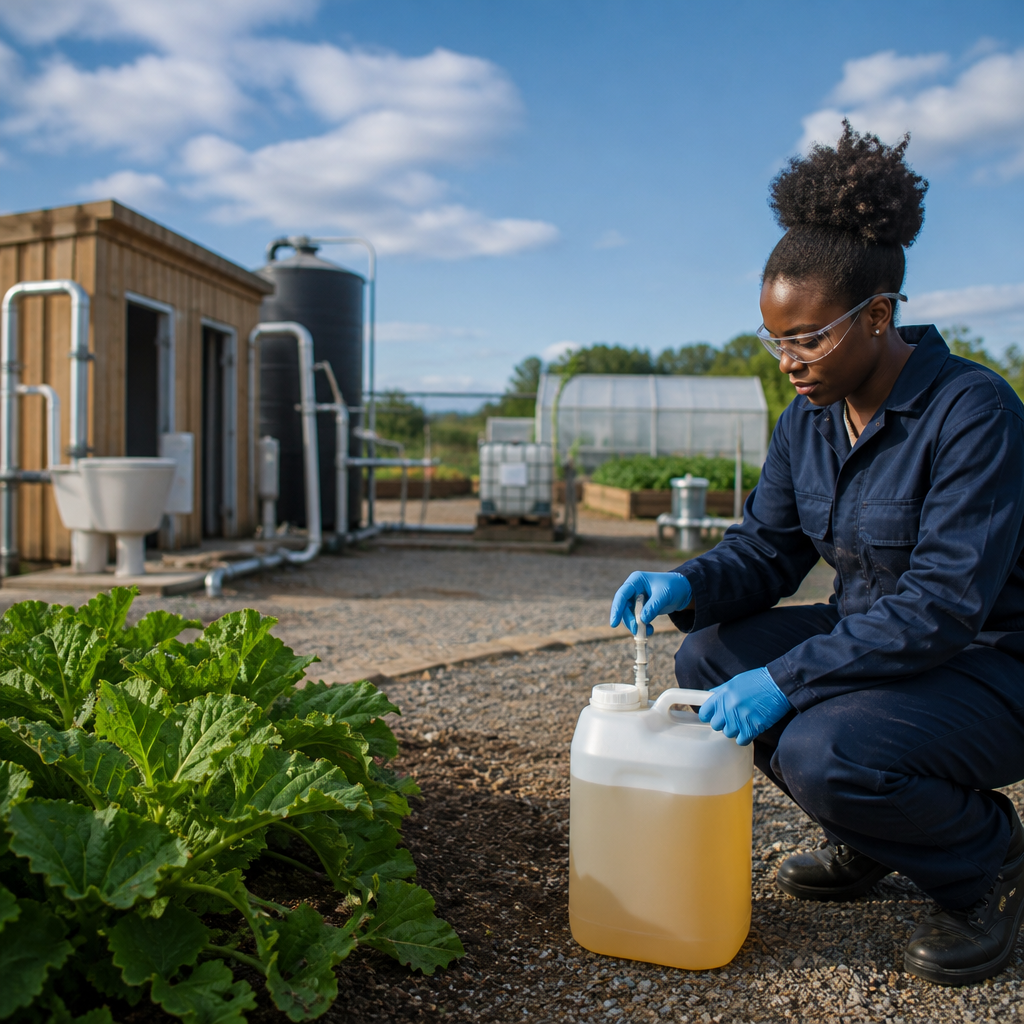
The main product routes for diverted urine are direct fertilizer use after storage or stabilization, phosphorus recovery as struvite, nitrogen recovery as ammonium salts, and concentrated liquid fertilizers. Direct use is the lowest-tech option and can work well in agriculture when regulations permit and handling is disciplined. It preserves most nutrients, but storage volume, odor management, and application timing can be challenging. In colder climates, seasonal storage may be necessary until crops can take up nutrients, which increases tank sizing requirements.
Struvite recovery produces a dry, easier-to-handle product, but it only captures part of the nutrient value because much of the nitrogen can remain in the liquid fraction. To recover more nitrogen, some systems strip ammonia and absorb it in acid to form ammonium sulfate or ammonium nitrate alternatives, though the latter requires stricter safety controls. Nitrification followed by distillation or evaporation can produce concentrated liquid fertilizers with more stable composition and lower odor. Research teams at Eawag, Rich Earth Institute, and several European demonstration programs have shown that carefully processed urine-derived fertilizers can achieve crop yields comparable to synthetic references in many applications.
| Pathway | Main output | Primary advantage | Main limitation |
|---|---|---|---|
| Storage and land application | Liquid fertilizer | Low equipment cost, high nutrient retention | Large storage needs, odor and logistics management |
| Struvite precipitation | Granular phosphorus fertilizer | Easy transport, established fertilizer form | Incomplete nitrogen recovery |
| Nitrification and concentration | Stabilized liquid concentrate | Better product consistency, lower odor | Higher process complexity |
| Ammonia stripping and absorption | Ammonium salt solution | Strong nitrogen recovery potential | Chemical handling and energy demand |
The best pathway depends on context. A remote eco-resort may favor direct agricultural reuse because nearby land application is available and infrastructure budgets are limited. A dense urban campus may need stabilized concentrates or crystallized products because transport, storage, and public acceptance demand a cleaner supply chain. In both cases, product quality assurance is non-negotiable. Nutrient concentration, salinity, pH, trace contaminants, and microbiological criteria must be measured consistently if the output is to earn user trust and regulatory approval.
Design, operations, and performance factors that decide success
The most common implementation mistake is treating urine diversion as only a toilet decision. In reality, performance depends on a chain: fixture usability, plumbing layout, ventilation, storage, treatment, monitoring, collection logistics, and end-use planning. Pipe material and slope matter because hydrolyzed urine can precipitate minerals that narrow lines. Smooth interiors, short runs, accessible cleanouts, and periodic flushing or maintenance protocols reduce blockage risk. Waterless urinals save water but can produce severe scaling if maintenance chemistry is ignored. Low-flow diverted fixtures often strike a better balance in high-traffic facilities.
User behavior also shapes outcomes. Clear signage, inclusive fixture design, and housekeeping routines are essential. I have seen systems fail not because the treatment skid underperformed, but because users were confused by bowl geometry or cleaners used incompatible chemicals that damaged seals and sensors. Institutional settings need facilities staff training from day one, not after complaints begin. Digital monitoring is increasingly useful here. Conductivity, pH, tank level, flow, and temperature sensors can identify dilution, leakage, or process drift before nutrient losses become significant.
Performance should be measured across four categories. The first is nutrient recovery efficiency: how much nitrogen, phosphorus, and potassium actually reach the final product. The second is public health protection, including pathogen reduction where relevant and safe handling procedures. The third is operational reliability, such as blockage frequency, downtime, odor incidents, and maintenance labor. The fourth is economics, including capital cost, consumables, transport, avoided wastewater treatment cost, and fertilizer value. Serious evaluations also include greenhouse gas implications. Poorly managed storage can emit ammonia and nitrous oxide, undermining environmental gains, while well-controlled systems can reduce impacts compared with conventional nutrient removal and fertilizer manufacturing.
Real-world adoption, policy barriers, and the research frontier
Real-world adoption is advancing through pilots, codes, and procurement standards rather than sudden mass rollout. European municipalities have supported source-separating sanitation in housing and public buildings. In the United States, the Rich Earth Institute has built one of the best-known urine nutrient recycling programs, generating practical lessons on collection logistics, farmer outreach, and fertilizer regulation. South African and Scandinavian projects have contributed valuable data on user acceptance and engineering reliability under different climates and infrastructure conditions. These examples show that the technology is proven enough to implement, but scaling still depends on policy alignment.
The main barriers are regulatory classification and market structure. In many jurisdictions, separated urine sits awkwardly between wastewater, waste, and fertilizer law. That uncertainty slows permits, product registration, and investment. Plumbing codes may not yet recognize source-separating fixtures, and building inspectors may have limited guidance on dual-pipe designs. Utilities can also resist models that reduce influent loads without fitting existing revenue systems. The solution is not marketing language; it is standards development, cross-agency coordination, and demonstration data that show health protection and product consistency.
Research is moving toward compact, automated treatment units, stronger contaminant monitoring, and better life-cycle analysis. Topics drawing the most attention include pharmaceutical residues, PFAS risk assessment, electrochemical oxidation byproducts, and low-energy concentration methods. Product design is also evolving. Instead of treating urine-derived fertilizer as a niche substitute, developers are engineering tailored formulations for horticulture, urban agriculture, and specialty crops. This is where the hub role of exploring cutting-edge EcoSan technologies matters most: it connects fixture innovation, treatment science, digital controls, regulation, and agricultural product development into one practical roadmap. If you are evaluating the field, start by mapping your site conditions, nutrient goals, and regulatory pathway, then compare technologies against actual operating constraints rather than ideal laboratory assumptions. That disciplined approach turns urine diversion from an interesting idea into durable sanitation infrastructure.
Next-gen urine diversion delivers its value by separating the richest nutrient stream at the source, protecting water systems, and creating useful fertilizer products from what conventional sanitation treats as diluted waste. The core lesson is simple: successful resource recovery depends on the whole chain, from user-friendly fixtures and scale-resistant plumbing to stabilization, concentration, quality control, and end-use markets. When those pieces are designed together, urine diversion can reduce nutrient pollution, lower pressure on wastewater plants, and strengthen local circular economies.
For readers following technological innovations and research, this sub-pillar hub should frame the rest of your exploration. The most important questions to ask are not whether urine contains recoverable nutrients, because it clearly does, but which treatment pathway fits your context, which standards apply, and how operations will be maintained over time. Storage, struvite recovery, nitrified concentrates, and ammonia capture each have valid use cases. The best option depends on building scale, transport distance, product goals, user behavior, and regulation.
If you are planning a project, use this article as your starting map for exploring cutting-edge EcoSan technologies, then move into detailed evaluation of fixture selection, treatment design, monitoring, and fertilizer compliance. A well-scoped pilot with clear performance metrics is the fastest way to turn theory into measurable resource recovery.
Frequently Asked Questions
What is next-gen urine diversion, and how is it different from traditional sanitation?
Next-gen urine diversion is an ecological sanitation approach that separates urine from feces at the source, usually through specially designed toilets, urinals, or plumbing systems. Instead of sending everything into one mixed waste stream, it captures urine independently so it can be stored, treated, and reused much more efficiently. This matters because urine contains a large share of the nutrients people excrete, especially nitrogen, phosphorus, and potassium, while making up a relatively small portion of total wastewater volume. When these nutrients are diluted in conventional sewage, they become harder and more energy-intensive to recover.
What makes the “next-gen” model different is the combination of improved fixture design, better user experience, smarter collection logistics, and more advanced treatment technologies. Older source-separating systems were sometimes seen as niche or difficult to maintain. Newer systems are designed for real-world use in homes, multifamily buildings, institutions, and commercial settings, with stronger odor control, more reliable plumbing, and clearer pathways for nutrient recovery. In practice, this can mean lower water demand, reduced loading on wastewater treatment plants, and more direct conversion of a waste stream into products such as fertilizers or industrial inputs. Rather than treating urine as something to dispose of, next-gen urine diversion treats it as a concentrated resource that can support circular sanitation and climate-smart infrastructure.
Why is urine considered such a valuable resource in sanitation and resource recovery?
Urine is valuable because it contains a disproportionate amount of the nutrients that sanitation systems often struggle to manage. Although it represents only a fraction of household wastewater by volume, it carries much of the nitrogen and a significant share of the phosphorus and potassium excreted by humans. These are exactly the nutrients needed for plant growth, which is why urine diversion is increasingly discussed in connection with fertilizer recovery, regenerative agriculture, and circular economy strategies.
From a systems perspective, separating urine before it mixes with other waste streams creates major efficiencies. Once urine is diluted in sewage, nutrient recovery becomes more complex and expensive, and conventional treatment plants must use energy, chemicals, and infrastructure capacity to remove or transform those nutrients before discharge. By collecting urine at the source, sanitation systems can reduce nutrient loads in downstream wastewater treatment, lower the risk of eutrophication in receiving waters, and create a cleaner feedstock for recovery processes. Depending on the treatment method, recovered outputs may include stabilized liquid fertilizers, concentrated nutrient salts, or materials suitable for blending into agricultural products. In addition to nutrients, source separation can contribute to water savings when paired with low-flush or waterless fixtures, making the overall sanitation model more resource-efficient and resilient.
How does urine diversion improve sustainability, water efficiency, and emissions performance?
Urine diversion improves sustainability on several fronts at once. First, it reduces the burden on centralized wastewater systems by intercepting a high-nutrient stream before it enters sewers and treatment plants. This can lower the energy and chemical demand associated with nutrient removal, aeration, and sludge management. Since conventional wastewater treatment is resource-intensive, any reduction in treatment load can improve operational efficiency and decrease lifecycle impacts.
Second, urine-diverting systems often support direct water savings. Many designs use less flush water than standard toilets, and waterless urinals can eliminate water use altogether for that fixture type. In buildings or regions where water scarcity, utility costs, or infrastructure constraints are significant, this can be a meaningful advantage. Less water entering the system also means less dilution of recoverable nutrients and potentially lower pumping and conveyance requirements.
Third, emissions performance can improve because source separation opens the door to more controlled handling of nutrients and organics. In conventional systems, biological treatment processes can generate greenhouse gases such as nitrous oxide, especially during nitrogen removal. By removing much of the nitrogen upstream through urine diversion and targeted recovery, operators may be able to reduce those emissions pathways. There can also be indirect climate benefits if recovered nutrients displace a portion of synthetic fertilizer production, which is typically energy-intensive. While outcomes depend on system design, treatment technology, transport distance, and end-use, the overall sustainability case is strong: less water use, less treatment burden, more nutrient recovery, and a better fit with circular infrastructure goals.
Is urine diverted from toilets safe to reuse, and what treatment does it need?
Yes, urine can be safe to reuse, but safety depends on proper collection, storage, treatment, and application practices. Fresh urine from healthy individuals is typically lower in pathogens than fecal waste, which is one reason source separation is so promising. However, once collected, it still needs to be managed carefully because contamination can occur through fixture design, user behavior, cross-mixing, storage conditions, or handling practices. In addition, concerns such as pharmaceuticals, salts, and nutrient concentration need to be addressed based on the intended end use and local regulations.
Treatment requirements vary by system and recovery goal. In some cases, storage alone can help stabilize the urine and reduce certain risks before agricultural use. In more advanced systems, treatment may include pH adjustment, pasteurization, evaporation, membrane processing, nitrification, distillation, or precipitation of specific nutrient compounds. These methods can improve product consistency, reduce odors, concentrate nutrients, and produce materials that are easier to transport and apply. The right treatment pathway depends on factors such as scale, climate, collection frequency, target crop, product specifications, and regulatory acceptance.
For real-world deployment, the most important principle is that reuse should happen within a managed system, not through informal handling. Clear technical standards, operator training, monitoring protocols, and end-use guidelines are essential. When these controls are in place, urine diversion can produce useful recovered products while maintaining public health protections and environmental performance. As the sector matures, growing attention is being paid to standardized treatment approaches that make safe reuse practical at both building and municipal scales.
Where is next-gen urine diversion most effective, and what challenges affect adoption?
Next-gen urine diversion can be effective in a wide range of settings, but it is especially compelling where water efficiency, nutrient recovery, decentralized infrastructure, or sustainability reporting are priorities. Examples include green buildings, campuses, multifamily developments, public facilities, remote sites, water-stressed regions, and communities seeking alternatives to costly sewer expansion. It can also be highly relevant for institutions and municipalities exploring circular sanitation models that connect waste management with agriculture, climate goals, and local resource recovery markets.
That said, adoption depends on more than just the toilet technology. Successful implementation requires an aligned value chain that includes collection logistics, storage capacity, treatment infrastructure, product certification, user acceptance, and a legal pathway for reuse. Building owners need confidence that fixtures are reliable and easy to maintain. Users need systems that feel intuitive and hygienic. Utilities and regulators need data showing that source separation delivers measurable benefits without creating new public health or operational risks.
One of the biggest challenges is that many sanitation systems were designed around mixed wastewater, so urine diversion may not fit neatly into existing codes, maintenance routines, or financing structures. There can also be concerns about odor, scaling in pipes, nutrient handling, and who is responsible for the recovered material after collection. However, these barriers are increasingly manageable as designs improve and pilot programs generate performance data. In many cases, the strongest long-term opportunities lie in places willing to think beyond disposal and treat sanitation as part of a broader resource system. When planning, policy, and technology are aligned, next-gen urine diversion can move from demonstration projects to mainstream infrastructure with real environmental and economic value.