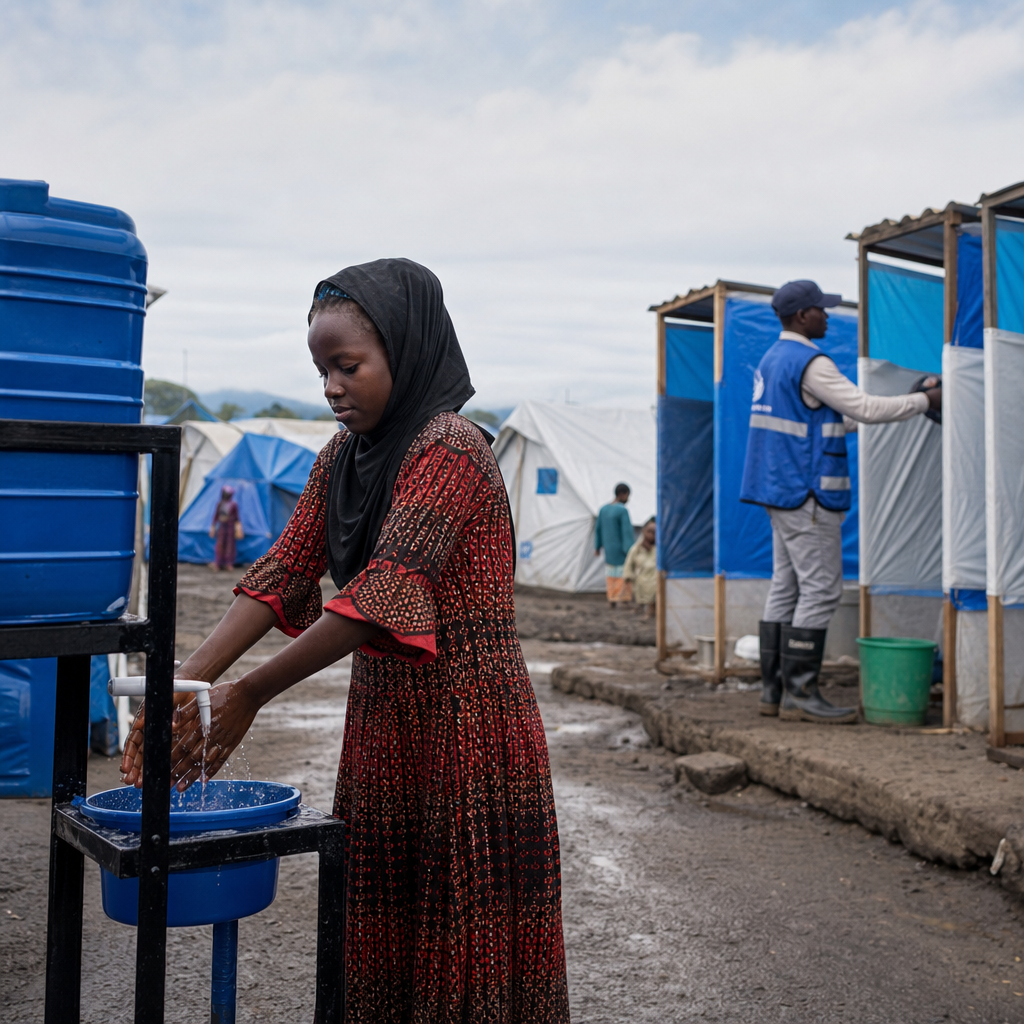
Global funding strategies for sanitation infrastructure determine whether cities, towns, and rural communities can deliver safe toilets, sewerage, fecal sludge management, drainage, and wastewater treatment at the scale public health requires. In practice, sanitation infrastructure includes both large networked systems and decentralized services such as septic tanks, pit emptying fleets, transfer stations, treatment lagoons, and reuse facilities. Funding strategies are the mix of taxes, tariffs, transfers, concessional finance, grants, climate funds, and private capital used to pay for construction, operations, maintenance, and long term asset renewal.
This matters because sanitation is chronically underfunded despite being fundamental to health, education, economic productivity, gender safety, and environmental protection. The World Health Organization has consistently linked sanitation improvements to reduced diarrheal disease, while the World Bank has shown that poor sanitation imposes large economic losses through healthcare costs, lost labor, and degraded water resources. I have seen projects fail not because engineers lacked designs, but because the financing plan covered pipes and concrete while ignoring operator training, sludge hauling contracts, electricity costs, and replacement reserves. A viable sanitation program is therefore a financing system, not just a construction budget.
Global initiatives and collaborations in sanitation have evolved around one central fact: no single funding source can close the gap alone. Public budgets remain the backbone, especially for low income communities where tariffs cannot recover full costs. Yet public money works best when it is blended with development finance, philanthropic grants, results based aid, municipal borrowing, and targeted private participation. The most effective global funding strategies align money with service outcomes, local capacity, and institutional accountability. As a hub for this subtopic, this article explains how leading initiatives, partnerships, and funding models work, where they succeed, and what decision makers should evaluate before scaling them.
The global sanitation funding gap and why collaboration is essential
The global sanitation funding gap is best understood as a mismatch between service obligations and the cash flow available to meet them. Sustainable Development Goal 6 calls for adequate and equitable sanitation for all, but many governments still allocate more capital to water supply than to sanitation, and more to visible sewer expansion than to less visible fecal sludge management. In lower income countries, sanitation budgets are often fragmented across ministries of water, health, urban development, education, and local government. That fragmentation leads to duplicated programs, weak asset ownership, and spending that favors one time construction over sustained service delivery.
International collaboration matters because sanitation systems cross technical and political boundaries. A drainage canal funded through climate adaptation can reduce contamination risk; a health program can justify hygiene behavior change; a city credit program can improve a utility’s balance sheet; and a circular economy partnership can create revenue from treated biosolids or reclaimed water. Global initiatives help connect these pieces. UN agencies set norms and convene governments. Multilateral development banks finance major assets and policy reforms. Bilateral agencies support technical assistance and pilot programs. Foundations often fund innovation, market shaping, and evidence generation. Civil society organizations provide community engagement and accountability that financiers cannot deliver alone.
The lesson from decades of implementation is clear: collaboration is not a soft add on. It is the operating model required to move from isolated projects to citywide and nationwide sanitation services. Where partners agree on service levels, asset standards, performance indicators, and financing responsibilities, money goes further and systems last longer.
Major global initiatives shaping sanitation finance
Several global initiatives have directly influenced sanitation infrastructure funding. Sanitation and Water for All has been particularly important as a high level partnership that brings governments, donors, development banks, utilities, researchers, and civil society into a shared accountability process. Its value is not simply advocacy. It encourages countries to make finance commitments, strengthen sector planning, and link policy reform to budget decisions. UNICEF and the World Health Organization, through the Joint Monitoring Programme, provide the service level data that funders use to target need and measure progress.
The World Bank’s sanitation portfolio has helped normalize blended approaches that combine infrastructure loans with institutional reform, utility strengthening, and pro poor targeting. The African Development Bank, Asian Development Bank, Inter-American Development Bank, and European Investment Bank play similar roles in their regions, often financing urban wastewater treatment, sewer networks, and resilience upgrades. In rural sanitation and market development, the Gates Foundation has significantly shaped the field by supporting non sewered sanitation technologies, container based sanitation models, and fecal sludge treatment innovation. These investments matter because they expand the menu of financeable assets beyond conventional sewers.
Climate and environmental funds are also becoming more relevant. The Green Climate Fund and Global Environment Facility can support sanitation where projects produce adaptation, mitigation, water quality, or ecosystem benefits. That is especially useful for flood prone cities where sanitation failure is a climate risk. In my experience, the strongest proposals do not force sanitation into a climate narrative artificially; they quantify avoided overflows, methane reductions, energy recovery, or watershed protection in a way investment committees can verify.
Core funding sources and how they fit together
Sanitation finance works when stakeholders understand the classic building blocks: taxes, tariffs, and transfers. Taxes are public revenues from national or local government budgets. They are essential for public goods, low income subsidies, and trunk infrastructure that cannot be financed purely through user charges. Tariffs are fees paid by households, businesses, or institutions for services such as sewer connections, desludging, or wastewater treatment. Transfers include donor grants, intergovernmental fiscal transfers, and concessional financing that fills affordability gaps or rewards performance.
In practice, the right blend depends on the service model. Urban sewerage usually requires high upfront capital funded largely through taxes and concessional borrowing, with tariffs covering an increasing share of operations and maintenance over time. Fecal sludge management often uses a combination of user fees for emptying, municipal support for treatment facilities, and public regulation to ensure safe disposal. School and healthcare facility sanitation may rely more heavily on budget allocations because the social return exceeds what direct users can pay. Trying to force full cost recovery through tariffs in very poor communities usually drives underuse, illegal discharge, and political backlash.
Development practitioners increasingly package these sources into structured financing plans with ring fenced revenue, phased capital investment, and explicit lifecycle costing. That approach is more credible than relying on a grant first and asking financing questions later. The discipline of planning for maintenance, depreciation, and eventual rehabilitation is what separates infrastructure delivery from infrastructure performance.
Blended finance, public private participation, and risk allocation
Blended finance is widely discussed in sanitation because public goals are large while commercial returns are often limited. The basic idea is to use concessional capital or guarantees to reduce risk and attract additional investment. In sanitation, this can mean output based aid for household connections, first loss capital for innovative service providers, viability gap funding for treatment plants, or partial credit guarantees that help a utility or municipality access debt on better terms.
Public private participation can add efficiency, specialized skills, and disciplined performance management, but it is not a cure for weak policy. The private sector rarely takes demand risk, political risk, and affordability risk all at once. A desludging operator may manage trucks effectively, yet still depend on the city to enforce scheduled emptying and control illegal dumping. A wastewater treatment concession can improve plant operations, but if tariffs are frozen below operating cost and the utility cannot collect bills, the contract will struggle. Good sanitation contracts allocate each risk to the party best able to manage it and define measurable service standards.
| Funding approach | Best use case | Main advantage | Main limitation |
|---|---|---|---|
| Public budget finance | Rural sanitation, pro poor urban services, trunk assets | Supports equity and public health goals | Competes with other budget priorities |
| Concessional development loans | Large wastewater and sewerage systems | Long tenors lower repayment pressure | Requires strong borrower capacity |
| Results based financing | Household access, verified service delivery | Pays for outcomes rather than inputs | Verification can be complex and slow |
| Municipal or utility borrowing | Creditworthy cities and utilities | Can scale local ownership and planning | Needs reliable revenue and governance |
| Private operator contracts | Desludging, treatment operations, collections | Improves operational efficiency | Does not replace public oversight |
When I assess blended sanitation projects, I look first at revenue realism. If the financial model assumes collection rates or tariff increases that local politics will never support, no amount of financial engineering will fix it. Durable structures start with realistic demand, transparent subsidies, and enforceable contracts.
Citywide inclusive sanitation and the shift from projects to services
One of the most important collaborative concepts in recent sanitation practice is citywide inclusive sanitation. The core principle is simple: every resident should receive a safely managed sanitation service, and cities should choose the mix of sewers, onsite systems, transfer logistics, treatment, and reuse that fits local density, topography, water availability, and income. This approach changed financing discussions because it moved the sector away from treating sewer networks as the only serious infrastructure.
Under a citywide model, funding is spread across the full service chain. A city may finance household containment upgrades through microloans or targeted subsidies, contract licensed emptiers, build fecal sludge treatment plants, and reserve sewers for the densest corridors where they make technical and economic sense. Development banks and foundations have backed this model because it increases coverage faster and often at lower cost per household than sewer first plans. It also makes informal settlements visible in capital planning rather than excluding them until land tenure is resolved.
Global collaborations have reinforced this shift. Utilities, mayors, regulators, and NGOs now share operational data on desludging frequency, treatment compliance, and service affordability, not just kilometers of pipe installed. That service orientation is critical for funders evaluating impact.
Country and city examples that show what works
Bangladesh offers a useful example of how collaboration can expand sanitation finance beyond household toilet construction. National leadership, municipal engagement, donor support, and nonprofit implementation created conditions for fecal sludge management investment in secondary cities. Rather than waiting for universal sewerage, cities developed treatment plants, licensing systems for emptiers, and public awareness programs that improved safe disposal. The funding package typically combined public capital with development partner support and locally managed service revenues.
In Senegal, the urban sanitation utility ONAS has often been cited for combining networked and onsite sanitation programs with donor backed investment. The experience shows that strong public institutions can use external finance effectively when roles are clear and technical standards are enforced. In India, national missions such as Swachh Bharat created unprecedented political attention and public financing for sanitation access, while state and city level programs increasingly turned toward wastewater treatment, fecal sludge management, and reuse. The lesson is that mass mobilization can open the fiscal space for infrastructure, but sustaining gains requires a second phase focused on service quality, environmental compliance, and O and M funding.
Utilities in Latin America and Africa have also used performance improvement programs to become more bankable. Better billing, nonrevenue water reduction, asset management, and audited accounts can indirectly strengthen sanitation finance because lenders and governments gain confidence in utility governance. Bankability is not only about balance sheets; it is about whether institutions can plan, procure, report, and deliver.
What policymakers, utilities, and donors should prioritize next
The next generation of global sanitation funding strategies should prioritize five actions. First, finance the full sanitation chain, including containment, emptying, transport, treatment, discharge control, and reuse. Funding toilets without treatment simply relocates risk. Second, embed sanitation within national public finance systems so annual budgets, transfers, and asset registers reflect real lifecycle costs. Third, improve creditworthiness at the municipal and utility level through better governance, audited reporting, and predictable intergovernmental transfers.
Fourth, use subsidies with precision. The best subsidies are targeted, transparent, and linked to public benefits such as service to low income households, schools, healthcare facilities, or climate resilience assets. Blanket subsidies that ignore performance usually crowd out maintenance and distort tariffs. Fifth, strengthen data systems. Funders need verified information on service coverage, treatment performance, customer affordability, greenhouse gas implications, and public health outcomes. Without comparable data, countries cannot prioritize investments well or demonstrate results to lenders, taxpayers, and communities.
Policymakers should also recognize where sanitation links to broader agendas. Housing programs influence onsite sanitation quality. Energy policy affects wastewater treatment operating costs. Agricultural regulation shapes reuse markets for treated biosolids and effluent. Climate adaptation plans can justify drainage and flood resilient sanitation. The strongest collaborations are cross sector by design, not by accident.
Global initiatives and collaborations in sanitation succeed when they turn fragmented funding into coordinated service delivery. The most effective strategies combine public budgets, user charges, donor support, concessional loans, and selective private participation in ways that match local institutions and household affordability. They also finance the entire sanitation chain, not just visible construction. That is the central lesson from citywide inclusive sanitation, development bank programs, and country reforms across Africa, Asia, and Latin America.
For decision makers, the practical takeaway is straightforward. Start with service outcomes, build a realistic financing mix, allocate risk carefully, and insist on lifecycle funding for operations and renewal. For donors and lenders, reward verified performance and institutional strengthening, not only ribbon cutting. For utilities and municipalities, improve governance and data quality so more capital can flow at lower risk. Sanitation infrastructure becomes sustainable when finance, policy, and operations are designed together.
If you are developing a sanitation strategy, use this hub as the starting point for deeper work on blended finance, citywide systems, development bank programs, climate linked sanitation investment, and public private delivery models. The global challenge is large, but the funding tools are proven when applied with discipline and collaboration.
Frequently Asked Questions
What does “global funding strategies for sanitation infrastructure” actually mean?
Global funding strategies for sanitation infrastructure refer to the practical ways governments, utilities, development banks, donors, private investors, and communities combine financial resources to build, operate, maintain, and expand sanitation systems. In sanitation, this is rarely a single funding source. Instead, it is usually a structured mix of public taxes, user tariffs, concessional loans, grants, climate finance, output-based subsidies, and in some cases commercial capital. The goal is to ensure that sanitation services are not only constructed, but also affordable, reliable, and sustainable over the long term.
This matters because sanitation infrastructure is broader than just sewer pipes and treatment plants. It includes on-site systems like septic tanks and pit latrines, fecal sludge collection vehicles, transfer stations, drainage connections, treatment lagoons, decentralized wastewater systems, and reuse facilities. Each part of the sanitation chain has different cost profiles, revenue potential, and public health benefits. For example, household containment may be privately financed, while sludge treatment plants may require public capital support because their benefits extend far beyond direct users.
At the global level, funding strategies also reflect policy choices about who pays, when they pay, and how risk is shared. Many sanitation projects cannot be financed through tariffs alone because affordability limits what households can pay, especially in low-income and informal settlements. That is why the most effective strategies align public finance with social goals, use grants to close viability gaps, and reserve commercial finance for components with predictable cash flows. In short, global funding strategies are about designing a realistic financial architecture that supports universal sanitation access, environmental protection, and long-term service delivery.
Why is sanitation infrastructure so difficult to finance compared with other public services?
Sanitation is difficult to finance because it delivers major public health, environmental, and economic benefits, but many of those benefits do not generate direct revenue for the service provider. A city may save money on healthcare costs, improve water quality, reduce flooding, and increase productivity when sanitation improves, yet those gains do not automatically appear on a utility’s balance sheet. As a result, sanitation often has weaker cost recovery than sectors like electricity or telecommunications, where users clearly see and pay for the service they receive.
Another challenge is that sanitation systems are highly fragmented. One community may rely on conventional sewerage, another on septic tanks, and another on shared or communal facilities. Financing needs therefore span everything from household toilets to vacuum trucks to wastewater treatment plants. This fragmentation makes planning more complex and often requires multiple institutions to coordinate budgets, regulation, land, service standards, and operating responsibilities. Weak coordination can delay projects and discourage investors.
Affordability is also a major barrier. Many households, especially in low-income urban areas and rural communities, cannot absorb the full cost of safe sanitation through tariffs or upfront connection fees. At the same time, underpricing services can leave operators unable to maintain infrastructure, causing frequent breakdowns or unsafe sludge disposal. The financing challenge is therefore not simply raising money for construction. It is creating a long-term model that balances affordability, cost recovery, subsidies, and operational performance. That is why strong sanitation finance strategies typically rely on blended funding, clear public policy, and realistic lifecycle budgeting rather than one-time capital injections alone.
What funding sources are most commonly used for sanitation infrastructure projects?
The most common funding sources for sanitation infrastructure are public budgets, user tariffs, donor grants, concessional loans, and increasingly blended finance structures that combine several of these tools. Public budgets funded through local or national taxes are often the backbone of sanitation finance because sanitation produces broad social benefits and includes services that are not fully bankable on their own. Tax-based finance is especially important for trunk infrastructure, treatment facilities, drainage works, service expansion into underserved areas, and subsidies for poor households.
User tariffs also play a central role, particularly for operations and maintenance. These can include sewer charges, desludging fees, wastewater service fees, or sanitation surcharges linked to water bills or property taxes. Well-designed tariffs help create predictable revenue streams and strengthen utility creditworthiness. However, because sanitation affordability is a real concern, tariffs usually need to be paired with targeted subsidies, cross-subsidies, or public transfers to avoid excluding low-income users.
Donor grants and concessional loans from development finance institutions are frequently used to close major financing gaps. Grants can support project preparation, technical assistance, behavior change programs, pro-poor services, and capital investments that would otherwise be unaffordable. Concessional loans are particularly valuable for large-scale infrastructure because they offer longer tenors and lower interest rates than commercial borrowing. In stronger markets, sanitation projects may also attract municipal bonds, public-private partnerships, results-based financing, climate adaptation funds, or impact investment, especially when the project includes resilient drainage, wastewater reuse, resource recovery, or measurable environmental outcomes.
The strongest financing strategies do not rely on one source alone. They match each funding instrument to the part of the sanitation chain it is best suited to support. For instance, household toilet improvements may need microfinance or targeted subsidies, while a treatment plant may be funded through sovereign borrowing and public capital grants, and service operations may be sustained through tariffs. This layered approach is what makes sanitation finance workable in practice.
How can governments make sanitation funding more sustainable and equitable?
Governments can make sanitation funding more sustainable and equitable by treating sanitation as an essential public service and financing it across the full service chain, not just the most visible construction projects. A common mistake is focusing heavily on toilet construction or sewer expansion while underfunding fecal sludge collection, transport, treatment, and maintenance. Sustainable finance begins with comprehensive planning that accounts for capital costs, operations, maintenance, rehabilitation, asset replacement, and regulatory oversight over the entire lifecycle of the infrastructure.
Equity improves when subsidies are targeted rather than generalized. Instead of keeping tariffs unrealistically low for everyone, governments can design support mechanisms for the households and communities that need help most. These may include connection subsidies, output-based aid, social tariffs, service vouchers, or public financing for sanitation in informal settlements and rural areas where market-based models are weak. Good targeting ensures scarce public funds expand access without undermining the financial viability of the provider.
Institutional reforms are equally important. Clear assignment of responsibilities among municipalities, utilities, environmental regulators, and health authorities reduces duplication and helps investors understand how projects will be governed. Governments can also improve sustainability by strengthening tariff regulation, ring-fencing sanitation revenues, improving billing and collection systems, and requiring better performance reporting. When providers have reliable data on service coverage, nonrevenue losses, treatment compliance, and operating costs, it becomes much easier to justify public spending and attract external finance.
Finally, sustainable sanitation funding depends on political commitment. Governments that consistently invest in sanitation planning, land allocation, inclusion policies, and asset management create the conditions for long-term success. In practical terms, that means sanitation should be integrated into urban development, water security, climate resilience, and public health strategies rather than handled as an isolated technical issue. When sanitation is financed as core infrastructure, outcomes are usually stronger, fairer, and more durable.
What are the biggest trends shaping sanitation infrastructure finance worldwide?
One of the biggest global trends is the move toward blended finance, where public and concessional funds are used strategically to reduce risk and attract additional capital. This is especially important in sanitation because many projects have high social value but limited standalone profitability. By combining grants, guarantees, soft loans, and performance-based incentives, governments and development partners can make projects more investable without losing sight of affordability and inclusion goals.
Another major trend is the growing recognition of citywide inclusive sanitation and non-sewered solutions. For many fast-growing cities, universal sanitation will not come from sewer expansion alone. Funding strategies are increasingly supporting mixed-service models that include septic systems, scheduled desludging, transfer infrastructure, modular treatment plants, and regulated private operators. This shift matters because it aligns finance with the actual way sanitation services are delivered in much of the world, especially in peri-urban areas and informal settlements.
Climate resilience and resource recovery are also reshaping the financing landscape. Sanitation systems are now being evaluated not only for health outcomes, but also for their role in flood management, drought resilience, pollution reduction, and circular economy opportunities. Projects that include wastewater reuse, nutrient recovery, biogas generation, or emissions reduction may qualify for green or climate-linked funding that was not traditionally available to the sanitation sector. That opens new opportunities, but it also requires stronger project preparation and better evidence of measurable outcomes.
A final trend is the increasing emphasis on data, creditworthiness, and performance. Lenders and investors want stronger utility finances, better service indicators, and clearer governance before committing funds. As a result, more countries and cities are investing in financial modeling, asset inventories, digital billing systems, and regulatory reforms. This may sound administrative, but it is fundamental. Better financial management makes sanitation projects easier to fund, easier to scale, and more likely to deliver lasting public health and environmental benefits.