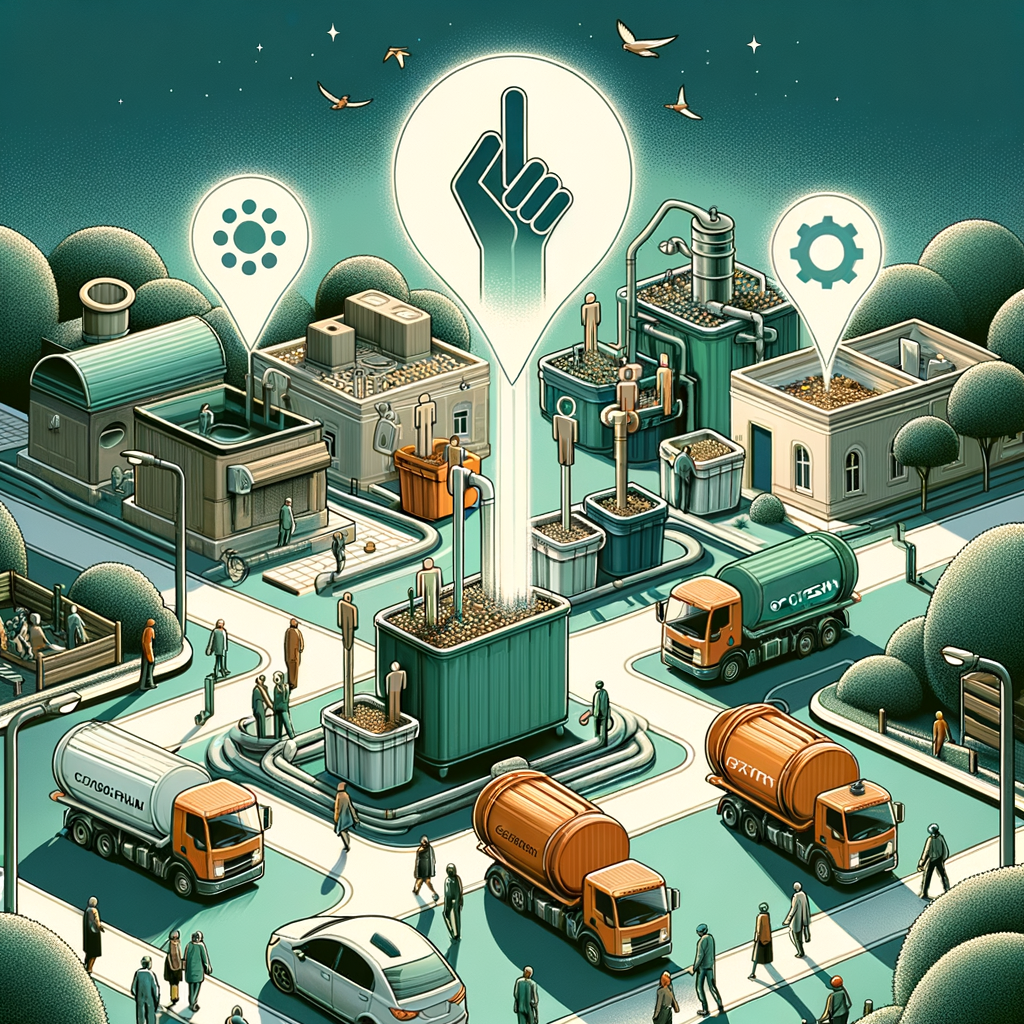
The intersection of ecological sanitation (EcoSan) and circular economy concepts offers an innovative solution to some of the most significant environmental challenges we face today. These two concepts individually bring transformative ideas to the management of natural resources and waste. When combined, they provide a comprehensive framework that enhances environmental sustainability, conserves natural resources, and creates economic opportunities. EcoSan focuses on closing the loop of nutrient elements from human waste back to the environment, ensuring that nothing is lost in the cycle of use and disposal. On the other hand, circular economy promotes the idea of an endless loop, where resources are reused and recycled in a never-ending cycle of renewal and sustainability.
Incorporating both concepts provides crucial strategic advantages in modern waste management practices and industry standards. The convergence addresses ecological, social, and economic aspects of sustainability, producing a multifaceted approach to renewable resources. These connections allow for the development of sustainable urban environments, promote healthier communities, and create value from what was once considered waste. By viewing waste as a resource, EcoSan and circular economy create systems that maintain and regenerate resources, improve life quality, and support biodiversity. Together, they tackle the urgent need to mitigate climate change by reducing resource consumption and lowering emissions.
In exploring the intersection of EcoSan and circular economy concepts, we must delve into the practical applications, benefits, and potential challenges of integrating these principles into everyday life. This article examines how these two approaches align, their potential to reshape industries, and how they contribute to the creation of resilient, sustainable societies. By encouraging innovation and advocating for systemic change, these ideas open a path toward sustainable development and environmental stewardship at the local, regional, and global levels.
An Overview of EcoSan and Circular Economy
At its core, ecological sanitation or EcoSan is a paradigm shift from the conventional end-of-pipe waste management systems. The traditional sanitation system involves flushing away waste, leading to water pollution and the depletion of non-renewable resources. EcoSan redefines waste as a resource, actively promoting the processing and conversion of human excreta into safe, usable products. By closing the nutrient cycle, it allows nutrients and organic matter typically wasted to enrich soil fertility, support agricultural production, and improve water quality. EcoSan practices often focus on composting toilets, urine diversion and reuse, and blackwater management, each aiming to mitigate the environmental impact of human waste.
The circular economy, conversely, is a restorative and regenerative economic system by design. Moving away from the linear economy model—take, make, dispose—it advocates for a closed-loop system where resources are continuously cycled through reuse, refurbishment, remanufacturing, and recycling. The circular economy minimizes waste generation by maximizing resource utilization through innovative design practices and sustainable business models. It promotes sustainable consumption patterns by ensuring materials are kept in use at their highest value for as long as possible, thus decoupling growth from finite resource consumption.
The interaction between EcoSan and circular economy principles presents numerous opportunities for implementing sustainable resource management practices. Both advocate for minimizing resource wastage, preserving ecosystem services, and ultimately contributing to sustainable growth. Their synergy lies in their shared vision of resource circularity and regenerative systems that prioritize ecological balance and resilience.
Practical Applications and Benefits
The integration of EcoSan and the circular economy offers a wide range of benefits, from environmental rehabilitation to economic innovation. Several practical applications exemplify how these concepts work together to address sustainability challenges.
First, consider urban and rural sanitation improvements. By adopting EcoSan principles within a circular economy model, sanitation systems become more efficient, reducing environmental impact and providing agricultural materials. For instance, composting toilets can transform waste into compost, valuable for agriculture or biogas production, thus supporting local economies and reducing the dependence on chemical fertilizers.
Agriculture is another area where these concepts shine. Using composted human waste to enrich soils not only recycles nutrients but also builds soil health, leading to higher crop yields and better water retention capacities. This creates a closed nutrient loop, benefiting farmers by lowering input costs and protecting crops against diseases. In a circular economy, agricultural practices emphasize zero waste, where livestock feed can derive from by-products, optimizing resource use across farming ecosystems.
Even in the energy sector, the principles of EcoSan and circular economy can be leveraged to reduce reliance on non-renewable resources. Waste produced by individuals and industries can be converted into biogas, a renewable energy source. This substitution supports energy independence, aids in carbon footprint reduction, and contributes to a more sustainable energy mix.
Moreover, these concepts have profound social benefits. EcoSan enhances public health by improving sanitation facilities, reducing the spread of waterborne diseases, and providing dignified waste management options. Communities adopting these methods experience improved living conditions and better health outcomes, a crucial contributor to overall societal well-being.
Potential Challenges and Strategies for Overcoming Them
While the integration of EcoSan and circular economy principles is promising, several challenges must be addressed to realize their full potential. One major obstacle is the lack of awareness and understanding among stakeholders, including governments, businesses, and the public. Limited knowledge can hinder the adoption and implementation of these innovations. Education campaigns, partnerships, and community engagement are essential to promote awareness and understanding of these systems and their benefits.
Policy and regulatory frameworks also present challenges. Policies designed for linear economies may not support the transition to circular models. Comprehensive policy reforms and incentivization strategies are necessary to encourage the adoption of EcoSan and circular economy initiatives. Governments must work towards regulatory environments that favor resource recovery and support business innovation for sustainable practices.
Financial constraints can also impede the innovation and formalization of EcoSan systems and circular economies. Investment is required to support infrastructure, technology development, and commercialization of sustainable products. Public-private partnerships, subsidies, and governmental incentives play vital roles in encouraging investments in sustainable ventures and technologies.
Another significant challenge is technical limitations, including the scalability and technological readiness of current EcoSan and resource recovery systems. Continuous research and development are needed to refine existing technologies, foster innovations, and improve the effectiveness and efficiency of EcoSan systems, ensuring they can meet varying contextual demands on a large scale.
Lastly, cultural and societal norms may act as barriers to adopting non-conventional practices like EcoSan. Changing perceptions around sanitation and resource use requires time and consistency. In cultures where open defecation or conventional toilet systems dominate, gradual but persistent engagement is necessary. Highlighting successful use-cases, promoting local champions, and integrating traditional practices with modern innovations can facilitate acceptance and integration into everyday life.
The Role of Innovation and Business Models
Innovation and business models play a critical role in the successful intersection of EcoSan and circular economy concepts. Entrepreneurs, designers, and innovators actively participate in these arenas by developing cutting-edge solutions facilitating sustainability. Technological advancements in waste treatment, nutrient recovery, and regenerative design significantly enhance the capacity of these systems, overcoming traditional limitations and expanding their application scope.
Additionally, new business models driven by circular economy initiatives, such as product-as-a-service or sharing economy platforms, offer innovative pathways to sustainable resource management. They change how products are designed, used, and perceived, creating value at multiple stages of the product life-cycle. Green entrepreneurship invests in sustainable solutions, providing eco-friendly alternatives in sectors such as agriculture, energy, and sanitation.
Moreover, integrating digital technologies, such as the Internet of Things (IoT) and data analytics, into EcoSan practices can optimize system performance and resource management. Smart systems can efficiently monitor and manage waste, track nutrient flows, and predict maintenance needs, increasing the reliability and efficiency of these systems. Data-driven insights contribute valuable information that informs policy, business strategy, and consumer behavior towards more sustainable practices.
Encouraging circular thinking and eco-innovation requires a concerted effort from academia, industry, and government sectors. Investing in education and training programs that emphasize sustainability can foster the next generation of eco-conscious leaders who prioritize long-term ecological and economic health.
Conclusion
In conclusion, the intersection of ecological sanitation and circular economy concepts represents a pivotal moment for sustainable resource management. Together they provide a comprehensive framework addressing the challenges posed by linear economic practices and inefficient resource utilization. Through practical applications such as improved sanitation, agricultural development, and renewable energy generation, these principles transform the perception of waste into valuable resources, fostering ecological balance and economic growth.
Despite facing challenges such as awareness, policy constraints, financial barriers, and cultural perceptions, the potential benefits of harmonizing EcoSan with circular economy concepts are immense. Overcoming these hurdles involves strategic action including policy reform, public-private partnerships, technological innovation, and community engagement, leading to sustainable change.
Ultimately, the intersection of these innovative ideas shifts traditional paradigms, emphasizing the significance of closed-loop systems and sustainable resource management practices. It compels industries, governments, and society to rethink consumption, production, and waste management for a sustainable future. By fostering collaboration, innovation, and a dedication to ecological stewardship, we pave the way to a more resilient, equitable, and sustainable world for generations to come.
Frequently Asked Questions
1. What is ecological sanitation (EcoSan) and how does it relate to the circular economy?
Ecological Sanitation, or EcoSan, is an approach to sanitation that aims to safely manage human excreta by promoting its reuse rather than disposal. Instead of viewing waste as something to be eliminated and forgotten, EcoSan sees it as a valuable resource, emphasizing its potential in agricultural applications due to the nutrient content found in human and animal waste. This is where it intersects with the circular economy concept, which advocates for reducing waste by keeping materials in use for as long as possible. In essence, EcoSan contributes to the circular economy by taking the output of waste and reintegrating it into the environmental and economic cycles, naturally closing the loop of nutrient flows and minimizing needless environmental impact.
2. How do EcoSan and the circular economy contribute to sustainability?
EcoSan and circular economy principles both emphasize sustainability by promoting the efficient use of natural resources and minimizing waste. EcoSan facilitates the recycling of nutrients, turning human waste into fertilizers that enhance soil quality and agricultural yields, thus reducing the need for chemical fertilizers. This not only bolsters food security but also helps protect water sources from pollution. On the other hand, the circular economy promotes the design and manufacturing of products in a way that allows for continual reuse and recycling, thereby reducing the demand for new resources and energy. Together, these approaches help maintain ecological balance, decrease greenhouse gas emissions, and foster a healthier planet by encouraging practices that lead to long-term ecological resilience and economic viability.
3. What are some practical examples of EcoSan solutions that support the circular economy?
There are several practical implementations of EcoSan solutions that integrate circular economy principles. One of the most prominent examples is the use of composting toilets, which turn human waste into safe, usable compost for agriculture. Urine-diverting toilets, which separate urine for direct use as fertilizer, are another solution. These systems not only improve sanitation in areas lacking proper infrastructure but also create valuable agricultural inputs. Another example is biogas digesters which convert human excrement and organic waste into biogas, a renewable energy source, while simultaneously producing nutrient-rich slurry that can serve as a potent fertilizer. These examples showcase how EcoSan solutions can be practically implemented to support and enhance circular economic models by closing the waste loop and turning potential pollutants into productive assets.
4. What economic benefits can be realized by integrating EcoSan with circular economy concepts?
Integrating EcoSan with circular economy concepts presents a multitude of economic benefits. By transforming waste into resources, such as fertilizers and biogas, communities can reduce their reliance on expensive chemical inputs and fossil fuels. The reuse of waste reduces disposal costs and can open up new revenue streams from the sale of fertilizers and energy. Furthermore, implementing these systems can spur technical innovation, creating jobs in fields like construction, system maintenance, and agricultural management. As resource efficiency improves, businesses may see cost reductions and enhanced competitiveness, while governments can benefit from decreased waste management costs and a healthier population, which translates into lowered healthcare expenses. Overall, the combination of EcoSan and circular economy practices leads to sustainable economic growth and development, particularly in regions where traditional infrastructure may be lacking.
5. What are the potential challenges of integrating EcoSan and circular economy practices?
While the integration of EcoSan with circular economy practices poses numerous benefits, it also presents some challenges. One major obstacle is public perception; there is often resistance to using human waste as a resource due to cultural and social stigmas. Overcoming these requires targeted education and communication efforts. Technologically, there may be barriers related to the availability of appropriate systems and the knowledge necessary to maintain them. Economic factors, such as initial costs and the need for incentives to encourage adoption, pose additional hurdles. Moreover, local regulations and policies might need adjustments to support these innovative approaches effectively. Lastly, infrastructure development and capacity building are necessary to ensure that these solutions are scalable and sustainable in diverse contexts. Addressing these challenges requires multidisciplinary collaboration between governments, businesses, and communities to create a supportive environment for the successful integration of EcoSan and circular economy approaches.