Community workshops are one of the most practical ways to help people understand sustainable sanitation, because they turn an abstract public health topic into local knowledge, shared responsibility, and everyday action. Sustainable sanitation means managing human waste, wastewater, stormwater, and hygiene in ways that protect health, conserve resources, reduce pollution, and remain affordable and socially acceptable over time. In community settings, that includes safe toilets, handwashing, menstrual health support, sludge management, drainage, behavior change, and clear maintenance systems. I have worked on sanitation outreach projects where the technical solution was sound, yet adoption failed because residents had never been included in the learning process. That experience makes one lesson clear: infrastructure alone does not create lasting sanitation outcomes. People need to know how systems work, why practices matter, what risks exist, and who is responsible for each part of the chain.
Building community awareness is the foundation of that process. A new toilet block, decentralized wastewater unit, composting toilet, or desludging schedule will only deliver health and environmental benefits if households trust it and use it correctly. Workshops create a space for that trust to develop. They allow residents, schools, health workers, local government staff, landlords, waste workers, and youth groups to ask direct questions and compare lived experience with technical guidance. They also help communities connect sanitation with issues they already care about, including child health, school attendance, flood resilience, neighborhood cleanliness, water security, and dignity. This hub article explains how community workshops support sustainable sanitation awareness, what effective programs include, which audiences to involve, and how to turn one-off events into long-term community education.
Why community workshops matter for sustainable sanitation awareness
Community workshops matter because sanitation behavior is shaped by social norms as much as by engineering. A household may have access to a toilet and still practice unsafe disposal if the pit fills, the water supply is unreliable, the space feels unsafe for women at night, or no one understands maintenance. Workshops uncover these barriers early. In practice, the best sessions do more than present information. They map the full sanitation service chain: user interface, containment, emptying, transport, treatment, reuse or disposal. When participants see that sanitation does not end at the toilet door, awareness becomes more practical and more durable.
Public health evidence supports this approach. According to the World Health Organization and UNICEF Joint Monitoring Programme, safely managed sanitation requires improved facilities that are not shared with other households and where excreta are safely disposed of in situ or transported and treated off-site. That definition is more demanding than simply counting toilets. Community education is what helps residents understand the difference between access and safe management. In workshop settings, I have found that simple demonstrations, such as tracing how fecal contamination reaches drinking water through poor drainage or open pits, often shift attitudes faster than generic awareness posters. People respond when the information clearly affects their own family, street, or school.
Workshops also strengthen accountability. They give residents a forum to ask who empties pits, how often septic tanks should be desludged, what standards contractors must follow, and how fees are set. In urban settlements, these questions are critical because sanitation failures often happen in the gaps between household responsibility and municipal service provision. In rural areas, the discussion may focus more on siting latrines away from water sources, managing flood risk, or maintaining shared school facilities. In both cases, the workshop serves as a bridge between technical systems and community practice.
Core topics every sanitation workshop should cover
An effective sustainable sanitation workshop covers health, environment, infrastructure, behavior, and governance in plain language. The first core topic is disease prevention. Facilitators should explain how pathogens spread through fecal-oral transmission and why toilets, safe child feces disposal, handwashing with soap, and clean water storage work together. The second topic is technology choice. Communities need practical explanations of pit latrines, ventilated improved pit latrines, pour-flush toilets, septic tanks, container-based sanitation, composting toilets, and simplified sewers. Each option has land, water, cost, and maintenance implications. Presenting these differences clearly helps residents make informed decisions rather than copying inappropriate designs.
The third topic is operations and maintenance. This is where many sanitation programs weaken. Households should know signs of system failure, such as overflowing pits, slow drainage, cracked slabs, foul odors, mosquito breeding, or illegal discharge into drains. They also need guidance on cleaning routines, accessible reporting channels, and safe emptying practices. The fourth topic is inclusion. Workshops must address the needs of children, older adults, people with disabilities, women, informal settlement residents, and sanitation workers. Sustainable sanitation is not only about technical performance; it is also about whether facilities are safe, private, reachable, and acceptable for everyone who uses them.
Environmental awareness is another essential component. Residents often understand dirty surroundings immediately, but they may not connect them to nutrient loading, groundwater contamination, eutrophication, or unsafe sludge dumping. This is where examples matter. A workshop can show how leaking pits contaminate shallow wells, how clogged drains worsen floodwater exposure, or how untreated wastewater harms downstream agriculture. In some communities, discussions on resource recovery are especially effective. Treated biosolids, biogas, urine diversion, and water reuse can be introduced carefully, with clear references to safety standards and cultural acceptance. The point is not to promote one model universally. The point is to explain that sanitation can protect health while also conserving water and recovering value when managed correctly.
How to design workshops that people trust and remember
Trust starts with listening. Before drafting agendas, organizers should identify what the community already knows, what myths persist, and what practical constraints shape daily behavior. I have seen workshops fail because facilitators arrived with polished slides but no understanding of local water access, tenancy patterns, language preferences, or prior conflicts over shared toilets. A short pre-assessment through household visits, school consultations, or discussions with community-based organizations can prevent that mistake. It allows the workshop to focus on local realities, such as seasonal flooding, desludging costs, or the safety concerns that keep women from using facilities after dark.
Facilitation quality matters as much as content. The strongest sessions use plain terms, visual aids, and direct examples. They avoid blaming residents for poor sanitation conditions that are often tied to poverty, weak service delivery, or insecure land tenure. They also separate facts from assumptions. If participants believe septic tanks never need emptying, the facilitator should explain that tanks accumulate solids and typically require scheduled desludging, with frequency depending on size, occupancy, and inflow. If a community assumes all wastewater is harmless once out of sight, the facilitator should explain treatment requirements and environmental impact. Clear correction of misinformation builds credibility when it is done respectfully.
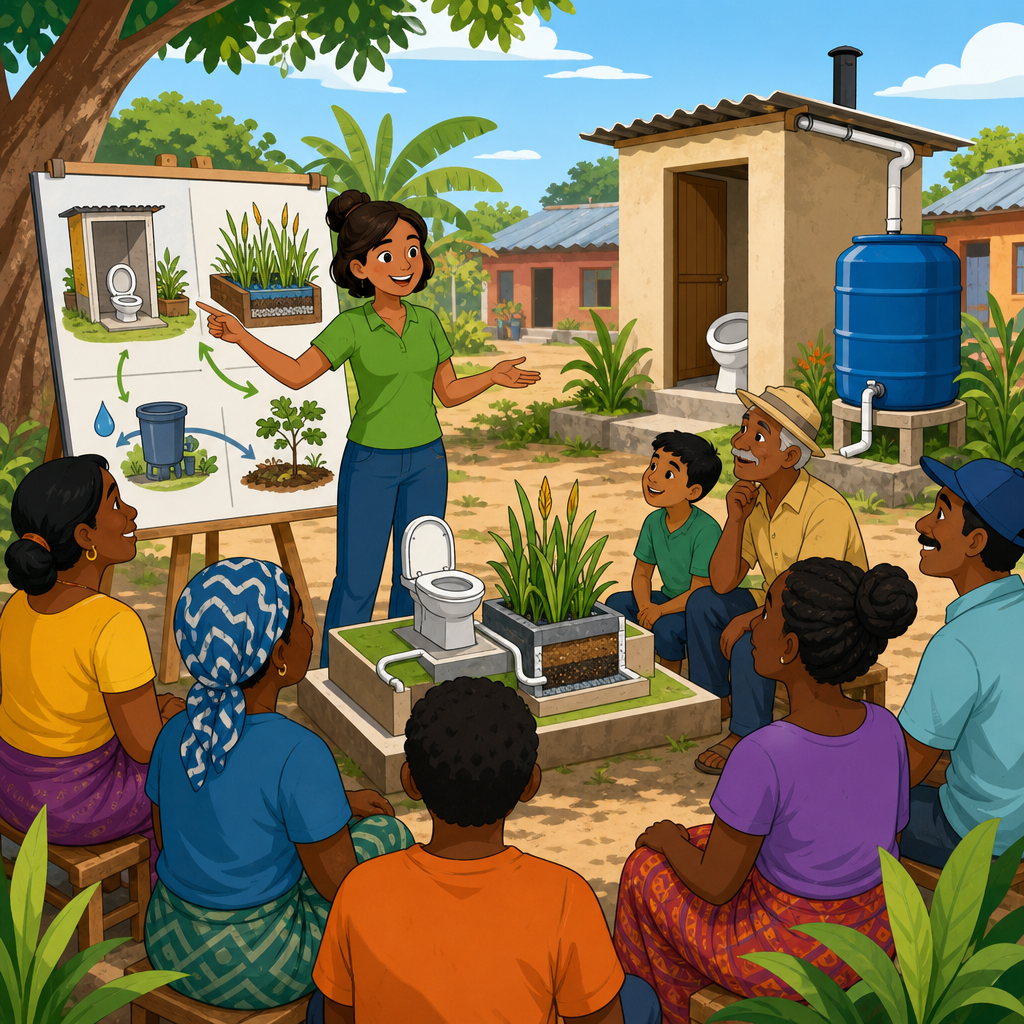
Retention improves when workshops are participatory. People remember what they discuss, map, inspect, and demonstrate. Community transect walks, toilet audits, drain mapping, and role-based exercises all help. Health workers can explain disease pathways, engineers can answer technical questions, and residents can identify actual service gaps. The most useful workshop designs also include follow-up materials: simple maintenance checklists, local contact numbers, illustrated guides, and links to related community education content on hygiene promotion, school sanitation, fecal sludge management, and inclusive toilet design. This hub should lead readers naturally to those subtopics because awareness grows through repeated, connected learning rather than one isolated meeting.
Who should be involved in community sanitation education
Effective workshops involve more than households. Sustainable sanitation awareness improves when every actor in the local system participates. That includes municipal environmental health teams, school administrators, teachers, youth leaders, women’s groups, landlords, tenants, disabled persons’ organizations, faith leaders, clinic staff, utility representatives, pit emptiers, and small sanitation businesses. Each group sees a different part of the problem. Landlords understand cost recovery, school staff understand child behavior, and sanitation workers understand what makes containment systems difficult or dangerous to empty. Bringing these perspectives together helps communities move from awareness to workable action.
Children and young people deserve special attention because they often influence household behavior. School-based workshops can connect sanitation learning to handwashing facilities, menstrual health management, toilet cleaning rosters, and anti-stigma education. Youth groups can support neighborhood campaigns, create peer education materials, and monitor public facility conditions using mobile reporting tools. In one program, student sanitation clubs produced simple maps of blocked drainage points near schools, which helped local officials prioritize maintenance before the rainy season. That kind of example shows why awareness should be treated as a community asset, not a side activity.
Frontline workers must also be visible in the education process. Sanitation workers are too often excluded, despite holding essential operational knowledge and facing serious occupational risks. Workshops should address safe emptying, protective equipment, exposure prevention, vaccination, and dignified working conditions. Referencing standards from organizations such as the International Labour Organization and guidance from the World Bank on inclusive sanitation strengthens these discussions. When communities understand the sanitation chain, they are more likely to respect workers, support safe service delivery, and reject unsafe manual practices.
Practical workshop formats, tools, and examples
There is no single workshop format that fits every community, but several models work consistently. Introductory awareness sessions are useful when a neighborhood is beginning a sanitation improvement project. Technical Q&A forums work well when households are comparing toilet or wastewater options. Demonstration days are effective for showing handwashing stations, slab upgrades, sealed pits, or accessible toilet features. Problem-solving clinics help residents troubleshoot maintenance failures with engineers or local service providers. Short sessions embedded in market days, clinic outreach, or school events can also reach people who would never attend a formal seminar.
| Workshop format | Best use | Practical example |
|---|---|---|
| Introductory community meeting | Launch awareness and align stakeholders | Explaining a new desludging schedule and household responsibilities |
| Technical demonstration | Show how systems operate | Comparing septic tank care with composting toilet maintenance |
| School sanitation session | Build habits and peer learning | Teaching handwashing, toilet etiquette, and menstrual health support |
| Neighborhood mapping workshop | Identify risks and service gaps | Marking flood-prone toilets, blocked drains, and illegal dumping points |
| Worker safety briefing | Improve service quality and protection | Reviewing PPE use, confined-space hazards, and emergency reporting |
Digital tools can extend workshop impact, but they should support, not replace, face-to-face engagement. WhatsApp groups, SMS reminders, QR-linked guides, and simple reporting forms can reinforce maintenance schedules and answer follow-up questions. For monitoring, organizers can use KoboToolbox, Google Forms, or Open Data Kit to record attendance, questions, and post-workshop commitments. In larger municipalities, GIS-based mapping can help visualize sanitation gaps and target future sessions. Still, digital outreach must account for literacy, connectivity, and device access. Printed materials and local radio remain important in many areas.
Real-world sanitation education works best when examples are concrete. If discussing septic tanks, explain that they are treatment units, not permanent storage, and need proper sizing, inlet and outlet design, and periodic desludging. If discussing urine-diverting dry toilets, explain the operational discipline required to keep streams separate and manage cover material. If discussing shared toilets in dense settlements, explain cleaning agreements, user caps, lighting, lockability, and payment systems. Specificity makes information usable, and usable information is what changes behavior.
Measuring success and turning workshops into long-term awareness
A strong workshop is not successful because people attended; it is successful because knowledge improved, attitudes shifted, and practices changed. Measurement should therefore include more than headcounts. Pre- and post-session questions can test understanding of handwashing, safe containment, desludging intervals, and wastewater risks. Follow-up visits can assess whether households adopted maintenance practices, whether schools kept soap available, and whether public complaints about blocked drains or overflowing pits declined. Municipal teams can also track service indicators such as legal emptying requests, toilet functionality, drainage blockages, and fecal sludge disposal compliance.
Long-term awareness depends on repetition, local leadership, and institutional support. Communities benefit when workshop content is embedded into routine health outreach, school programs, tenant meetings, faith gatherings, and neighborhood planning sessions. Training local facilitators is especially valuable because they can continue education after outside organizations leave. This creates continuity, local ownership, and cultural relevance. It also helps link this hub topic of building community awareness with related articles on behavior change communication, school WASH engagement, inclusive outreach methods, and community monitoring systems. The goal is not to hold more workshops for their own sake. The goal is to create a learning culture where sanitation is understood as a shared public good.
Community workshops remain one of the most reliable ways to build lasting awareness about sustainable sanitation because they connect technical facts with local decision-making. They help residents understand health risks, compare sanitation options, demand better services, and maintain systems correctly. They also make sanitation more inclusive by bringing in schools, workers, landlords, youth, and public agencies. When workshops are well designed, participatory, and linked to ongoing education, they move communities beyond awareness campaigns toward practical action. If you are building a community engagement and education strategy, start by mapping your audiences, identifying local sanitation questions, and planning workshop formats that answer them clearly. Then use this hub as the starting point for a broader community awareness program that stays active long after the first meeting ends.
Frequently Asked Questions
What is sustainable sanitation, and why is it important in community workshops?
Sustainable sanitation is an approach to managing toilets, human waste, wastewater, stormwater, and hygiene practices in ways that protect public health, reduce environmental harm, conserve resources, and remain affordable and practical over the long term. It goes beyond simply installing a toilet or building drainage. It includes safe containment, treatment, reuse or disposal, handwashing, menstrual hygiene support, and local systems for maintenance and behavior change. In a community setting, these issues are closely connected to daily life, including water access, neighborhood cleanliness, school attendance, disease prevention, and the dignity and safety of women, children, older adults, and people with disabilities.
Community workshops matter because they make sanitation understandable and relevant. Many people hear sanitation discussed as a technical or government issue, but workshops help translate it into local knowledge and everyday action. Residents can learn how germs spread, why drainage matters during rainy seasons, how poor wastewater management affects wells and streams, and what practical steps households can take to improve hygiene and toilet use. Workshops also create space for questions, shared experiences, and collective problem-solving. Instead of treating sanitation as an individual responsibility alone, they help communities see it as a shared system where each household’s practices affect the health and environment of the wider area.
What topics are usually covered in a community workshop on sustainable sanitation?
A strong community workshop on sustainable sanitation usually covers both infrastructure and behavior. On the practical side, participants may learn about different types of safe toilets, proper pit or septic system use, fecal sludge management, drainage, stormwater control, graywater handling, and how to reduce contamination of nearby water sources. Workshops often explain how sanitation systems should function, what signs of failure to watch for, and why regular maintenance is essential. This can be especially valuable in places where systems exist but are not used correctly or are not serviced often enough.
Workshops also focus heavily on hygiene and inclusion. Common topics include proper handwashing with soap, safe water storage, menstrual hygiene management, cleaning routines for shared toilets, child feces disposal, and the prevention of odors, flies, and stagnant water. Good workshops address social realities as well, such as privacy, accessibility, cultural norms, affordability, and community safety. For example, a workshop may discuss why toilets need lighting, locks, and pathways that are usable during floods or at night. In many communities, the most effective training combines technical guidance with discussion of local challenges so participants leave with realistic, actionable steps rather than generic advice.
How do community workshops help change sanitation behavior in lasting ways?
Community workshops are effective because they do more than deliver information. They create participation, trust, and local ownership. People are much more likely to change sanitation behaviors when they understand the reasons behind those changes, can discuss barriers openly, and see solutions that fit their own homes, budgets, and routines. A workshop can help participants connect sanitation to immediate concerns they already care about, such as children getting sick less often, cleaner surroundings, fewer bad smells, safer water, and reduced mosquito breeding. That connection makes the topic practical instead of abstract.
Lasting change also depends on repetition and community reinforcement. Workshops often work best when they involve demonstrations, group discussions, mapping of local sanitation problems, and follow-up activities. For instance, residents may identify where runoff collects, where wastewater is discharged, or which public toilets need maintenance. When a community discusses these issues together, good practices become more visible and more socially supported. Workshops can also help local leaders, teachers, health workers, and volunteers act as ongoing messengers after the event ends. This creates a stronger foundation for sustained improvements in handwashing, toilet use, maintenance, and neighborhood cleanliness than one-time awareness campaigns typically achieve.
Who should take part in sustainable sanitation workshops, and why is inclusion so important?
Sustainable sanitation workshops should involve a broad cross-section of the community because sanitation affects everyone, but not everyone experiences sanitation problems in the same way. Households, landlords, tenants, school staff, health workers, local officials, sanitation workers, youth groups, women’s groups, and community leaders all have useful perspectives and responsibilities. Involving multiple groups helps identify practical gaps that might otherwise be missed, such as the needs of children, the location of handwashing stations, the safety of women using toilets after dark, or the accessibility challenges faced by older adults and people with disabilities.
Inclusion is essential because sanitation systems fail when they are designed only for the average user and not for the full community. A toilet that is too far away, lacks privacy, cannot be accessed by someone with limited mobility, or does not support menstrual hygiene may exist physically but still not function well in practice. Inclusive workshops encourage communities to discuss dignity, safety, affordability, and cultural acceptability alongside health and engineering. They also help ensure that sanitation workers and maintenance staff are recognized as part of the system, with attention to occupational health and safe handling practices. When workshops include diverse voices, the resulting solutions are more realistic, more equitable, and more likely to be used consistently over time.
What outcomes can communities expect from effective sustainable sanitation workshops?
When community workshops are well planned and followed by practical action, they can lead to meaningful improvements in health, cleanliness, and local resilience. In the short term, communities often see better awareness of disease prevention, more consistent handwashing, safer toilet use, improved cleaning routines, and stronger understanding of how wastewater and stormwater should be managed. People may begin making low-cost changes right away, such as covering waste, fixing drainage pathways, organizing cleaning schedules for shared facilities, improving soap access, or reporting damaged sanitation infrastructure earlier.
Over the longer term, workshops can strengthen collective responsibility and support better local decision-making. Communities may organize maintenance committees, advocate for improved services, monitor sanitation conditions around schools or public spaces, and work with local authorities or service providers to address persistent issues. Effective workshops can also reduce stigma around topics that are often neglected, including menstrual hygiene, child feces management, and sanitation worker safety. Perhaps most importantly, they help build a culture in which sanitation is seen not as a one-time construction project, but as an ongoing public health system that depends on education, maintenance, inclusion, and community cooperation. That shift in mindset is what makes sustainable sanitation truly sustainable.