Cultural sensitivity in sanitation education determines whether a well-funded campaign changes daily behavior or becomes another poster on a clinic wall. In practice, sanitation education means helping people understand and adopt safer habits around toilets, handwashing, menstrual hygiene, child feces disposal, wastewater, and solid waste. Cultural sensitivity means designing that education around local beliefs, languages, gender norms, routines, and power structures instead of assuming one message fits everyone. This matters because sanitation is never only technical. A latrine can be perfectly engineered and still go unused if families fear smell inside the home compound, if women lack privacy, if elders reject unfamiliar designs, or if local words for contamination carry meanings outsiders miss. Across community engagement and education work, I have seen the strongest sanitation outcomes come from programs that listen first, map social realities carefully, and then teach in ways people recognize as respectful, practical, and credible.
Building community awareness is the foundation of that process. Awareness is not simply informing people that germs exist. It is creating shared understanding of risk, dignity, convenience, cost, and responsibility in a way that motivates action across households, schools, markets, and local leadership. A hub page on this topic must therefore connect behavior change, social inclusion, trust building, and service access. Community awareness succeeds when residents can explain why a practice matters, know what option is realistic for them, and see that respected peers are doing it too. It fails when messages ignore religion, shame people publicly, or recommend products that are unavailable. Effective sanitation education translates public health principles into local social meaning. That translation is the difference between compliance in front of project staff and durable change after the project leaves.
Why cultural sensitivity is central to sanitation behavior change
Sanitation behavior is shaped by norms as much as knowledge. Public health evidence is clear that safe disposal of excreta, handwashing with soap at critical times, and hygienic management of water and menstrual materials reduce disease risk, school absenteeism, and environmental contamination. Yet people do not make sanitation decisions in a laboratory. They act within households, under financial pressure, and inside systems of status and identity. In one rural campaign I supported, mothers understood handwashing messages well, but water collection was so time intensive that placing a handwashing station near the cooking area mattered more than repeating disease facts. In another setting, open defecation was associated with freedom and fresh air for some men, while women preferred private toilets but feared using facilities at night without lighting. The educational strategy had to address these lived realities directly.
Cultural sensitivity improves uptake because it starts with what communities already believe and do. That does not mean affirming harmful practices. It means understanding their logic so education can respond intelligently. For example, some communities view child feces as less dangerous than adult feces. A generic message that “all feces are harmful” may be dismissed unless educators explain contamination pathways in plain language and demonstrate safe disposal options that fit caregivers’ routines. In places where menstrual hygiene is surrounded by silence, school sanitation sessions must be timed, staffed, and framed carefully to avoid embarrassment while still addressing disposal, washing, pain management, and attendance. Sensitivity also protects trust. Once people feel judged or stereotyped, they disengage, and even technically correct information loses influence.
How to assess a community before designing sanitation education
Good sanitation education begins with assessment, not messaging. Before drafting materials, identify who influences household decisions, which languages are spoken at home, what sanitation services actually exist, and which groups face barriers. A basic assessment should cover social norms, seasonal conditions, literacy levels, local terminology, and prior campaign history. Use household interviews, focus groups segmented by age and gender, school visits, transect walks, and observations of actual facilities. Pair this with service mapping: Are toilets functional? Is soap affordable? Where are sludge emptying services available? Education cannot compensate for a missing service chain. If a program teaches hygienic pit emptying where no safe provider exists, people will either ignore the advice or adopt unsafe workarounds.
I recommend organizing findings into a practical design matrix so educators can connect barriers with responses. The matrix below is simple but effective when planning a community awareness campaign.
| Assessment area | What to ask or observe | Common risk | Education response |
|---|---|---|---|
| Language and literacy | Which language is used at home, school, and clinic? Can people read posters easily? | Messages are understood by leaders but not households | Use local-language audio, demonstration, visuals, and trusted interpreters |
| Gender norms | Who decides toilet spending? Who cleans facilities? Who moves freely at night? | Facilities are promoted without considering women’s safety or men’s spending authority | Run separate and joint sessions; address privacy, lighting, and budget choices |
| Beliefs about contamination | How do people explain diarrhea, smell, purity, and dirt? | Health messages conflict with local explanations of illness | Link germ concepts to familiar experiences like flies, food, and children’s play areas |
| Service availability | Are toilets usable? Is soap sold locally? Is fecal sludge safely managed? | Education promotes impossible behaviors | Align messages with affordable options and service providers |
| Social influence | Whose behavior matters most: elders, teachers, faith leaders, landlords, youth? | Campaign ignores real decision makers | Use visible champions and peer examples from respected groups |
This assessment stage is also where hub content should direct readers to deeper resources on stakeholder mapping, formative research, and social norms analysis. Community awareness is not a poster campaign; it is the public-facing result of careful listening and operational planning.
Designing messages that respect local beliefs and still change practice
The most effective sanitation messages are concrete, respectful, and behavior specific. Instead of saying “improve hygiene,” say “wash both hands with soap after using the toilet, after cleaning a child, and before touching food.” Instead of saying “use sanitation services,” say “keep the latrine path lit, store water and soap at the entrance, and empty pits through a trained provider.” Precision helps because communities need actions, not abstractions. Respect matters because people are more likely to change when education acknowledges constraints. A message for low-income renters should not assume they can build a new toilet. It should explain what they can request from landlords, how to keep shared toilets cleaner, and where to report unsafe conditions.
Message framing should match local motivations. Health risk is important, but it is rarely the only driver. In many communities, dignity, convenience, child safety, smell reduction, social status, and school attendance motivate sanitation improvements more strongly than disease statistics alone. Community-led approaches have shown that disgust and pride can accelerate behavior change, but they must be handled carefully. Shame-based tactics may create short-term compliance while harming vulnerable households, especially older adults, people with disabilities, or families that genuinely cannot afford upgrades. A better approach is to pair social motivation with practical pathways: low-cost handwashing stations, installment payment options, accessible toilet designs, and public recognition for neighborhood improvements. When people see a route from intention to action, awareness becomes behavior.
Working with local leaders, educators, and trusted messengers
Sanitation education spreads fastest when trusted messengers carry it into everyday settings. Community health workers, teachers, women’s groups, religious leaders, landlords, masons, and youth volunteers each reach different audiences and influence different decisions. The key is not recruiting the longest possible list. It is assigning each messenger a role that matches their credibility. Teachers can normalize handwashing routines in schools, but they may not be the right voice for sensitive menstrual hygiene discussions without training and private spaces. Faith leaders can support messages about dignity, cleanliness, and care for neighbors, especially when sanitation intersects with communal worship spaces. Local artisans and masons are crucial because awareness often rises before supply does; if households decide to upgrade but builders lack appropriate designs, momentum is lost.
Training trusted messengers requires more than handing out flip charts. They need clear talking points, referral information, and practice responding to resistance without confrontation. In my fieldwork, role-play has consistently improved educator performance because sanitation conversations can become personal very quickly. Residents may ask why a government-endorsed toilet is too expensive, why desludging trucks never come to their settlement, or why women are being told to change habits when men leave facilities dirty. Messengers need honest answers. They should know when to explain, when to listen, and when to connect a household to another service. This hub should therefore anchor readers to supporting content on training facilitators, partnering with schools, and engaging faith and civic leaders in behavior change programs.
Reaching groups often missed by standard sanitation campaigns
Culturally sensitive sanitation education is incomplete if it reaches only the easiest audiences. Standard campaigns often miss people with disabilities, linguistic minorities, informal settlement residents, migrants, older adults, and adolescents who are out of school. They also frequently under-serve people managing menstruation, incontinence, or caregiving for young children. Inclusive awareness building starts by identifying who faces extra obstacles and then adapting both content and delivery. For people with visual impairments, audio and tactile demonstrations may work better than printed materials. For Deaf participants, qualified sign language interpretation is essential. For renters in dense settlements, education must address shared sanitation etiquette, maintenance agreements, and landlord accountability, not just household construction.
Gender-responsive sanitation education deserves special emphasis. Women and girls often carry the burden of cleaning, water collection, and caregiving, yet men may control spending decisions and public leadership. Boys and men therefore need direct education on toilet cleanliness, menstrual dignity, privacy, and safety. Likewise, child-focused sanitation messaging should not stop at schools. Caregivers need practical guidance on potties, child feces disposal, and handwashing after cleaning children, because exposure pathways often center on domestic spaces where young children crawl and play. When campaigns include these realities, they build awareness that is usable, not performative. This is one of the most valuable principles across community engagement and education: design for those most excluded, and the whole system becomes clearer and stronger.
Using channels, materials, and feedback loops that communities actually use
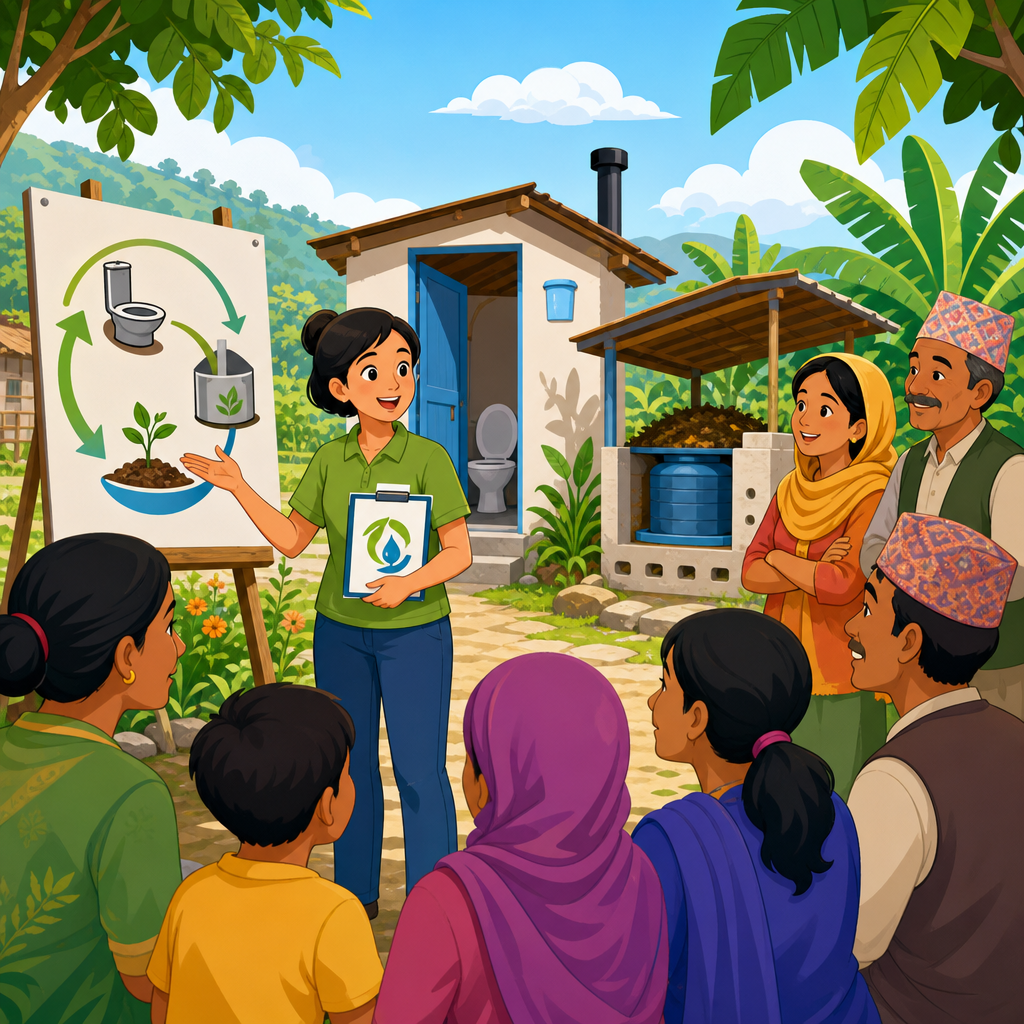
The delivery channel matters as much as the message. In some areas, radio remains the most efficient way to reinforce sanitation education in local languages. In others, WhatsApp groups, school clubs, market demonstrations, and door-to-door visits outperform mass media. Printed posters can support recall, but only when literacy, placement, and imagery are appropriate. Demonstration is usually the strongest method because sanitation behaviors are physical. People remember how to build a tippy tap, where to place soap, how to clean a slab safely, or how to wrap and dispose of menstrual materials when they see the steps with familiar tools. Repetition also matters. A single event may raise awareness, but durable behavior change usually requires reminders, peer discussion, and visible cues in the environment.
Feedback loops separate effective community awareness from one-way communication. Build simple mechanisms for residents to ask questions, report barriers, and suggest adjustments. That could be a community meeting schedule, a teacher logbook, a hotline, or structured follow-up visits by health workers. Then use the data. If families say soap is too expensive, partner with local vendors on smaller package sizes or low-cost alternatives. If schoolgirls report locked toilets or missing bins, address facility management rather than repeating menstrual hygiene lessons. Measure outcomes that reflect behavior and experience, not just attendance at sessions. Useful indicators include observed presence of soap and water, toilet cleanliness, safe child feces disposal, school attendance during menstruation, and household recall of key actions. Awareness becomes meaningful when communities can see that their feedback changes the program.
Cultural sensitivity in sanitation education is the discipline of making public health practical, respectful, and locally credible. The core lesson for building community awareness is simple: people adopt sanitation behaviors when messages fit their language, beliefs, constraints, and aspirations, and when services make those behaviors possible. Assess first, design messages around real motivations, work through trusted messengers, include groups commonly missed, and use channels that communities already trust. Just as important, build feedback into every campaign so education evolves with local reality instead of freezing into assumptions.
As a hub within community engagement and education, this topic connects to every stage of sanitation improvement, from formative research and stakeholder mapping to school outreach, gender inclusion, behavior change communication, and monitoring. If you are planning a sanitation awareness program, start by listening closely to the community you want to serve, then build with them rather than for them. That approach produces better uptake, stronger trust, and outcomes that last.
Frequently Asked Questions
Why is cultural sensitivity so important in sanitation education?
Cultural sensitivity is essential because sanitation behaviors are shaped by far more than access to information. People make decisions about toilet use, handwashing, menstrual hygiene, child feces disposal, wastewater handling, and household waste management within the context of local beliefs, family roles, privacy expectations, religious practices, and daily routines. A sanitation campaign may be technically correct and well funded, but if it ignores how a community understands cleanliness, dignity, gender, or authority, the message often fails to translate into lasting behavior change.
In practice, culturally sensitive sanitation education helps educators present health information in ways that feel relevant, respectful, and realistic. For example, if women and girls face restrictions around discussing menstruation openly, a successful program will adapt how and where those conversations happen. If a community relies on elders, religious leaders, teachers, or mothers’ groups to validate new practices, education efforts should involve those trusted voices. When people feel that a program understands their reality instead of judging it, they are more likely to listen, ask questions, and test new habits.
Just as importantly, cultural sensitivity reduces resistance. Communities may reject sanitation messages that appear to attack long-held customs or impose outside values. Respectful education does not mean accepting unsafe practices without question; it means engaging communities in a way that builds trust and ownership. That trust is often the difference between a short-lived campaign and a genuine shift in behavior.
What does culturally sensitive sanitation education look like in real-world programs?
Culturally sensitive sanitation education begins with listening before teaching. Effective programs usually start by learning how people currently manage sanitation and hygiene, what they believe causes illness, who controls household decisions, which languages are used at home, and what barriers different groups face. That groundwork informs how messages are framed, who delivers them, and where they are shared. Instead of using a one-size-fits-all poster or lecture, educators tailor materials and methods to fit the local context.
In real-world settings, this may include using local language rather than formal or technical terms, choosing examples that match daily life, and scheduling sessions at times when women, men, adolescents, or workers can actually attend. It may also mean separating discussion groups by age or gender when topics such as menstruation or toilet use are sensitive. Visual materials may need to reflect local clothing, household layouts, and social norms so that participants recognize themselves in the message rather than seeing it as something designed for another place.
Strong programs also adapt to power structures within the community. If landlords, village leaders, school staff, or household heads influence sanitation decisions, education cannot focus only on individual behavior. It should include the people who shape access, permission, and resources. At the same time, culturally sensitive programs avoid reinforcing harmful exclusions. They make room for women, children, people with disabilities, lower-status groups, and others whose needs are often overlooked. The best programs are respectful without being passive: they work within the culture while still promoting safer, healthier practices.
How can sanitation educators address harmful practices without disrespecting local culture?
This is one of the most important challenges in sanitation education. Cultural sensitivity does not mean staying silent about practices that increase disease risk or compromise dignity and safety. Instead, it means addressing those issues in ways that are constructive, evidence-based, and respectful. Educators should avoid language that shames people or labels traditions as backward. That approach usually creates defensiveness and weakens trust. A better strategy is to begin with shared goals such as child health, family well-being, privacy, convenience, and community pride.
From there, educators can connect sanitation recommendations to outcomes the community already values. For instance, if families are concerned about keeping children healthy, messages about safe child feces disposal and handwashing can be framed around protecting young children from diarrhea and infection. If dignity and modesty matter deeply, improved toilet use and menstrual hygiene management can be discussed in terms of comfort, privacy, and respect. When recommendations are linked to local priorities, they are more likely to be accepted.
Dialogue is also critical. Communities should have space to ask questions, challenge assumptions, and discuss practical obstacles. Sometimes a behavior that appears cultural is actually driven by cost, water scarcity, distance, or lack of facilities. In those cases, education alone is not enough. The most effective educators combine respectful communication with problem-solving, community participation, and local leadership. They help people evaluate risks and identify acceptable alternatives, rather than simply issuing instructions from outside.
Which groups should be involved when designing sanitation education materials and campaigns?
Sanitation education is strongest when it is shaped by the people who live with its consequences every day. That means involving a wide range of community members, not just officials or technical experts. Women and girls are especially important participants because they often manage water, child care, household hygiene, and menstrual health, yet they may be excluded from planning decisions. Men and boys should also be included, since they influence household spending, social norms, facility use, and support for behavior change.
Children, adolescents, teachers, health workers, elders, religious leaders, and local service providers all play important roles as well. Caregivers of young children can speak directly to the realities of child feces disposal and handwashing routines. People with disabilities and older adults can highlight barriers related to accessibility, safety, and independence that others may miss. Waste workers, cleaners, and sanitation staff often provide practical knowledge about what is feasible and sustainable. When these voices are absent, programs tend to overlook real-world constraints.
Inclusive design improves both relevance and legitimacy. It helps campaign materials reflect actual language, actual routines, and actual points of resistance. It also helps identify who is trusted to communicate sensitive topics and who may be left out by standard outreach methods. Involving diverse groups early creates stronger messages and stronger accountability. People are more likely to adopt and sustain sanitation practices when they feel they helped shape the education, rather than simply receiving it.
How can organizations measure whether culturally sensitive sanitation education is working?
Measuring success requires looking beyond how many posters were distributed or how many workshops were held. Those output measures matter, but they do not show whether education changed understanding, attitudes, or daily behavior. Organizations should assess whether people remember key messages, whether they believe those messages are relevant, and whether they are actually adopting safer sanitation and hygiene practices over time. This includes observing or tracking changes in toilet use, handwashing with soap at critical times, menstrual hygiene management, safe disposal of child feces, and handling of wastewater and solid waste.
Culturally sensitive programs should also measure trust, participation, and inclusion. Did the campaign reach women, men, adolescents, marginalized groups, and people with disabilities? Were materials understood in the local language? Did participants feel respected and comfortable asking questions? Were local leaders and informal influencers engaged? These factors are strong indicators of whether the education approach fits the community context or is being treated as an outside message with limited staying power.
Qualitative feedback is especially valuable. Focus groups, interviews, community discussions, and follow-up visits can reveal why certain messages worked, why others failed, and what social barriers remain. Organizations should be prepared to adjust materials and methods based on that feedback. In sanitation education, success is rarely a single event; it is an ongoing process of learning, adapting, and reinforcing behavior change. When programs combine behavioral data with community insight, they can judge not only whether people heard the message, but whether the message truly made sense in their lives.