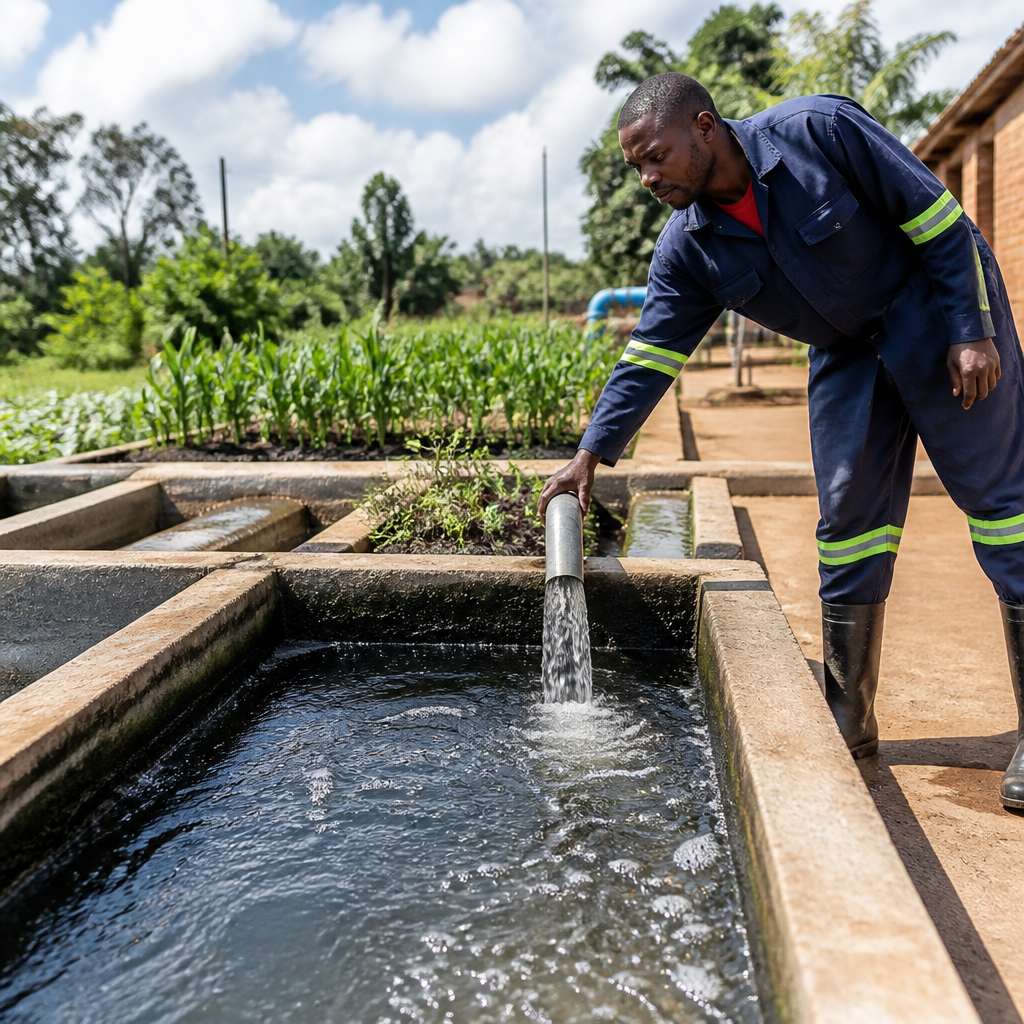
Effective greywater treatment is emerging as one of the most practical water management breakthroughs in Lilongwe, where rapid urban growth, rising water demand, and stressed sanitation systems are forcing households, institutions, and planners to rethink wastewater as a reusable resource. Greywater refers to relatively lightly contaminated wastewater from showers, hand basins, laundry, and kitchen sinks, excluding toilet waste, which is classified as blackwater and carries far higher pathogen loads. When greywater is treated properly, it can be reused for irrigation, flushing, cleaning, and in some systems groundwater recharge, reducing pressure on scarce freshwater supplies while lowering pollution in drains, streams, and wetlands.
In Lilongwe, this matters because the city faces a difficult combination of seasonal water shortages, intermittent piped supply, expanding low-income settlements, and inadequate centralized sewer coverage. I have seen projects fail when greywater was treated as an afterthought, usually because systems were oversized, maintenance was ignored, or users were never taught what not to pour down sinks. I have also seen simple, well-managed systems deliver strong results with basic filtration, grease control, and planted gravel beds. The difference is rarely technology alone. It is usually design matched to local conditions, realistic operation plans, and community ownership from the start.
This hub article on case studies and success stories in Malawi explains what effective greywater treatment looks like in practice, why some Lilongwe projects work better than others, and which lessons are most useful for households, schools, clinics, landlords, NGOs, and municipal decision-makers. It also connects the most important themes across this subtopic: treatment methods, costs, health safeguards, reuse options, policy implications, and measurable outcomes. If you want a clear picture of how greywater reuse is being applied on the ground in Lilongwe rather than in theory, these examples provide the most reliable starting point.
What Effective Greywater Treatment Means in Lilongwe
Effective greywater treatment in Lilongwe means reducing solids, grease, detergents, organic load, and microbial risks to a level that makes the intended reuse safe and practical. The treatment target depends on the use. Water for garden irrigation of non-leafy crops can tolerate different quality than water intended for toilet flushing inside a school or office. In most successful projects, treatment follows several barriers rather than a single unit process: source separation, screening, grease interception, settling, biological treatment, filtration, and controlled reuse. This multi-barrier approach aligns with accepted sanitation practice and is far more dependable than relying on chemicals alone.
Local conditions shape every design decision. Lilongwe has a pronounced wet and dry season, variable electricity reliability, mixed housing densities, and neighborhoods with very different soil infiltration characteristics. A small lodge with stable occupancy can run a compact packaged system, but a peri-urban cluster of rental units usually needs a low-energy design that tolerates fluctuating flows and inconsistent maintenance. Soap chemistry also matters. High-sodium detergents can degrade soil structure over time, so successful reuse projects often pair treatment with user education about cleaning products. In practice, the best systems are not the most complex systems. They are the systems that match local water use patterns and can be maintained with available skills and parts.
For Lilongwe specifically, effective treatment also means visible public health protection. Stagnant greywater attracts odors, mosquitoes, and complaints quickly, especially where drainage is already poor. Systems that keep water moving, limit surface exposure, and direct treated effluent to subsurface irrigation or sealed storage perform better socially as well as technically. That is why the strongest success stories in this sub-pillar are not just engineering stories. They are management stories, behavior-change stories, and governance stories.
Case Studies and Success Stories: What the Best Projects Have in Common
Across Lilongwe and other parts of Malawi, the most convincing greywater success stories share five characteristics. First, they start with a clear water balance: how much water is generated, at what times, and from which fixtures. Second, they separate blackwater completely to avoid overwhelming a small treatment unit with pathogens and solids. Third, they choose a reuse purpose before building the system. Fourth, they assign maintenance responsibility in writing. Fifth, they monitor performance using simple indicators such as odor, turbidity, clogging frequency, plant health, and daily reuse volumes.
I have found that weak projects usually skip one of those steps. For example, a landlord may install a gravel trench to solve standing wastewater behind a block of rentals, but if kitchen water with oils enters without a grease trap, the trench clogs rapidly. A school may construct a reed bed because it looks sustainable, but if there is no plan for desludging pretreatment chambers, the bed starts short-circuiting within months. By contrast, a clinic that trains cleaners, labels drains, and tracks flushing demand can achieve reliable reuse with relatively modest infrastructure. Practical discipline beats expensive equipment surprisingly often.
These case studies also show that success must be judged broadly. Water savings matter, but so do reduced flooding, lower sewer discharge, better site hygiene, lower borehole abstraction, and improved resilience during supply interruptions. For many users in Lilongwe, the real breakthrough is not just reusing water. It is gaining more control over water security at property level while reducing nuisance wastewater discharge into shared environments.
Representative Lilongwe Project Types and Results
The most useful way to understand greywater treatment in Lilongwe is by project type, because performance depends heavily on where the water comes from and how treated water is reused. Household systems are often the simplest, usually collecting bathroom and laundry water for garden irrigation after passing through settling chambers, sand or gravel filters, and sometimes a planted bed. Their main advantage is affordability and direct user control. Their main risk is neglect. If filters are not cleaned and soaps are not managed, odor and clogging appear quickly.
Institutional systems in schools, offices, training centers, and lodges tend to perform better when there is a regular grounds or facilities team. These projects often justify higher upfront investment because they have predictable toilet flushing or landscaping demand. Some of the best examples use balancing tanks, screened inflow, anaerobic or aerobic pretreatment, then horizontal subsurface flow wetlands before reuse. This configuration is robust, low-energy, and understandable to local operators. It also handles variable occupancy better than extremely compact mechanical systems that depend on uninterrupted power and specialist servicing.
Community or shared-compound systems are the hardest but potentially most impactful. In dense settlements, many families generate enough greywater to create serious drainage problems but not enough individually to finance strong treatment. Shared systems can work when user rules are clear, collection pipes are protected from solid waste entry, and a local committee or landlord has authority to enforce maintenance. Without governance, these schemes often fail for social reasons before technical ones.
| Project type | Typical treatment train | Common reuse | Main success factor | Main failure risk |
|---|---|---|---|---|
| Single household | Screening, grease trap, settling tank, sand or gravel filter | Garden irrigation | Owner involvement | Poor maintenance |
| School or clinic | Screening, settling, wetland, storage | Toilet flushing, landscaping | Assigned operators | Ignored desludging |
| Lodge or office | Balancing tank, biofilter, filtration, disinfection where needed | Flushing, cleaning, irrigation | Stable demand profile | Power-dependent equipment failure |
| Shared compound | Grease control, baffled settling, planted bed | Subsurface irrigation | Clear governance | Misuse by multiple users |
These patterns mirror what practitioners see across southern Africa: simple systems with sound pretreatment and realistic reuse plans outperform poorly managed high-tech installations. That is a critical lesson for Lilongwe, where affordability, operator capacity, and supply-chain reliability are as important as treatment efficiency on paper.
Lessons from Household, Institutional, and Community Examples
Household greywater success stories in Lilongwe usually begin with a practical problem: rising water bills, unhealthy pooling near kitchens, or dry-season pressure on home gardens. The most successful households separate bathroom water from kitchen water when possible, because kitchen effluent has more grease and food solids. Where combined greywater must be treated together, adding a grease trap before filtration dramatically extends the life of downstream media. Families who reuse water effectively also adjust irrigation methods. They do not spray greywater onto edible leaves. They apply it below the soil surface or around fruit trees, bananas, ornamentals, or compost areas where contact risk is lower.
Institutional examples add another layer of discipline. In schools, treated greywater can support toilet flushing and gardens, but only if the system design accounts for uneven term-time occupancy and holidays. I have seen school systems in the region fail because tanks were undersized during peak periods, then sat stagnant during closures. Better projects include bypasses, shaded storage, and clear shutdown procedures. In clinics, separation is even more important. Handwashing and laundry streams may be candidates for treatment, but wastewater contaminated by clinical processes should never be mixed casually into a greywater line. The strongest clinic projects respect that distinction from day one.
Community-scale success stories reveal a harder truth: social design is infrastructure. In compounds with multiple tenants, who cleans the grease trap, who pays for replacing filter media, and who stops someone from dumping diaper waste into a drain are not minor questions. They determine the life of the asset. Some of the most durable shared systems in Malawi succeed because landlords include wastewater rules in tenancy agreements, while community organizations hold regular inspections and small maintenance funds. This may sound administrative, but it is central engineering risk control in real life.
Technology Choices That Fit Malawi’s Urban Realities
Several treatment approaches are particularly suited to Lilongwe. Settling tanks and baffled chambers are valuable first steps because they remove coarse solids and reduce shock loading. Grease traps are essential wherever kitchen water is included. Intermittent sand filters can produce good clarity when loading rates are controlled, while gravel filters and planted wetlands provide reliable biological treatment with low energy demand. Horizontal subsurface flow constructed wetlands are especially useful because they limit human contact and mosquito breeding compared with open channels, while supporting microbial breakdown in the root zone.
More compact packaged systems can also work in hotels, offices, and higher-income developments, especially where space is limited. However, these systems depend on pumps, blowers, replacement parts, and trained servicing. In Lilongwe, that dependency can become a hidden cost if supply chains are uncertain or maintenance contracts lapse. Ultraviolet disinfection may be effective after good filtration, but it does not compensate for poor pretreatment. Chlorination can provide residual protection for toilet flushing networks, yet overdosing creates odor and corrosion issues. Every technology choice therefore involves tradeoffs among land area, energy use, operator skill, effluent target, and capital cost.
For most subtopic articles under this Malawi hub, the recurring message is straightforward: choose the simplest technology that can consistently achieve the intended reuse standard. This is not a compromise. It is good engineering. Reliability under local conditions is a stronger predictor of long-term success than brochure performance.
Health, Regulation, and Long-Term Performance
Any serious discussion of greywater treatment in Lilongwe must address health protection and regulatory alignment. Greywater is not harmless. It can contain pathogens from skin contact, laundry, food preparation, and child care, along with surfactants, oils, nutrients, and micro-pollutants. The risk rises when water is stored too long, applied by spray, or allowed to pool where children play. Effective systems reduce those risks through treatment and exposure control. Subsurface irrigation, restricted reuse, routine cleaning, and clear signage are simple but powerful safeguards.
Although Malawi’s water and sanitation regulation continues to evolve, project developers should work from established public health principles and recognized international guidance for wastewater reuse, including risk-based management and fit-for-purpose treatment. In practical terms, that means documenting the water source, treatment steps, reuse destination, maintenance schedule, and emergency response if the system fails. It also means testing when the reuse application justifies it. Parameters such as turbidity, biochemical oxygen demand, suspended solids, and indicator bacteria are not academic extras. They are the basis for proving that a system is doing what users believe it is doing.
Long-term performance depends on maintenance culture. Media clogs, roots need management, tanks need desludging, and pumps fail. The success stories featured in this hub stand out because they plan for those realities openly. They budget for spare parts, train operators, and review performance after seasons change. If you are building, funding, or studying greywater systems in Lilongwe, use these case studies as practical benchmarks, then explore the linked articles in this Malawi hub to compare technologies, costs, safety controls, and implementation models that can turn wastewater into a dependable local resource.
Frequently Asked Questions
What is greywater, and why is it becoming so important in Lilongwe?
Greywater is wastewater that comes from showers, bathroom hand basins, laundry activities, and in many cases kitchen sinks, although kitchen water often requires more careful treatment because it can contain grease, food particles, and higher organic loads. It does not include toilet wastewater, which is known as blackwater and carries a much greater concentration of pathogens and contaminants. In practical terms, greywater is often seen as the “easier” portion of household wastewater to recover, treat, and reuse safely.
In Lilongwe, greywater treatment is gaining attention because the city is experiencing the combined pressure of rapid population growth, increased water demand, expanding residential development, and sanitation systems that are not always keeping pace. These conditions make conventional water use patterns harder to sustain. Instead of treating used household water as something to immediately discard, greywater systems create an opportunity to reuse a significant portion of it for non-drinking purposes such as irrigation, toilet flushing, landscaping, and in some settings cleaning applications.
This matters because every litre of greywater that is properly treated and reused can reduce dependence on fresh potable water supplies. It can also decrease the burden on drains, septic systems, and the surrounding environment. For households, institutions, schools, lodges, and health facilities in Lilongwe, that translates into lower water consumption, improved resilience during supply interruptions, and a more practical response to water scarcity. As a result, greywater treatment is increasingly being recognized not just as an environmental idea, but as a realistic urban water management solution.
How does an effective greywater treatment system work?
An effective greywater treatment system works by collecting wastewater from selected household or institutional sources, removing solids and contaminants, and then treating the water to a quality suitable for safe reuse in approved applications. The exact design depends on scale, budget, available space, and intended reuse, but most systems follow the same basic treatment sequence: collection, screening or filtering, settling, biological treatment, and in some cases final disinfection.
The first stage usually involves separating greywater from blackwater at the plumbing level. Once collected, the water passes through a screening process that removes hair, lint, food particles, soap scum, and other coarse materials. This is important because solids can clog pipes, foul filters, and reduce the effectiveness of later treatment stages. After screening, the greywater may enter a settling chamber where heavier particles sink and lighter materials can be skimmed off.
From there, the core treatment step often relies on biological processes. These systems use naturally occurring microorganisms to break down organic matter in the water. Depending on the design, treatment may occur in sand filters, gravel beds, planted wetlands, biofilters, or compact treatment units. In more advanced systems, pumps, aeration, and specialized media may be used to improve performance. If the treated water is intended for uses that involve higher human contact risk, a final disinfection step such as chlorination or ultraviolet treatment may be added.
What makes a system truly effective is not just the technology itself, but proper design, installation, and maintenance. A well-designed greywater system should match the volume and quality of water generated, account for local conditions in Lilongwe, and ensure that treated water is reused safely and consistently. Without maintenance, even a technically sound system can become ineffective. With good operation, however, greywater treatment can be reliable, efficient, and highly valuable in both residential and institutional settings.
What are the main benefits of treating and reusing greywater in Lilongwe?
The benefits of treating and reusing greywater in Lilongwe are both immediate and long term. The most obvious advantage is water conservation. By reusing treated greywater for non-potable purposes, households and institutions can reduce the amount of clean mains water they need for tasks that do not require drinking-quality water. This is especially important in a growing city where water demand continues to rise and supply reliability can be inconsistent.
Another major benefit is cost efficiency. Although treatment systems require an upfront investment, they can reduce monthly water bills over time, particularly in properties with high water use such as guesthouses, schools, apartment developments, and commercial facilities. In areas where residents already face costs associated with water storage, pumping, or supplementary supply sources, greywater reuse can improve overall water management economics.
There are also important sanitation and environmental gains. When greywater is discharged untreated into yards, drains, or open ground, it can create stagnant pools, unpleasant odours, mosquito breeding conditions, and localized pollution. Proper treatment reduces these risks and helps protect soil quality, surface water, and groundwater. It also decreases pressure on wastewater disposal systems, which is valuable in urban areas where infrastructure may already be under strain.
Beyond these direct advantages, greywater treatment supports urban resilience. It helps families and organizations become less vulnerable to water shortages and strengthens the broader shift toward circular water use, where wastewater is recognized as a recoverable resource rather than a waste stream. In a city like Lilongwe, where growth and climate uncertainty are making water planning more complex, that kind of flexibility is increasingly important.
Is treated greywater safe to use, and what can it be used for?
Treated greywater can be safe to use when it has been processed through an appropriate system and applied only to uses that match its treatment level. Safety depends on several factors, including the original source of the greywater, the effectiveness of treatment, storage time, maintenance practices, and how the water is ultimately reused. Even though greywater is less contaminated than blackwater, it can still contain soaps, detergents, oils, nutrients, and microorganisms, so it should never be assumed safe without proper treatment and management.
In most cases, treated greywater is best suited for non-potable uses. Common examples include garden irrigation, landscape watering, toilet flushing, and in some controlled settings, cleaning outdoor surfaces. Subsurface irrigation is often preferred because it reduces direct human contact and lowers the chance of aerosol exposure. If kitchen sink water is included in the system, additional treatment may be needed because fats, grease, and food residues make the water more challenging to process effectively.
It is important to understand what treated greywater should not be used for. It generally should not be used for drinking, cooking, bathing, or any activity involving direct consumption or sensitive personal contact unless it has undergone highly advanced treatment and meets strict quality standards. In most normal household and institutional applications in Lilongwe, the goal is safe reuse for practical, lower-risk purposes rather than full potable recovery.
Good safety practice also includes avoiding long-term storage of untreated greywater, because it can quickly turn septic and develop odours. Regular inspection of filters, pipes, tanks, and treatment components is essential. When the system is properly designed and maintained, treated greywater can be a dependable and safe supplementary water source that helps conserve fresh water without compromising public health.
What should homeowners, developers, and institutions consider before installing a greywater treatment system in Lilongwe?
Before installing a greywater treatment system in Lilongwe, the first consideration should be the intended purpose of the treated water. A system designed only for garden irrigation will differ significantly from one intended for toilet flushing across a large building. Understanding the expected volume of greywater, the sources it will come from, and the level of treatment required is essential for choosing the right design. Oversized systems can be unnecessarily expensive, while undersized systems often perform poorly.
Site conditions are equally important. Property layout, available land area, slope, soil characteristics, plumbing configuration, and proximity to buildings or water sources all influence the best treatment approach. Some locations are well suited to simple gravity-fed systems and planted filtration beds, while others may require compact engineered units because of limited space or higher reuse demands. In urban settings, retrofitting existing buildings can be more complex than integrating greywater reuse into new construction from the beginning.
Budget and maintenance capacity should also be evaluated realistically. The best system is not always the most advanced one; it is the one that can be operated and maintained consistently. Filters need cleaning, tanks require inspection, and treatment units must be monitored to ensure the water remains suitable for reuse. If maintenance is neglected, system performance can decline quickly. For institutions such as schools, offices, and accommodation facilities, assigning responsibility for routine operation is a critical success factor.
Finally, it is wise to seek technical guidance and ensure compliance with local building, environmental, and public health requirements where applicable. Professional input can help avoid common mistakes such as poor source separation, inadequate treatment, or unsafe reuse practices. For Lilongwe’s households and developers, greywater treatment offers major potential, but the strongest results come from systems that are planned carefully, installed correctly, and managed with long-term practicality in mind.