Public-private synergies in global sanitation efforts are essential because no single actor can close the world’s sanitation gap alone. Sanitation refers to the safe management of human waste across the full service chain: toilet access, containment, emptying, transport, treatment, and reuse or disposal. It is broader than building latrines. In practice, effective sanitation also includes hygiene behaviors, menstrual health support, drainage, fecal sludge management, and the institutions that finance, regulate, and monitor services over time. When governments, utilities, local enterprises, donors, civil society groups, and community leaders align around shared outcomes, sanitation systems become more durable, affordable, and equitable.
The scale of the challenge is immense. According to the WHO and UNICEF Joint Monitoring Programme, billions of people still lack safely managed sanitation, and hundreds of millions practice open defecation. The consequences are measurable and severe: diarrheal disease, parasitic infection, child stunting, unsafe schools and clinics, polluted waterways, reduced tourism, and lost productivity. Women and girls face additional burdens tied to privacy, safety, and menstrual hygiene. In dense informal settlements, poor sanitation can contaminate drinking water sources within days. In drought-prone areas, failing systems also waste scarce water and weaken resilience to climate shocks.
I have worked on sanitation planning discussions where the most expensive mistake was assuming infrastructure alone would solve the problem. It never does. Toilets without pit emptying services fill up. Treatment plants without revenue streams fail. Subsidies without targeting reward households that could have paid. Community campaigns without municipal enforcement fade after the first year. The lesson repeated across countries is clear: sanitation is a systems challenge. Public institutions set policy, standards, and public health goals. Private actors bring operational flexibility, innovation, local distribution, and performance discipline. Communities provide demand, accountability, and social legitimacy. The strongest programs are designed around that mix from the start.
This hub article explains how to tackle sanitation challenges on a global scale through coordinated public-private action. It covers the major barriers, the partnership models that work, financing approaches, urban and rural strategies, technology choices, and the governance conditions that determine whether sanitation services last. It also points to the practical questions decision-makers should ask: Who owns assets? Who regulates tariffs and quality? How are low-income households supported? How is fecal sludge tracked from toilet to treatment? What data proves health outcomes are improving? Those questions separate short-lived projects from effective sanitation systems.
The global sanitation challenge is a service delivery problem, not just an infrastructure gap
Global sanitation efforts often fail when planners define success as the number of toilets built instead of the number of people receiving safe, continuous service. A household toilet is only one node in a wider chain. In cities without sewers, onsite sanitation such as pit latrines and septic tanks dominates. That means emptying operators, transfer stations, sludge haulage, treatment sites, and enforcement against illegal dumping matter as much as the original toilet. In sewered areas, utilities need network expansion, nonrevenue water control, energy management, and wastewater treatment performance. In both settings, operation and maintenance drive outcomes.
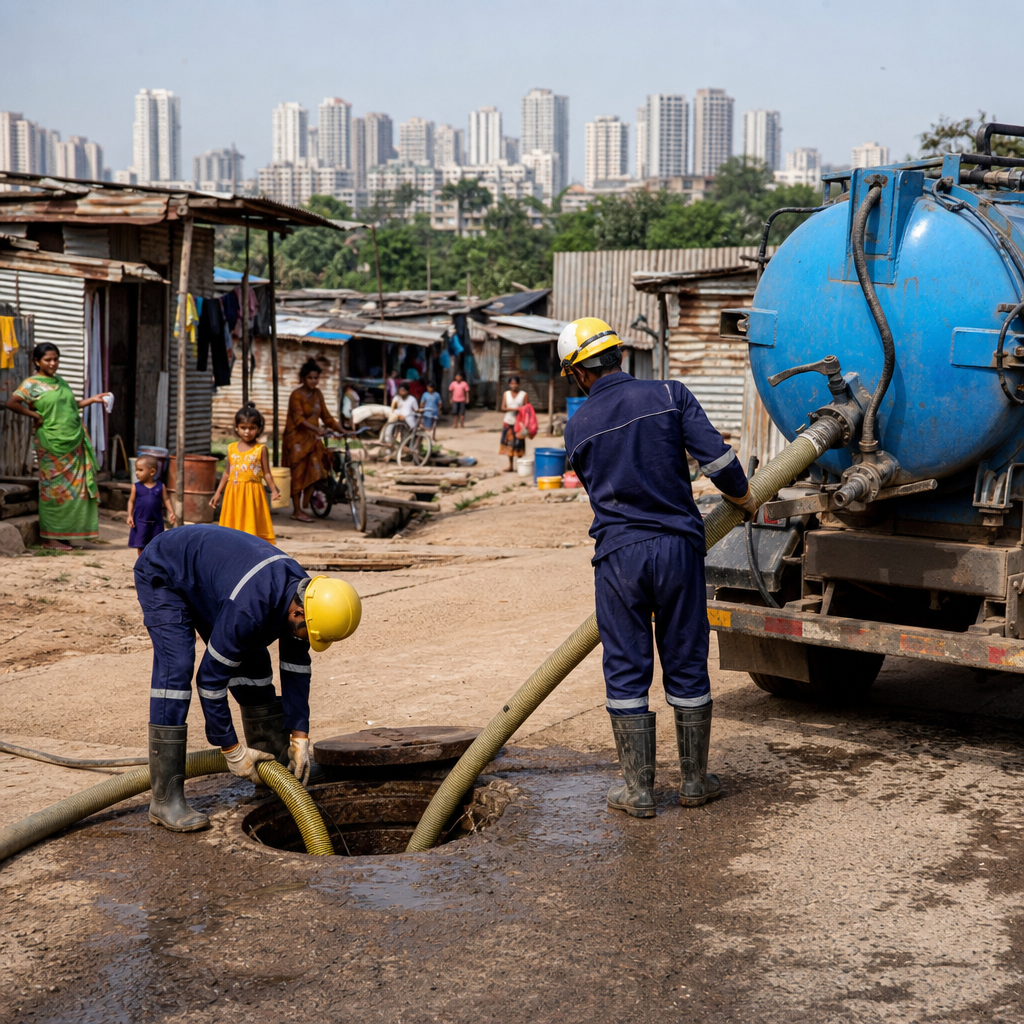
Real-world cases show why service delivery matters. In many fast-growing African and South Asian cities, septic tanks are common, yet much of the sludge is never treated. It is dumped into drains, rivers, or vacant land because treatment capacity, contracts, or route monitoring are weak. By contrast, cities that map containment systems, license emptiers, set discharge points, and digitize trip records tend to reduce uncontrolled dumping quickly. Sanitation therefore depends on institutions that can manage every handoff in the chain. The private sector is often best placed to run last-mile services, but it needs public rules, permits, and investment to operate safely and profitably.
Rural sanitation presents a different but equally important service challenge. Open defecation reduction campaigns can raise toilet adoption fast, yet slippage occurs when pits collapse, water is unavailable, or households cannot afford upgrades. The most successful rural programs combine behavior change, local supply chains, trained masons, targeted subsidies for vulnerable households, and post-construction monitoring. That approach recognizes sanitation as an ongoing household service supported by local markets and local government, not a one-time construction event.
How public and private roles complement each other
Public-private synergies work best when each party does what it is structurally suited to do. Governments establish sanitation policy, health regulations, land use rules, environmental discharge standards, and consumer protections. They finance public goods, such as trunk infrastructure, treatment plants, and subsidies for poor or remote populations. Municipalities and utilities coordinate service areas, contract providers, and enforce compliance. Private firms, social enterprises, and informal operators contribute market reach, technical specialization, customer service, logistics, and lower-cost delivery models. Nongovernmental organizations often bridge trust gaps, pilot new approaches, and support community engagement.
In my experience, confusion over roles is one of the fastest ways to undermine a sanitation program. If regulators also operate services, conflicts arise around enforcement. If private emptiers are expected to serve low-income areas without any viability support, they bypass difficult neighborhoods. If donor-funded hardware arrives without a municipal budget line for maintenance, assets deteriorate. Clear role allocation avoids those failures. It also makes performance measurable. A city can require licensed operators to meet response times, safe disposal rules, and customer complaint standards while the municipality tracks treatment volumes and environmental compliance.
Several partnership structures are common. Service contracts pay private operators to empty pits, clean public toilets, or manage treatment units against agreed standards. Management contracts bring in specialist firms to improve utility operations without transferring asset ownership. Concessions can assign broader responsibility for operation, billing, and maintenance, although they require strong regulation and political stability. Output-based aid links payments to verified results, such as functioning household toilets or treated sludge volumes. In informal settlements, microfranchising has helped local entrepreneurs deliver standardized toilet, maintenance, and handwashing services under a trusted brand.
| Model | Best use case | Main public role | Main private role | Key risk |
|---|---|---|---|---|
| Service contract | Pit emptying, public toilet management, treatment plant O&M | Set standards, monitor compliance, pay or regulate tariffs | Deliver specific services efficiently | Weak contract oversight |
| Management contract | Improving utility performance | Retain assets, define targets, enforce reporting | Strengthen operations and staffing systems | Limited incentives for capital upgrades |
| Concession | Large urban systems with stable regulation | Protect consumers, approve tariffs, manage long-term planning | Operate and maintain broad service area | Political backlash if tariffs rise too fast |
| Output-based aid | Reaching poor households with verified results | Fund subsidies, verify outputs independently | Pre-finance delivery and meet quality benchmarks | Cash flow pressure on smaller firms |
Financing sanitation at scale requires blended capital and targeted subsidies
One of the most common questions in global sanitation is who pays. The answer is usually a blend of taxes, tariffs, transfers, and household contributions. Public finance remains indispensable because sanitation generates major public health and environmental benefits that markets alone do not price adequately. At the same time, private capital and private operators can stretch scarce public funds when revenue models are realistic. The challenge is matching financing instruments to the type of service being funded.
Household toilets in middle-income or stable low-income markets can often be financed through savings, microloans, or supplier credit, especially when local sanitation businesses offer standard designs at transparent prices. The World Bank’s sanitation marketing work and programs inspired by community-led total sanitation have shown that demand can increase rapidly when products are affordable and aspirational. However, the poorest households, people with disabilities, renters, and those in flood-prone settlements usually need targeted support. Smart subsidies are specific, temporary, and verified. They reduce exclusion without distorting the wider market.
For fecal sludge treatment plants, sewer expansion, and wastewater facilities, governments and development banks typically provide capital expenditure because the public returns are high and payback is long. Private firms may then operate assets under performance contracts. Blended finance can be effective when grants absorb early risk, public funds support core infrastructure, and commercial investors finance scalable service businesses such as desludging fleets, container-based sanitation, or digital billing platforms. Results-based financing is especially useful in sanitation because it rewards verified service outcomes rather than construction alone.
Tariff design matters. If user fees are set below cost with no subsidy mechanism, service quality collapses. If tariffs rise without social protection, low-income households disconnect or revert to unsafe practices. Cities need transparent tariff policies, cross-subsidies where feasible, and direct support for vulnerable groups. Good sanitation finance is therefore not simply about raising money. It is about aligning incentives so that safe service remains affordable for users, viable for operators, and accountable to regulators.
Urban, peri-urban, and rural contexts need different partnership strategies
Sanitation solutions should be fitted to settlement patterns, land tenure, water availability, and institutional capacity. In dense urban neighborhoods, sewerage is often too slow or expensive to reach everyone quickly, especially in informal settlements with narrow lanes and uncertain tenure. In those settings, onsite and nonsewered solutions are usually the practical first step. Shared toilets, container-based sanitation, simplified sewers, transfer stations, and scheduled desludging can all outperform waiting years for a conventional network. The public role is to legalize service provision, define standards, and create safe disposal pathways. The private role is to innovate around collection, routing, payment, and customer support.
Peri-urban areas often fall through institutional gaps because they are neither fully rural nor fully urban. I have seen peri-urban settlements where households owned septic tanks but no licensed emptier served the zone, leaving illegal dumping as the default. These are ideal places for hybrid models: municipalities coordinate zoning and treatment access, while local operators receive route support, licensing, and possibly output-linked payments to serve low-income blocks. Geographic information systems and simple customer databases can dramatically improve service planning in such areas.
Rural sanitation still depends heavily on community processes and local government extension systems. But private supply chains are equally important. When rural households can easily buy slabs, pans, pipes, and emptying services nearby, toilet use is more likely to persist. Countries that train rural masons, certify products, and support village-level retailers generally see better durability than those that rely on one-off project construction. Schools and health centers also need dedicated operation budgets, cleaning protocols, and menstrual hygiene facilities, not just new buildings.
Technology, data, and regulation determine whether sanitation systems last
Technology choices in sanitation should follow context, not fashion. Conventional sewerage can be effective in dense, formally planned districts with reliable water and long-term utility capacity. Elsewhere, decentralized wastewater treatment, condominial sewers, improved septic systems, urine-diverting toilets, biodigesters, or container-based services may be better options. The International Organization for Standardization has helped legitimize nonsewered sanitation through standards that support safety and performance testing. What matters most is whether the chosen system can be maintained locally, financed over its lifecycle, and regulated consistently.
Data is the backbone of credible sanitation management. Utilities and municipalities need baseline maps, service coverage data, customer records, fecal sludge flow diagrams, and treatment performance indicators. Tools such as Shit Flow Diagrams, now widely used by the Sustainable Sanitation Alliance and city planners, make it easier to visualize where waste is safely managed and where it leaks into the environment. Digital tools can track desludging trips by GPS, log maintenance requests, and verify whether subsidies reached eligible households. Better data also strengthens contracting because payment can be linked to measurable outputs.
Regulation is what turns fragmented sanitation activity into a functioning public service. Standards should cover toilet design, worker safety, licensing, discharge quality, sludge handling, and environmental protection. Enforcement has to be realistic. If compliance costs are impossible for small operators, informality persists. A phased approach often works better: formalize operators, set minimum standards, provide access to disposal sites, then progressively tighten requirements as the market matures. Worker protections are nonnegotiable. Manual scavenging and unsafe emptying practices must be eliminated through mechanization, legal enforcement, and social protection measures.
Climate resilience is now central to sanitation planning. Floods can inundate pits and treatment plants, spreading pathogens widely. Drought can make flush systems unreliable. Heat can affect biological treatment performance. Public-private sanitation planning should therefore include flood-safe siting, backup power, robust drainage interfaces, water-efficient designs, and contingency arrangements for emergency desludging. The systems that endure are the ones designed for shock, not average conditions.
Global sanitation progress accelerates when partnerships are built around whole-service delivery, not isolated construction targets. The core lesson is straightforward: governments must lead on policy, equity, and regulation, while private actors expand reach, efficiency, and innovation within a clear public framework. Financing should blend public investment, realistic user contributions, and targeted subsidies for those who would otherwise be excluded. Urban, peri-urban, and rural areas need different models, but all require reliable operations, trusted data, and enforceable standards across the sanitation chain.
This matters because sanitation is one of the few development investments that improves health, education, gender equity, environmental quality, and economic productivity at the same time. A safe toilet is important, but a safe sanitation system is transformative. It protects groundwater, keeps children in school, reduces disease outbreaks, supports dignified care in clinics, and makes cities more livable. Where public agencies and private providers cooperate well, those benefits arrive faster and last longer.
As the hub for tackling sanitation challenges on a global scale, this page should guide your next step: assess the service chain in your target context, identify the public and private actors already shaping it, and focus reforms on the weakest link. Whether the issue is financing, fecal sludge treatment, rural supply chains, or urban regulation, durable progress comes from practical collaboration backed by evidence. Start with systems thinking, demand clear accountability, and build sanitation partnerships that can endure.
Frequently Asked Questions
1. What do public-private synergies mean in global sanitation efforts?
Public-private synergies in global sanitation refer to structured collaboration between governments, utilities, local authorities, private companies, social enterprises, financiers, NGOs, and community organizations to improve the full sanitation service chain. This includes not only providing toilets, but also ensuring safe containment, pit emptying, transport, treatment, and the final reuse or disposal of waste. The public sector typically sets policy, regulates quality, funds public goods, and protects equitable access, while private actors often contribute operational efficiency, technology, innovation, logistics, and investment. When these roles are aligned, sanitation systems become more scalable, responsive, and financially sustainable.
This matters because sanitation challenges are too large and too complex for any one sector to solve alone. Governments may have the mandate but limited implementation capacity. Private providers may be innovative and agile, but they need clear rules, viable business conditions, and oversight to serve communities responsibly. Strong partnerships can connect public priorities such as health, inclusion, and environmental protection with private strengths such as service delivery, product development, and performance management. In practical terms, these synergies can improve urban fecal sludge management, expand rural service options, strengthen menstrual health support, improve drainage planning, and promote behavior change programs that encourage long-term use of sanitation facilities.
2. Why is sanitation more than just building toilets?
Sanitation is often misunderstood as a construction issue, but toilets are only one visible part of a much larger system. A toilet that is poorly designed, never emptied, disconnected from treatment services, or inaccessible to women, children, older adults, or people with disabilities does not deliver safe sanitation. Real sanitation means safely managing human waste from the point of use through containment, collection, transport, treatment, and either safe disposal or beneficial reuse. If any part of that chain fails, communities remain exposed to disease, environmental contamination, and dignity-related harms.
Effective sanitation also depends on hygiene behaviors, menstrual health support, drainage, wastewater or fecal sludge management, and functioning institutions. For example, schools may have toilets, but if they lack water, privacy, menstrual supplies, and maintenance budgets, attendance and health outcomes may still suffer. In dense urban areas, the key challenge may be not toilet construction but affordable pit emptying, licensed transport, and treatment capacity. In flood-prone communities, drainage and climate resilience become essential parts of sanitation planning. Public-private synergies are especially valuable here because they help connect infrastructure with operations, financing, behavior change, technology, and long-term maintenance rather than treating sanitation as a one-time building project.
3. What roles do governments and private companies each play in successful sanitation partnerships?
Governments play the foundational role in creating an enabling environment for sanitation. They establish national strategies, local service standards, licensing rules, tariffs, environmental safeguards, and public health requirements. They also identify underserved populations, coordinate land use and urban planning, invest in treatment facilities and public infrastructure, and design subsidies or blended finance models that make services affordable for low-income households. Just as importantly, public institutions are responsible for accountability. They monitor providers, enforce safety standards, and ensure sanitation services are inclusive rather than concentrated only in profitable markets.
Private companies and other non-state providers bring different but complementary strengths. They may manufacture toilets and handwashing products, run desludging fleets, digitize customer scheduling, operate treatment plants, support waste-to-resource models, or design service packages tailored to informal settlements and rural communities. Social enterprises can often reach overlooked users with flexible business models, while larger firms may contribute capital, engineering expertise, and supply-chain reliability. The most effective partnerships clearly define who does what, how performance is measured, how risks are shared, and how public goals such as safety, affordability, and gender equity will be protected. In other words, success comes not from privatizing sanitation, but from aligning public leadership with private capability in a transparent, well-regulated system.
4. How do public-private sanitation partnerships improve health, equity, and long-term sustainability?
Well-designed sanitation partnerships can generate major health gains by reducing human contact with untreated waste. This lowers the spread of diarrheal disease, parasitic infections, and other sanitation-related illnesses, while also protecting water sources and surrounding ecosystems. When private operators are integrated into regulated public systems, waste is more likely to be collected on time, transported safely, and treated properly rather than dumped into drains, rivers, or open land. Better sanitation also supports broader development goals, including improved school attendance, stronger workforce participation, safer neighborhoods, and lower health system burdens.
Equity improves when partnerships are intentionally designed to reach people who are usually left behind. That includes low-income households, residents of informal settlements, remote rural communities, women and girls needing menstrual health support, and people living with disabilities. Public financing and regulation can make sure services remain affordable and inclusive, while private and nonprofit partners can develop practical delivery models that work in difficult settings. Sustainability improves when sanitation is approached as an ongoing service rather than a one-off asset. Revenue models, maintenance contracts, digital monitoring, local entrepreneurship, and treatment-and-reuse systems can help keep services functioning over time. The result is a sanitation ecosystem that is operationally stronger, socially fairer, and more resilient to population growth, climate stress, and urban expansion.
5. What are the biggest challenges in building effective public-private synergies for sanitation worldwide?
One of the biggest challenges is misalignment of incentives. Public authorities are expected to prioritize universal access, health protection, and environmental compliance, while private firms need financially viable operations. If tariffs are too low, contracts are vague, or regulation is weak, providers may cut corners or avoid serving low-income areas. Another major challenge is institutional fragmentation. Responsibility for sanitation is often split across multiple ministries, utilities, municipalities, and regulators, which can create confusion over ownership, budgeting, and service standards. In many countries, data on the sanitation service chain is also incomplete, making it harder to plan investments or evaluate what is working.
Additional barriers include limited treatment infrastructure, weak enforcement, informal service markets, social stigma around waste work, and underinvestment in maintenance and behavior change. Climate-related flooding, rapid urbanization, and growing settlements without formal planning make these gaps even more difficult to manage. Overcoming these problems requires clear governance, realistic financing, transparent contracting, and strong local capacity. It also requires recognizing sanitation workers, community voices, and small-scale service providers as essential parts of the system. The most durable public-private synergies are built on trust, accountability, and a shared understanding that sanitation is a public health necessity, an environmental priority, and a long-term service that depends on continuous coordination across sectors.