Rainwater harvesting is moving from a niche sustainability practice to a practical financial strategy in sanitation, especially where water tariffs are rising, sewer infrastructure is strained, and decentralized systems are gaining policy support. In sanitation, rainwater harvesting means collecting precipitation from roofs or other surfaces, filtering or storing it, and using it for toilet flushing, cleaning, handwashing support, sludge handling, or treatment processes that do not require potable supply. Economic viability refers to whether the system saves or generates enough value over time to justify its capital, operating, maintenance, and replacement costs. For EcoSan programs, this question matters because sanitation systems often fail not from weak engineering, but from weak financing, poor cost recovery, and underpriced water assumptions.
I have worked on sanitation budgets where the decision was not whether rainwater harvesting was technically possible, but whether it would reduce lifecycle costs compared with expanding piped supply, trucking water, or oversizing treatment units. That is the right lens. A rainwater harvesting system tied to sanitation is not simply a tank on a roof. It is an economic asset whose value depends on rainfall patterns, storage sizing, building use, local water prices, demand timing, treatment requirements, maintenance discipline, and financing structure. In schools, markets, transport hubs, apartment blocks, and public toilets, the economics can be strong because flushing and washdown demand is predictable and water quality requirements are lower than for drinking. In low-density homes with cheap municipal water, payback can be slower.
As the hub page for economic strategies in EcoSan, this article explains how to assess rainwater harvesting in sanitation using the same standards applied to other infrastructure investments: capital expenditure, operating expenditure, avoided utility costs, resilience value, public health externalities, and long-term asset performance. It also connects rainwater harvesting to wider EcoSan economics, including nutrient recovery, source separation, decentralized treatment, fecal sludge management, and blended finance. The central point is clear: rainwater harvesting becomes economically viable when it is designed around sanitation demand, not added as a symbolic green feature after the main system is already fixed.
Why Rainwater Harvesting Changes Sanitation Economics
Sanitation depends on water more than many budgets initially show. Conventional flush toilets use roughly 3 to 9 liters per flush depending on fixture type, while older institutional systems may use more. Cleaning toilet blocks, washing urinals, managing odors, and supporting treatment operations all add demand. When water tariffs increase, these recurring costs compound across years. In one portfolio review I conducted for public facilities, toilet flushing alone represented one of the largest controllable water uses after landscape irrigation. Substituting harvested rainwater for nonpotable sanitation demand directly reduces purchased water volume and, in some jurisdictions, wastewater charges linked to metered supply.
The economic effect is strongest where three conditions align. First, roof catchment area is large relative to toilet demand, as in schools, warehouses, factories, shopping centers, and bus terminals. Second, rainfall is seasonal but sufficient on an annual basis, allowing stored water to offset a significant share of utility purchases. Third, local tariffs or supply insecurity make alternative water expensive. Where tanker water is common, the avoided cost per cubic meter can be many times higher than municipal rates, radically improving project returns. Even when annual savings alone produce a moderate payback, resilience during outages can justify the investment because sanitation service interruption carries reputational, health, and compliance costs.
EcoSan planning expands this analysis. A decentralized sanitation strategy may already include urine diversion, composting, anaerobic digestion, or onsite wastewater treatment. In those systems, rainwater harvesting can reduce the need for imported freshwater in cleaning and process support, and it can improve site autonomy. However, more water is not always better. Source-separating systems often work best when dilution is minimized. The financially sound approach is to match harvested rainwater to uses that benefit from substitution, while protecting process efficiency in units that rely on concentrated waste streams.
Core Cost Components and Revenue Logic
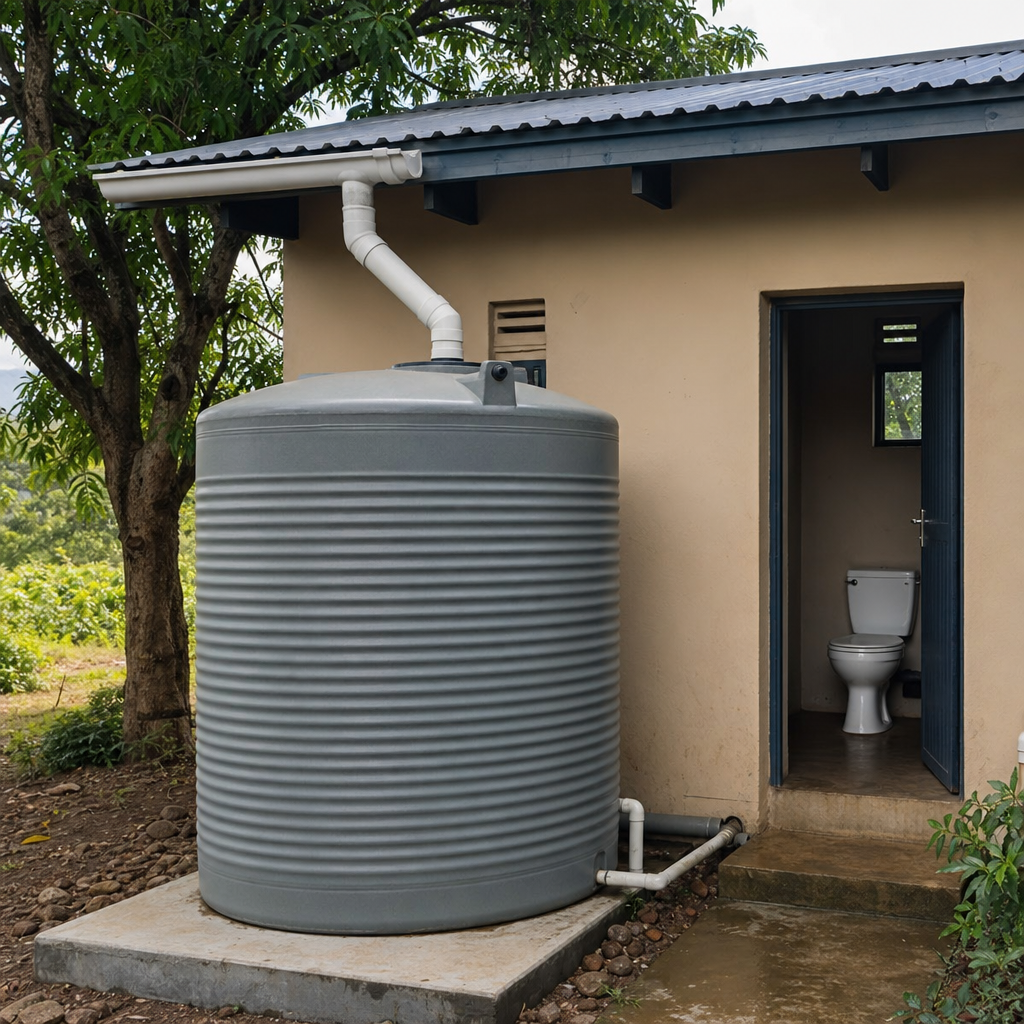
A proper business case starts with capital expenditure. Typical line items include gutters, downpipes, leaf screens, first-flush diverters, storage tanks, pumps, level controls, filtration, disinfection where required, nonpotable plumbing, backflow prevention, civil works, and monitoring equipment. Large commercial tanks may be polyethylene, fiberglass, steel, or reinforced concrete, each with different installed costs and service lives. Underground tanks save space but usually increase construction expense. Retrofitting occupied buildings often costs more than integrating rainwater systems during new construction because dual plumbing and structural coordination are harder after the fact.
Operating expenditure is usually modest but must not be ignored. Pumps consume electricity. Filters need cleaning or replacement. Tanks require periodic inspection for sediment, mosquito control, and biofilm management. Sensors fail. Valves stick. In public buildings, neglected maintenance can erase projected savings within a few seasons. I have seen systems with excellent hydrology and poor economics simply because no one owned routine upkeep. For this reason, realistic budgets should include annual preventive maintenance, minor repairs, and a reserve for component replacement, especially pumps and controls.
Financial benefits extend beyond lower water bills. Where sewer charges are based on incoming potable supply, substituting harvested rainwater can reduce both water and wastewater costs. Some sites also avoid stormwater fees or meet retention requirements that would otherwise require separate detention infrastructure. In industrial settings, rainwater harvesting may support environmental compliance targets and reduce business interruption risk from water restrictions. Public institutions can add educational value, but that benefit should remain secondary in a financial model unless it links to measurable funding or enrollment outcomes.
| Economic factor | How it affects viability | Typical high-value setting |
|---|---|---|
| Water tariff level | Higher avoided purchase cost shortens payback | Cities with rising block tariffs |
| Catchment-to-demand ratio | Large roofs serving steady toilet demand improve utilization | Schools and commercial buildings |
| Storage sizing | Oversized tanks raise capex without proportional savings | Monsoon or seasonal rainfall zones |
| Dual plumbing complexity | Retrofits can increase installation cost sharply | Older apartment and office blocks |
| Supply reliability | Outage resilience adds indirect economic value | Facilities using tanker backup |
| Maintenance capacity | Strong upkeep protects yield and lowers lifecycle risk | Managed campuses and hospitals |
How to Evaluate Payback, Lifecycle Cost, and Risk
The most useful first metric is annual potable water offset. Estimate roof area, runoff coefficient, local rainfall, first-flush losses, filter losses, and storage behavior, then compare available supply with monthly sanitation demand. A simple annual total can be misleading because demand occurs every day while rainfall is uneven. Monthly or daily water-balance modeling is better. Tools range from spreadsheet simulations to specialized water software, and serious projects should test dry-year scenarios rather than assuming average rainfall.
Once expected yield is clear, calculate avoided cost per cubic meter. Include volumetric water tariff, wastewater charges where relevant, tanker replacement cost if applicable, and any stormwater fee reduction. Then compare these annual savings with lifecycle cost using net present value, internal rate of return, and discounted payback. For public projects, I prefer net present value because it handles long asset lives and replacement cycles more transparently than simple payback. A steel or concrete tank may last decades, while pumps may need replacement in 7 to 15 years. Ignoring replacement timing can make a weak project appear stronger than it is.
Risk analysis matters because the economics are sensitive to assumptions. Rainfall variability, occupancy changes, tariff reforms, and maintenance lapses can all shift returns. The most common modeling error I encounter is oversized storage. Teams often assume that a larger tank must improve economics, but beyond a certain point each extra cubic meter captures relatively little additional usable water. The result is diminishing marginal savings and higher capital cost. Optimization should find the tank size that maximizes financial return, not water autonomy alone. In many buildings, the best-performing design captures a substantial but not total share of flush demand.
Best-Case Applications Across EcoSan Systems
The strongest economics usually appear in institutional and semi-public sanitation assets. Schools are a classic example because they combine large roof areas with concentrated daytime toilet demand. If the school already struggles with intermittent supply, harvested rainwater can stabilize sanitation service and reduce absenteeism linked to unusable toilets. Transport hubs and markets also perform well because washdown demand is significant and reputational costs of dirty facilities are high. For apartment complexes, results depend on roof area per resident; low-rise compounds may outperform high-rise towers because catchment scales differently from occupancy.
In EcoSan systems, rainwater harvesting fits particularly well where sanitation is decentralized and local resource management is intentional. Consider a peri-urban toilet block with urine diversion, onsite blackwater treatment, and composting of organic fractions. Harvested rainwater can supply handwashing top-up, surface cleaning, and limited flushing where needed, reducing purchases from a weak utility. By contrast, for dry toilets designed to preserve nutrient concentration and minimize leachate, using harvested water for flushing would be counterproductive. The financially sound EcoSan strategy is therefore selective substitution, not blanket use.
Fecal sludge management offers another angle. Transfer stations, desludging depots, and treatment sites often need water for equipment cleaning, odor management, and operational housekeeping. These are nonpotable uses with clear recurring costs. Where such sites have extensive roofed structures, harvesting can reduce operating expense without compromising process safety. In my experience, these applications are often easier to justify than household systems because the demand is operationally necessary, budget lines are visible, and facility managers can maintain the equipment.
Financing Models, Policy Support, and Economic Barriers
Even financially sound projects can stall if upfront capital is the main hurdle. New construction offers the cheapest path because rainwater harvesting can be integrated into plumbing and structural design. For retrofits, financing options matter: municipal green bonds, climate adaptation grants, concessional loans, utility rebates, development finance, and performance contracts tied to water savings can all improve feasibility. In commercial real estate, the decision may depend on capex approval rules rather than pure economics. A project with a seven-year discounted payback can still be rejected if the owner requires three years.
Policy can materially change returns. Building codes that permit nonpotable reuse, stormwater retention mandates, floor-area bonuses for water-sensitive design, or tariff structures that reward reduced potable demand all strengthen the case. Conversely, unclear regulations on cross-connection, testing, and labeling can raise compliance costs and delay implementation. Standards from organizations such as the World Health Organization, national plumbing codes, and local public health agencies matter because sanitation-linked rainwater systems must be safe, auditable, and clearly separated from potable lines.
The main barriers are predictable. Cheap subsidized water weakens direct savings. Poor maintenance culture threatens reliability. In dense settlements, roof area may be too small relative to user numbers. Financing can be fragmented across departments, with sanitation savings accruing to one budget and capital costs to another. That split incentive is common in municipalities. The practical solution is to treat rainwater harvesting as part of integrated water and sanitation asset management, with one business case covering avoided water purchases, avoided service disruption, and compliance value.
Building a Strong Economic Strategy in EcoSan
As a hub within economic strategies in EcoSan, rainwater harvesting should be assessed alongside source separation, nutrient recovery, biogas generation, compost sales, sludge transport optimization, and decentralized treatment scaling. The right question is not whether rainwater harvesting beats every other intervention in isolation. The right question is how it improves whole-system economics. For example, reducing potable water demand in sanitation can free municipal supply for higher-value uses, lower utility costs in community toilet blocks, and make decentralized facilities more resilient during drought restrictions. Those system benefits often matter as much as direct bill savings.
A robust strategy starts with data. Measure current sanitation water use by fixture, occupancy, and season. Verify roof area and rainfall records from at least ten years if available. Model alternatives: no intervention, efficiency upgrades only, rainwater harvesting only, and combined efficiency plus harvesting. In many cases, low-flush fixtures and leak control should come first because they reduce the storage volume needed. Then test financing structures and assign maintenance responsibility before procurement. The projects that succeed are rarely the most elaborate; they are the ones with clear ownership, realistic assumptions, and designs matched to actual sanitation demand.
The economic viability of rainwater harvesting in sanitation is therefore neither automatic nor marginal. It is highly viable in the right settings, especially institutions, managed facilities, and decentralized EcoSan systems with significant nonpotable demand and expensive or unreliable water supply. It is weaker where tariffs are low, catchment is limited, or maintenance is neglected. Decision-makers should use lifecycle costing, realistic water-balance modeling, and risk analysis rather than simple payback alone. If you are building an EcoSan investment roadmap, start by identifying sanitation uses that do not require potable water, size systems to those demands, and compare them against efficiency and reuse options across the full asset life.
Frequently Asked Questions
1. Why is rainwater harvesting becoming economically attractive for sanitation systems?
Rainwater harvesting is becoming more financially attractive in sanitation because it directly reduces dependence on increasingly expensive mains water for uses that do not require drinking-quality supply. In many sanitation settings, large volumes of water are needed for toilet flushing, washdown, facility cleaning, handwashing support, sludge management, and certain treatment processes. When that demand is met with harvested rainwater instead of utility water, operators can lower recurring water bills, reduce exposure to tariff increases, and improve budget predictability over time.
The economics also improve when local sewer and stormwater systems are under pressure. By capturing roof runoff and using it onsite, facilities can reduce peak discharge volumes, which may lower drainage fees in some jurisdictions or help avoid site upgrades linked to stormwater management compliance. This is particularly relevant for schools, public toilet blocks, transport hubs, commercial buildings, health facilities, and decentralized sanitation systems, where water use is steady and roof catchment is often available.
Another reason for growing viability is policy support. Many municipalities and regulators now encourage decentralized water reuse and climate-resilient infrastructure through rebates, permitting pathways, green building credits, or development incentives. When these mechanisms are available, they can materially shorten payback periods. Combined with falling costs for modular tanks, filters, pumps, and controls, rainwater harvesting is no longer viewed only as an environmental add-on. In the right sanitation application, it can function as a practical cost-control strategy with resilience benefits layered on top.
2. Which sanitation uses offer the strongest financial return from harvested rainwater?
The best financial returns usually come from non-potable sanitation uses that have regular demand and can consume meaningful volumes throughout the year. Toilet and urinal flushing are often the clearest examples because they create predictable, daily water use in offices, apartment buildings, schools, factories, and public facilities. When a building has high occupancy and a sizeable roof area, harvested rainwater can offset a substantial share of purchased water, making the business case easier to justify.
Cleaning and washdown applications are also strong candidates, especially in markets, depots, industrial sites, public sanitation complexes, and institutions that must regularly maintain floors, bins, holding areas, and process equipment. In some systems, harvested rainwater can support handwashing where regulations permit appropriate treatment and risk controls, although this depends heavily on local standards and intended use. Sludge handling and selected treatment-process needs can also benefit, particularly in decentralized or semi-centralized sanitation systems where operators want to reduce use of treated potable water for operational tasks.
From an economic standpoint, the most attractive uses share several characteristics: they do not require potable-grade water, they occur frequently enough to absorb stored rainwater, and they align with simple treatment requirements such as screening, sediment control, and basic filtration. The stronger the match between rainfall supply, storage capacity, and year-round sanitation demand, the better the return on investment tends to be. In contrast, low-volume or highly seasonal uses may still provide environmental value, but they often deliver a weaker purely financial outcome.
3. What costs and savings should be included when evaluating the economic viability of rainwater harvesting in sanitation?
A sound financial assessment should look beyond the initial tank purchase and include the full lifecycle of the system. Upfront capital costs typically include catchment adaptation, gutters and downpipes if upgrades are needed, first-flush diversion, filtration, storage tanks, pumps, pipework, controls, backflow protection, installation labor, and integration with the sanitation system. If the project involves retrofitting an existing building, design complexity and plumbing modifications can be significant cost drivers. For new construction, these costs are often lower relative to the project budget because the system can be designed in from the beginning.
Operating and maintenance costs are equally important. These may include pump electricity, filter replacement, periodic tank cleaning, inspection of valves and controls, water quality monitoring where required, and occasional repairs. While these costs are usually modest compared with the value of displaced utility water, they need to be captured accurately to avoid overstating savings. Facilities with poor maintenance practices may see reduced system performance, which weakens the financial case.
On the savings side, analysts should include avoided mains water purchases, reduced exposure to future tariff increases, and any lower stormwater or drainage charges where applicable. In some areas, projects may also qualify for grants, tax incentives, development bonuses, or green finance terms. Less direct but still meaningful financial benefits can include reduced operational disruption during water shortages, improved continuity for sanitation services, lower reputational risk for large institutions, and better compliance with resilience or sustainability mandates. The most credible evaluation combines all of these elements in a lifecycle cost analysis rather than relying on simple upfront-versus-bill-savings comparisons alone.
4. How long does it usually take for a rainwater harvesting system in sanitation to pay for itself?
Payback periods vary widely, but they are most favorable where three conditions come together: high non-potable water demand, reliable rainfall or adequate seasonal capture, and high or rising utility water prices. In sanitation applications such as toilet flushing in large buildings or public facilities, payback can be relatively attractive because the substituted water use is both frequent and measurable. New-build projects often achieve better economics than retrofits because storage, plumbing, and controls can be integrated efficiently from the start, reducing installation costs.
That said, there is no universal payback number that applies everywhere. A system in a dense urban area with expensive water tariffs, drainage charges, and supportive local incentives may recover its costs much faster than a similar installation in a location with cheap water and limited rainfall. Tank sizing is also critical. Oversized storage can tie up capital without adding proportional savings, while undersized storage may leave too much rainwater uncaptured. The most economically successful projects usually rely on careful matching of roof area, rainfall profile, demand pattern, and storage volume.
Decision-makers should also remember that payback is only one metric. Net present value, internal rate of return, and lifecycle savings often provide a better picture, especially when water tariff escalation and resilience value are taken seriously. In sanitation, the ability to maintain flushing and cleaning functions during supply disruptions can have operational and public health importance that is not fully reflected in a narrow payback calculation. So while many stakeholders ask how quickly the system pays for itself, the better question is whether the project delivers durable financial and service value over its full operating life.
5. What factors can make or break the business case for rainwater harvesting in sanitation?
Several factors strongly influence whether a rainwater harvesting project is economically successful. The first is the relationship between catchment and demand. A large roof connected to a facility with steady sanitation water use creates a strong foundation for viability. The second is local rainfall distribution. Annual rainfall matters, but seasonal patterns matter just as much. A site with moderate rainfall spread across the year may perform better financially than a site with high total rainfall concentrated in short periods that require costly storage to capture effectively.
Water pricing is another decisive variable. Where utilities charge high volumetric rates, escalating tariffs, or sewer and stormwater fees, the value of every cubic meter of harvested rainwater increases. Regulatory conditions also matter. Clear standards for non-potable use, practical permitting, and supportive policies reduce project risk and help owners invest with confidence. Conversely, unclear rules or excessive approval burdens can slow implementation and increase soft costs.
System design and maintenance quality can either strengthen or undermine the economics. Well-designed systems use appropriate filtration, avoid unnecessary complexity, include reliable backup supply arrangements, and size storage based on realistic water balance calculations. Poorly designed systems may suffer from underuse, water quality issues, pump failures, or excessive maintenance, all of which reduce savings. Finally, project timing is crucial. Installing rainwater harvesting during new construction or major renovation is often far more cost-effective than retrofitting later. In short, the best business cases are built on accurate demand analysis, sensible engineering, realistic cost assumptions, and a clear understanding of local policy and water-market conditions.