Sanitation shapes health, dignity, education, and economic development, yet it is still one of the most unevenly distributed public services in the world. When people lack safe toilets, fecal sludge management, handwashing facilities, drainage, and hygiene services in homes, schools, and clinics, diseases spread quickly and communities lose time, income, and opportunity. The World Health Organization’s initiatives in sanitation matter because they convert a broad public health goal into practical guidance, measurable targets, and country-level action that reduces illness and saves lives. I have worked on health content and policy analysis long enough to see a consistent pattern: sanitation is often discussed as infrastructure, but WHO treats it correctly as a preventive health system.
In public health terms, sanitation means the safe management of human excreta across the entire service chain, from containment and emptying to transport, treatment, and reuse or disposal. It also intersects with hygiene, water quality, infection prevention, wastewater surveillance, and environmental health regulation. WHO does not build every toilet or sewer itself. Instead, it sets norms, develops technical guidance, supports ministries of health, tracks progress with partner agencies, and integrates sanitation into larger agendas such as universal health coverage, child survival, nutrition, climate resilience, and emergency response. That role is essential because poor sanitation contributes to diarrhoeal disease, cholera, typhoid, intestinal worm infections, stunting, and broader exposure to pathogens that undermine immune and nutritional status.
The scale of the issue explains why this topic sits at the center of global challenges and opportunities. According to the WHO and UNICEF Joint Monitoring Programme, billions of people still lack safely managed sanitation services, and hundreds of millions continue to practice open defecation. The burden falls hardest on low-income households, rural communities, informal settlements, displaced populations, women and girls, people with disabilities, and patients in under-resourced health facilities. A sanitation gap is never just a toilet gap. It affects school attendance, maternal care, workforce participation, tourism, environmental quality, and public confidence in institutions. For countries trying to meet Sustainable Development Goal 6, sanitation is both a moral imperative and a high-return investment.
This hub article explains how WHO approaches sanitation on a global scale, where its main initiatives are focused, and what lessons emerge for governments, organizations, and communities. It covers standards, monitoring, health care facilities, disease prevention, climate and urban pressures, financing, and implementation barriers. It is designed to answer the core questions readers usually have: what WHO actually does, which sanitation interventions have the biggest health impact, how progress is measured, and why coordination across sectors matters. Understanding these initiatives helps decision-makers move from broad commitments to interventions that are technically sound, equitable, and durable.
How WHO defines sanitation as a public health priority
WHO frames sanitation as a front-line health intervention, not a secondary municipal service. That distinction matters. When ministries classify sanitation only as an engineering issue, they often underinvest in behavior change, regulation, surveillance, and service quality. WHO’s guidance consistently links sanitation to disease prevention, child health, safer childbirth, antimicrobial resistance risk reduction, and stronger health systems. In practice, that means sanitation planning must account for exposure pathways, pathogen control, and vulnerable settings such as hospitals, refugee camps, flood-prone neighborhoods, and schools.
One of WHO’s most influential contributions is its use of health-based standards and risk management. Rather than assuming one technology fits every context, WHO supports a service approach: pit latrines, septic systems, simplified sewers, conventional sewers, container-based sanitation, and fecal sludge treatment can all play a role if they safely interrupt transmission. I have seen this point misunderstood repeatedly in sanitation debates. The core question is not whether a system looks modern. The core question is whether waste is safely contained and kept out of water, food, hands, and living environments. That public health lens helps countries avoid costly infrastructure that fails in operation.
WHO also pushes sanitation higher on national agendas by tying it to measurable health outcomes. Diarrhoeal disease remains a major killer, especially among young children, and inadequate water, sanitation, and hygiene are a significant contributing factor. In health policy discussions, this evidence is powerful because it justifies sanitation spending as prevention, which is usually far cheaper than treating recurring outbreaks or managing chronic undernutrition linked to repeated infection. The organization’s work gives ministries a basis for budget requests, regulatory reform, and interagency planning.
Global monitoring and the push for safely managed sanitation
A major WHO initiative in sanitation is global monitoring through the WHO-UNICEF Joint Monitoring Programme, commonly called the JMP. The JMP is the standard reference for tracking household water, sanitation, and hygiene services under Sustainable Development Goal 6. Its importance is hard to overstate. Before comparable monitoring frameworks existed, countries often reported sanitation coverage in inconsistent ways, usually counting infrastructure presence rather than whether services were safe, available, and used. The JMP changed the conversation by defining service ladders and distinguishing basic access from safely managed sanitation.
Safely managed sanitation means improved facilities that are not shared with other households and where excreta are safely disposed of in situ or transported and treated off-site. That definition forces governments and funders to confront the full chain. A toilet alone is not enough if pits overflow into drains or sludge is dumped untreated near homes or rivers. This standard has practical consequences for planning. Cities now need data on emptying services, treatment capacity, and regulation of private operators, not only counts of household latrines.
| WHO sanitation focus area | Main purpose | Example of impact |
|---|---|---|
| JMP monitoring | Track access and service quality globally | Helps governments identify gaps beyond toilet coverage |
| WASH in health care facilities | Protect patients and staff from infection | Improves safe childbirth and infection prevention |
| Sanitation safety planning | Manage risks across the service chain | Reduces unsafe sludge handling and environmental contamination |
| Guidelines and norms | Set evidence-based standards | Supports regulation, procurement, and national policy design |
| Outbreak and emergency support | Control cholera and other sanitation-linked threats | Speeds targeted action in camps and crisis settings |
The monitoring agenda also creates accountability. When national data show stagnation among rural populations, informal settlements, or schools, policymakers cannot hide behind national averages. I have found this disaggregation especially useful because sanitation inequality is often masked by urban progress. A capital city may expand sewer networks while peri-urban settlements remain dependent on unsafe pits and illegal discharge. WHO-backed monitoring gives advocates and officials a shared evidence base for targeting resources where they are most needed.
WHO guidelines, standards, and sanitation safety planning
WHO’s sanitation initiatives are grounded in guidance that ministries, utilities, regulators, and development banks can actually use. Two areas are particularly important: normative guidelines and sanitation safety planning. The guidelines establish health-protective benchmarks, while sanitation safety planning provides a practical framework for identifying hazards, assessing exposure, prioritizing control measures, and verifying that the system is working. In my experience, this approach is one of WHO’s strongest contributions because it closes the gap between high-level policy and operational decision-making.
Sanitation safety planning mirrors other risk-based public health methods. A team maps the sanitation system, from user interface to final disposal or reuse, identifies where people may be exposed to pathogens or chemicals, evaluates existing controls, and sets improvement actions. For example, in a dense city neighborhood with on-site containment, the most urgent risk may not be the toilet itself but manual emptying without protective equipment, followed by illegal dumping into drains used by children. A safety plan turns that diffuse problem into specific actions: licensing emptiers, enforcing discharge points, upgrading treatment, and educating households on maintenance and payment.
WHO’s standards also matter for wastewater and reuse. As water scarcity pushes more communities toward wastewater use in agriculture or resource recovery, health safeguards become nonnegotiable. WHO has long provided guidance on safe wastewater use, balancing public health protection with the reality that informal reuse already happens in many regions. That balance is a hallmark of good sanitation policy: insisting on risk reduction without pretending that all contexts can jump immediately to expensive centralized systems. Effective guidance acknowledges tradeoffs and creates a path to safer practice.
Sanitation in health care facilities, schools, and vulnerable settings
Some of WHO’s most urgent sanitation work focuses on institutions where poor services directly amplify health risks. Health care facilities are the clearest example. A clinic without safe toilets, reliable water, hand hygiene stations, waste management, and environmental cleaning cannot deliver safe care. WHO has repeatedly emphasized water, sanitation, and hygiene in health care facilities because infection prevention depends on these basics. During childbirth, surgery, vaccination campaigns, and outbreak response, sanitation failures can put patients and staff in danger within hours, not years.
The consequences are concrete. In maternity wards, inadequate toilets and hygiene facilities increase infection risks for mothers and newborns and undermine respectful care. In isolation areas or cholera treatment centers, sanitation failures can spread pathogens inside the facility. WHO’s guidance helps countries assess service levels, prioritize upgrades, train staff, and integrate WASH indicators into health system performance. This is one of the most overlooked sanitation opportunities globally because targeted improvements in clinics can yield fast gains in safety, trust, and service utilization.
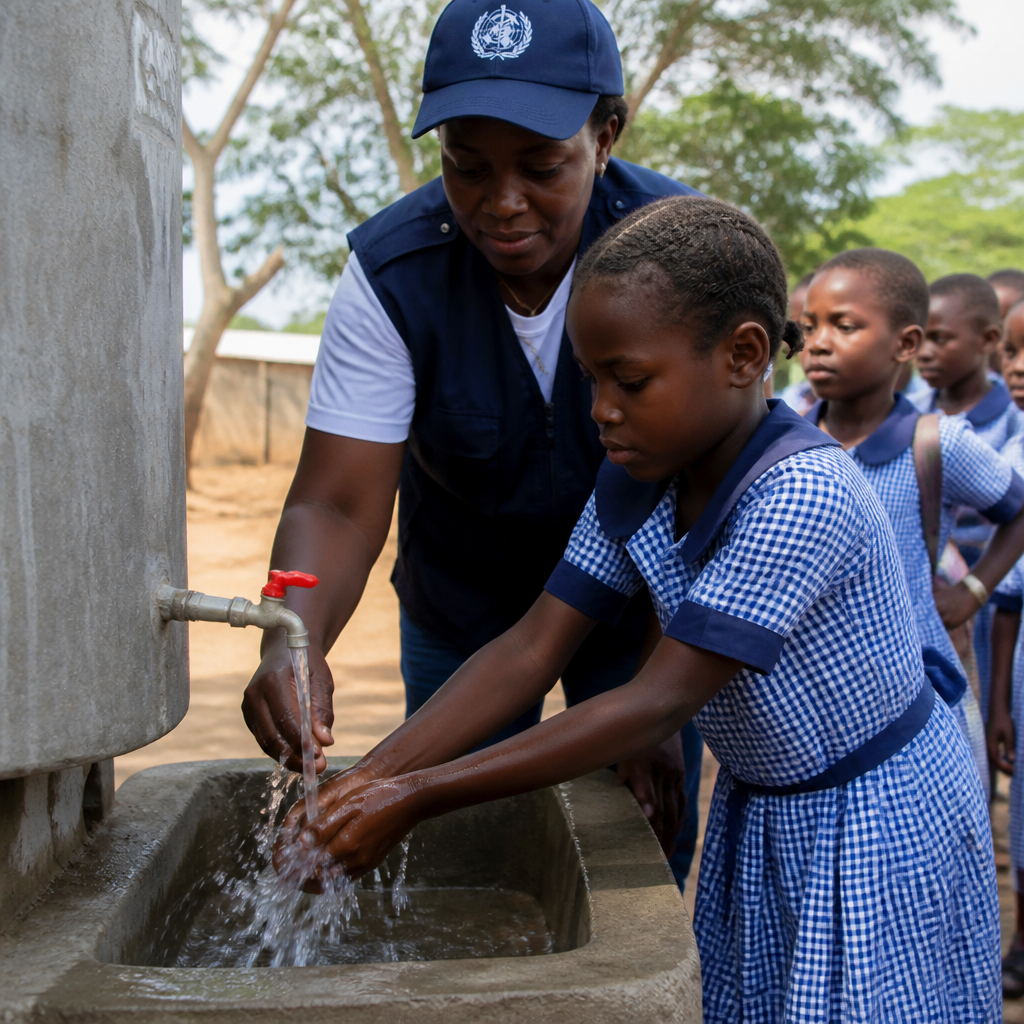
Schools are another priority. When toilets are unsafe, inaccessible, or not separated by sex, attendance suffers, especially for girls during menstruation. WHO’s broader sanitation and hygiene work supports school environments where children can learn without repeated exposure to disease or humiliation. Accessibility also matters. Toilets designed without ramps, handrails, privacy, or adequate space exclude people with disabilities and older adults. A sanitation initiative that ignores inclusion is not a successful initiative; it simply shifts the burden onto those already underserved.
WHO is also active in fragile and emergency settings, where sanitation must be delivered rapidly under difficult conditions. In refugee camps, conflict zones, flood responses, and cholera hotspots, sanitation is a life-saving intervention. Here the organization’s value lies in technical guidance, coordination with health and humanitarian partners, and disease control strategies that connect sanitation to surveillance, case management, and risk communication. Temporary solutions may be necessary, but WHO consistently pushes for systems that remain safe under heavy use and environmental stress.
From policy to implementation: financing, urbanization, and climate pressure
The hardest sanitation problems are rarely technical alone. They are institutional and financial. WHO’s sanitation initiatives increasingly intersect with governance questions: who regulates service providers, who pays for treatment capacity, how rural services are maintained, and how cities manage fecal sludge when sewer expansion lags behind population growth. Rapid urbanization has made these questions unavoidable. In many cities, most residents rely on on-site sanitation, yet public investment still favors sewer projects that reach a minority of households. WHO’s service-chain perspective helps correct that mismatch.
Financing remains a major barrier. Household toilets may be privately funded, but safe emptying, transport, treatment, monitoring, and enforcement often require public systems or blended finance. I have seen sanitation plans fail because they treated containment as a one-time capital expense instead of an ongoing service. WHO’s emphasis on safely managed sanitation supports a more realistic model: capital investment, operations and maintenance, tariff design, targeted subsidies for low-income users, and regulation of formal and informal operators. Without that full package, infrastructure deteriorates or contamination simply moves out of sight.
Climate change adds another layer. Flooding can inundate pits and septic tanks, spreading fecal contamination through neighborhoods and water sources. Drought can increase reliance on wastewater reuse and strain water-dependent sanitation technologies. Coastal intrusion affects groundwater and containment performance. WHO’s sanitation work increasingly sits within climate adaptation because resilient sanitation must withstand extreme weather, shifting hydrology, and growing displacement. The right system in one location may be the wrong system in another. That is why standards, local risk assessment, and adaptive planning are more valuable than one-size-fits-all prescriptions.
For governments and partners tackling sanitation challenges on a global scale, the core lesson is straightforward: use WHO guidance to build systems, not projects. Measure the full service chain, prioritize high-risk settings, invest in health care facilities and schools, regulate emptying and treatment, and design finance around long-term operations. The World Health Organization’s initiatives in sanitation provide the structure for doing this well. They turn sanitation from a vague development promise into a measurable public health agenda. If you are building a policy, program, or research agenda in this field, start with WHO’s standards and monitoring tools, then apply them rigorously to the communities most often left behind.
Frequently Asked Questions
What is the World Health Organization’s role in improving sanitation worldwide?
The World Health Organization (WHO) plays a central role in turning sanitation from a broad development goal into a practical public health agenda. Rather than building toilets directly in every country, WHO provides the evidence, standards, technical guidance, and health-focused frameworks that help governments and partners design effective sanitation systems. Its work connects sanitation to disease prevention, child survival, maternal health, nutrition, school attendance, environmental protection, and health system resilience.
One of WHO’s most important contributions is setting norms and guidance that countries can use to improve sanitation safely and sustainably. This includes guidance on safe sanitation services, wastewater management, fecal sludge management, sanitation in health care facilities, and hygiene practices such as handwashing. WHO helps policymakers understand not only why sanitation matters, but also which interventions reduce health risks most effectively in different settings, from dense urban settlements to rural communities and emergency zones.
WHO also works closely with governments, UN agencies, development banks, and civil society to monitor progress. Through global tracking efforts, it helps measure access to sanitation services and identify where inequalities are most severe. This matters because sanitation is not only about infrastructure coverage; it is about whether services are safe, inclusive, affordable, and consistently used. By combining scientific research, policy leadership, and global monitoring, WHO helps countries move from isolated projects to stronger sanitation systems that protect public health over the long term.
Why are WHO sanitation initiatives so important for public health?
WHO sanitation initiatives are important because poor sanitation is directly linked to the spread of infectious disease and indirectly linked to broader social and economic harm. When human waste is not safely contained, transported, treated, and disposed of or reused, pathogens can contaminate water, food, soil, and surfaces. This creates ideal conditions for diarrheal diseases, cholera, typhoid, intestinal worm infections, and other illnesses that disproportionately affect children, older adults, and people with weakened immune systems.
From WHO’s perspective, sanitation is not a narrow infrastructure issue; it is one of the foundations of disease prevention. Safe toilets, clean surroundings, proper drainage, handwashing facilities, and reliable hygiene services in homes, schools, and health care facilities help interrupt transmission pathways before outbreaks begin. This preventive approach is especially important in places where health systems are already under pressure, because reducing preventable illness lowers demand on clinics, hospitals, and families who would otherwise face repeated treatment costs and lost income.
WHO also emphasizes that sanitation supports dignity, safety, and opportunity. Girls are more likely to stay in school when sanitation facilities are private, safe, and usable. Patients receive better care when health facilities have functional toilets, water, and hygiene infrastructure. Workers lose fewer days to illness. Communities become more resilient during floods, conflicts, and disease emergencies when sanitation systems are better planned and maintained. In short, WHO’s sanitation initiatives matter because they protect lives while also supporting education, productivity, gender equity, and human dignity.
What kinds of sanitation initiatives does WHO support or promote?
WHO supports a wide range of sanitation initiatives, but they are generally united by one principle: sanitation must reduce health risks across the entire service chain. That means the focus is not limited to toilet access alone. WHO promotes approaches that include safe containment of human waste, emptying and transport services, wastewater and fecal sludge treatment, drainage where relevant, hand hygiene, and safe management in institutions such as schools and health care facilities.
In practice, WHO develops technical guidance and policy tools that countries can adapt. This includes recommendations on sanitation safety planning, which helps authorities identify hazards and manage risks from the point waste is generated to the point it is treated or reused. WHO also promotes sanitation improvements in health care settings, where inadequate toilets and hygiene facilities can put patients, newborns, and health workers at serious risk. In schools, WHO-backed approaches support cleaner, more inclusive environments that improve attendance and learning outcomes.
Another major area is data and accountability. WHO contributes to international monitoring systems that track sanitation access and service quality, helping governments see whether progress is reaching low-income households, rural populations, informal settlements, and people with disabilities. It also supports integration between sanitation and other sectors, including water, hygiene, nutrition, environmental health, and outbreak preparedness. By promoting risk-based planning, evidence-driven policy, and service quality across the full sanitation chain, WHO encourages solutions that are both practical and protective of public health.
How does WHO help countries address sanitation inequalities in homes, schools, and health care facilities?
WHO addresses sanitation inequalities by highlighting where the greatest service gaps exist and by helping decision-makers prioritize the people and places facing the highest health risks. In many countries, sanitation services are deeply uneven. Urban centers may have more infrastructure than rural districts, wealthier neighborhoods may have safer waste management than informal settlements, and schools or clinics may operate without reliable toilets, handwashing facilities, or waste systems. WHO’s work helps make these disparities visible through data, guidance, and targeted policy support.
In homes and communities, WHO encourages countries to go beyond simple coverage statistics and look at whether sanitation services are safely managed, affordable, and consistently usable. A household may technically have a toilet, but if waste leaks into the environment or there is no safe emptying and treatment system, major health risks remain. In schools, WHO emphasizes that sanitation must be safe, private, gender-sensitive, and accessible, because poor facilities can discourage attendance, especially for girls and children with disabilities. In health care facilities, the standards are even more critical, since weak sanitation and hygiene can increase infection risks for patients and staff alike.
WHO also helps countries integrate sanitation into national health planning, universal health coverage efforts, and emergency preparedness. This means sanitation is not treated as an afterthought but as a core health service. By promoting evidence-based investment, inclusive standards, and stronger monitoring systems, WHO helps governments design responses that reach underserved populations rather than only improving averages at the national level. That focus on equity is essential because sanitation improvements deliver the greatest health gains when they reach communities that have been left behind the longest.
How do WHO sanitation initiatives contribute to long-term development and economic progress?
WHO sanitation initiatives contribute to long-term development by reducing the everyday burdens that poor sanitation places on families, institutions, and national economies. When sanitation is inadequate, communities pay in many ways: higher health care costs, more missed school and work days, lower productivity, environmental contamination, and repeated outbreaks that strain public services. WHO’s sanitation agenda helps countries understand that investing in prevention is often far more effective and affordable than repeatedly responding to disease after it spreads.
Better sanitation improves educational outcomes because children are healthier and more likely to attend school regularly. It improves labor productivity because adults lose fewer working days to illness and caregiving demands. It strengthens health systems because clinics and hospitals face fewer preventable infections and can deliver safer care when water, sanitation, and hygiene services are in place. It can also improve urban management and environmental quality by supporting safer wastewater handling, reducing contamination, and encouraging more systematic public service planning.
WHO’s influence is especially important because it frames sanitation as a development issue grounded in measurable health outcomes. That makes it easier for governments and funders to justify sustained investment, build national strategies, and coordinate action across sectors. Over time, this approach helps move countries away from fragmented sanitation efforts and toward stronger systems that support public health, economic stability, and social inclusion. In that sense, WHO sanitation initiatives do not just help prevent disease today; they help create the conditions for healthier, more productive, and more resilient societies in the future.