Rainwater harvesting in EcoSan systems connects two essential goals: reducing pressure on freshwater supplies and lowering the environmental footprint of sanitation. EcoSan, short for ecological sanitation, is an approach that treats human waste as a resource rather than something to flush away and forget. In practice, that means separating waste streams, minimizing water use, recovering nutrients, and protecting soil, rivers, and groundwater from contamination. Rainwater harvesting is the collection and storage of rainfall from roofs, paved surfaces, or dedicated catchments for later use. When these two approaches are designed together, they create a practical, resilient water and nutrient management system for homes, schools, farms, and community facilities.
I have worked on sanitation planning where the biggest failures did not come from toilets alone, but from poor integration. A water-saving toilet installed without a plan for handwashing water, greywater, stormwater, or sludge handling usually shifts the problem somewhere else. By contrast, EcoSan systems paired with rainwater harvesting can reduce mains water demand, improve drought resilience, support hygiene, and cut polluted runoff. This matters in water-scarce regions, in peri-urban areas with weak sewer networks, and in rural settings where groundwater contamination from pits and poorly managed effluent remains a serious risk.
This hub article explains EcoSan and the environment through the lens of rainwater harvesting because the environmental gains are interconnected. Water conservation, nutrient recovery, climate adaptation, energy savings, and public health all depend on system design choices. Key terms are straightforward. Urine diversion separates urine from feces at the toilet or latrine, making nutrient recovery easier. Greywater is lightly used water from sinks, showers, or laundry. Blackwater is wastewater containing fecal matter. Leachate is the liquid that can seep from waste and contaminate soil or groundwater if systems are not sealed and managed correctly. Catchment yield describes how much rainwater a roof can realistically provide after losses.
For anyone building an environmental impact content hub, this topic deserves comprehensive treatment because it sits at the meeting point of sanitation engineering, watershed protection, and circular resource use. A properly designed system can conserve thousands of liters of potable water per year, reduce nutrient discharge into waterways, and turn locally available rain into a useful buffer during dry periods. Just as important, it can do this without the energy intensity of centralized pumping and treatment in places where infrastructure is unreliable or unaffordable.
How Rainwater Harvesting Strengthens EcoSan Performance
Rainwater harvesting strengthens EcoSan performance by supplying nonpotable water where it is actually needed while preserving the core water-saving logic of ecological sanitation. In many EcoSan installations, especially urine-diverting dry toilets, the toilet itself requires little or no flushing water. That does not mean water demand disappears. Users still need water for handwashing, cleaning slabs and pans, preparing cover material mixes, maintaining nearby gardens, and sometimes supporting compost curing or urine dilution before agricultural use. Capturing rainwater for these tasks avoids using treated drinking water for nonpotable purposes.
The direct environmental benefit is lower abstraction from rivers, reservoirs, and aquifers. In urban areas, roof-based collection also reduces stormwater runoff peaks. That matters because heavy runoff can overload drains, erode soil, and carry pathogens, nutrients, oils, and litter into receiving waters. In EcoSan projects I have reviewed, combining sealed storage tanks with first-flush diverters and simple gutter guards consistently improved site cleanliness while lowering standing water around sanitation blocks. That reduces mosquito breeding, mud, and accidental contamination pathways.
There is also a systems benefit. EcoSan works best when each flow is handled deliberately: urine collected, feces sanitized, greywater infiltrated or reused, and rainwater stored or directed safely. Rainwater harvesting gives designers another controlled flow instead of leaving rainfall to create erosion, flood pits, or saturate treatment zones. In schools and clinics, this can be the difference between a facility that remains usable in the rainy season and one that becomes unpleasant or unsafe.
Environmental Benefits Across Water, Soil, Energy, and Climate
The environmental case for integrating rainwater harvesting with EcoSan rests on four measurable outcomes. First, water conservation. Conventional toilets can use roughly 4.8 to 13 liters per flush depending on fixture type and age, while dry or low-water EcoSan designs use little or none. If harvested rain supplies associated cleaning and hygiene needs, total demand for municipal or pumped groundwater drops further. Second, water quality protection. Separating and safely treating waste reduces pathogen and nutrient loading to surface and groundwater. Third, energy reduction. Less potable water treatment and distribution usually means lower energy use, especially where utilities pump over long distances. Fourth, climate resilience. Stored rainwater provides a decentralized reserve during intermittent supply, drought, or emergency disruption.
Soil health is another often overlooked benefit. Nutrient recovery from urine and sanitized fecal compost can return nitrogen, phosphorus, potassium, and organic matter to land when local regulations and safety protocols allow it. This supports a circular model that cuts reliance on synthetic fertilizers, whose production can be energy intensive. At the same time, careful stormwater management around EcoSan structures prevents soil saturation that can undermine foundations or spread contamination. These are not abstract gains. They affect crop yields, maintenance budgets, and the long-term acceptance of sanitation systems by communities.
Core Design Principles for Integrated Systems
Successful integration starts with matching water quality to use. Roof-harvested rainwater can be suitable for handwashing, toilet cleaning, floor washing, irrigation, or compost moisture control after basic screening and storage hygiene, but drinking water requires more robust treatment and monitoring. The second principle is source separation. Keep rainwater, urine, feces, and greywater on distinct paths unless there is a deliberate treatment step. Mixing streams usually increases treatment complexity and environmental risk.
Third, size the system with local rainfall data and realistic demand. A common rule of thumb estimates annual harvest as roof area multiplied by annual rainfall and a runoff coefficient, often around 0.8 for metal roofing. A 100 square meter roof in a location receiving 800 millimeters of rain can theoretically yield about 64,000 liters per year after losses. Whether that is useful depends on seasonality and storage. A site with intense wet months and long dry months may need a larger tank or a hybrid supply plan. Fourth, protect storage quality with leaf screens, first-flush diversion, opaque tanks to limit algae, covered inlets, and accessible cleaning points.
| Component | Environmental function | Best practice | Common mistake |
|---|---|---|---|
| Roof catchment | Captures rainfall and reduces runoff | Use clean, inert roofing and maintain gutters | Collecting from dirty or lead-painted surfaces |
| First-flush diverter | Removes dust, bird droppings, and debris from initial runoff | Size for roof area and clean regularly | Bypassing it during storms or never emptying it |
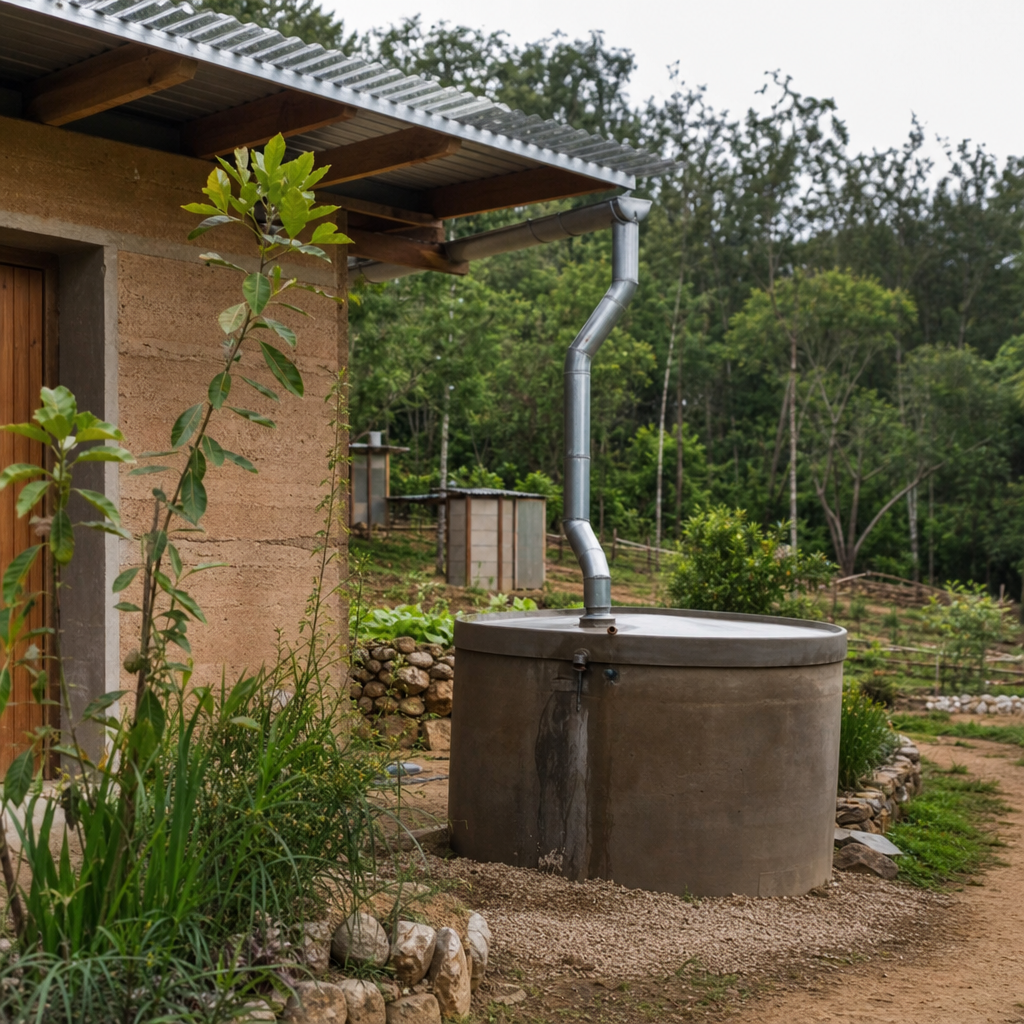
| Storage tank | Buffers supply and prevents contamination | Use opaque, sealed tanks with screened vents | Leaving lids loose, allowing insects and light in |
| Urine-diverting toilet | Reduces water use and enables nutrient recovery | Maintain correct user interface and dryness | Cross-contamination from poor user training |
| Greywater area | Safely infiltrates or reuses lightly used water | Use mulch basins, filters, or planted beds | Letting greywater pond near the sanitation block |
System Types and Where They Work Best
Not every site needs the same EcoSan and rainwater harvesting configuration. Urine-diverting dry toilets are often the strongest fit for water-stressed rural areas, schools, parks, and off-grid sites because they sharply reduce water demand and simplify nutrient recovery. Rainwater can then be reserved for handwashing and cleaning. Composting toilets may suit ecolodges, low-density housing, and demonstration projects where trained caretakers can manage carbon balance, aeration, and curing times. Low-flush urine-diverting systems can work in peri-urban homes that want some flush functionality while still cutting water use and preserving nutrient separation.
In dense informal settlements, shared sanitation blocks with roof harvesting can provide meaningful environmental gains if maintenance responsibilities are clear. Large roofs produce substantial runoff capture, and centralized tanks can support handwashing stations. However, shared systems fail quickly when cleaning budgets, spare parts, and sludge or compost removal plans are absent. In flood-prone zones, raised structures, sealed vaults, and overflow management are essential. In arid climates, storage sizing and evaporation control become the dominant design concerns. The best system is not the most advanced one. It is the one matched to climate, user behavior, maintenance capacity, and regulatory requirements.
Public Health, Water Quality, and Risk Management
Environmental performance is inseparable from health protection. Rainwater harvesting linked to EcoSan must be designed so that collected water is not contaminated by fecal material, animal droppings, or poor storage hygiene. The first line of defense is catchment selection and maintenance. Smooth metal roofs generally perform better than rough or contaminated surfaces. The second is first-flush diversion and filtration. The third is storage management, including sealed tanks, periodic cleaning, and avoiding cross-connections with wastewater lines.
For nonpotable uses, risk can be managed with practical controls. Handwashing water should be visibly clean and, where necessary, disinfected according to local guidance. If rainwater is intended for potable use, treatment must be fit for purpose: sediment control, filtration, and disinfection, with ongoing testing. On the sanitation side, urine storage time, compost curing temperature, moisture management, and safe handling procedures matter. The World Health Organization and many national sanitation guidelines recognize multi-barrier approaches because no single measure is enough on its own. In field settings, the most common breakdown is not technical impossibility but operational neglect: blocked gutters, broken taps, full vaults, or missing ash and cover material.
Costs, Maintenance, and Long-Term Environmental Returns
Upfront costs vary widely based on tank material, toilet type, site conditions, and labor. A basic roof harvesting system with gutters, screens, first-flush devices, and a polyethylene tank can be affordable at household scale, while institutional systems with ferrocement or reinforced concrete tanks cost more but benefit from economies of scale. EcoSan toilets can be inexpensive in materials yet demanding in supervision if users are unfamiliar with source separation. That is why life-cycle thinking matters more than installation price alone.
Maintenance determines environmental return. Gutters need regular cleaning, tanks need inspection, urine pipes need flushing or anti-scaling management where struvite buildup is likely, and compost vaults need controlled curing and scheduled emptying. These tasks are manageable, but they must be assigned. In projects that succeed, a caretaker, household lead, or school management committee owns a checklist and budget. The payoff is real: lower water bills or pumping costs, reduced fertilizer expenditure where reuse is practiced safely, and fewer repairs caused by flooding or saturated ground around sanitation units.
Building an Effective Environmental Impact Hub Around EcoSan
As a hub topic, EcoSan and the environment should connect readers to the full decision landscape, not treat rainwater harvesting as an isolated feature. The strongest supporting articles usually branch into nutrient recovery, groundwater protection, greywater reuse, climate resilience, school sanitation design, operation and maintenance, pathogen reduction, and policy standards. This hub should make one central point clear: environmental impact in sanitation is cumulative. You do not get the full benefit from a dry toilet if roof runoff floods the site, if handwashing lacks water, or if recovered nutrients are mishandled.
A useful hub also answers practical questions directly. How much rainwater can a roof collect? Which roof materials are safe? Can harvested rainwater be used for handwashing? What maintenance is required? Is EcoSan suitable in high-rainfall areas? These are the questions planners, homeowners, NGOs, and facility managers actually ask. Clear answers, grounded in design logic and operating reality, help readers move from interest to implementation.
Rainwater harvesting in EcoSan systems is one of the most effective ways to turn sanitation from a linear disposal problem into a circular environmental solution. When waste is separated and treated appropriately, when rainfall is captured and stored safely, and when each water stream is matched to a sensible use, the result is lower freshwater demand, cleaner waterways, healthier soils, and better resilience during droughts and supply interruptions. Those benefits are practical, not theoretical, and they scale from single homes to schools and community sanitation blocks.
The main lesson is simple: environmental sanitation works best as an integrated system. Toilets, tanks, gutters, handwashing points, reuse areas, and maintenance routines should be planned together from the start. If you are developing an EcoSan project or expanding environmental content on this topic, use this hub as the foundation, then map the supporting details for design, health safeguards, nutrient reuse, and operations. Start with your site conditions, rainfall pattern, and user needs, and build a system that protects water while making every drop count.
Frequently Asked Questions
What is the role of rainwater harvesting in EcoSan systems?
Rainwater harvesting supports EcoSan systems by supplying a local, renewable water source while reinforcing the core ecological sanitation goal of reducing unnecessary demand on treated freshwater. EcoSan, or ecological sanitation, is designed around the idea that human waste should be managed safely and productively, with minimal pollution and maximum resource recovery. Because many EcoSan systems use little or no water for flushing, harvested rainwater can be directed to the uses that still matter most, such as handwashing, cleaning toilet areas, maintaining surrounding vegetation, or supporting small-scale greywater applications where appropriate.
In practical terms, rainwater harvesting helps households and communities become more resilient. Instead of depending entirely on municipal water or groundwater, users can capture rainfall from roofs and store it for later use. That lowers utility costs, reduces pressure on aquifers and piped systems, and can improve sanitation reliability in places where water access is inconsistent. When planned properly, the combination of rainwater harvesting and EcoSan creates a more circular, site-sensitive approach to sanitation: water is conserved, nutrients are retained in the sanitation cycle, and contamination risks to soil, rivers, and groundwater are reduced.
How does rainwater harvesting reduce the environmental impact of sanitation?
Rainwater harvesting reduces the environmental footprint of sanitation by decreasing the amount of freshwater that must be extracted, treated, and transported for everyday use. Conventional sanitation often depends on large volumes of clean water to move waste through sewer systems, which is both resource-intensive and energy-intensive. EcoSan systems challenge that model by minimizing or avoiding flush water altogether. When rainwater harvesting is added, the remaining non-potable water needs can be met with captured rainfall instead of drinking-quality water, which is a major environmental advantage.
This approach also helps reduce pollution risks. By keeping sanitation systems decentralized and water-efficient, EcoSan can lower the chances of untreated or poorly treated wastewater entering rivers, lakes, or groundwater. Rainwater harvesting contributes by reducing stormwater runoff from roofs and hard surfaces, which can otherwise carry sediments and pollutants into local waterways. In a well-designed system, rainwater is intercepted, stored, and put to beneficial use, while sanitation outputs are managed as resources through composting, nutrient recovery, or safe soil application protocols. The result is a sanitation strategy that uses fewer external inputs, generates less waste, and aligns more closely with natural cycles.
Can harvested rainwater be used directly in EcoSan toilets?
In many cases, EcoSan toilets do not require water for flushing, which is one of their biggest advantages. Urine-diverting dry toilets, composting toilets, and other low-water or no-water EcoSan designs are intended to function without sending waste away in a water stream. Because of that, harvested rainwater is usually not needed for the toilet’s core operation. However, it can still play an important supporting role. For example, rainwater may be used for cleaning toilet surfaces, washing collection containers where safe and appropriate, handwashing stations, or related hygiene needs around the sanitation area.
Whether harvested rainwater can be used directly depends on the specific system design and intended application. If the water is being used for non-potable purposes, filtration and basic maintenance may be sufficient, but storage tanks, gutters, first-flush diverters, and outlets must be kept clean to maintain water quality. If there is any plan to use harvested rainwater for personal contact uses beyond simple cleaning, the system should be designed with clear treatment and safety standards in mind. The key point is that EcoSan and rainwater harvesting complement each other best when the water is matched carefully to suitable uses, rather than assuming all collected rainwater is appropriate for every sanitation function.
What are the main design considerations when combining rainwater harvesting with an EcoSan system?
Successful integration starts with understanding water demand, rainfall patterns, storage capacity, and the sanitation technology being used. The first question is how the harvested rainwater will actually be used. In a dry EcoSan system, demand may be relatively low and focused on hygiene and cleaning. In that case, the collection surface, tank size, and seasonal storage strategy should reflect realistic non-potable needs rather than oversized assumptions. Roof material, gutter design, leaf screens, and first-flush systems are also important because they influence how clean the collected rainwater will be before it enters storage.
Another major consideration is safe separation of water flows and waste flows. EcoSan systems depend on careful source separation, whether that means dividing urine and feces or keeping greywater distinct from excreta handling areas. Rainwater infrastructure should be designed so that stored water is protected from contamination and does not come into contact with sanitation byproducts unless there is a deliberate, controlled treatment process in place. Ventilation, drainage around the toilet structure, tank covers, mosquito prevention, overflow management, and routine inspection all matter. Just as important is user behavior: even a technically sound system performs poorly if tanks are not cleaned, diversion channels are blocked, or water is used in ways the system was never intended to support.
What are the long-term benefits of using rainwater harvesting in EcoSan systems for households and communities?
Over the long term, the combined approach can deliver economic, environmental, and public health benefits. For households, rainwater harvesting can lower dependence on purchased or pumped water, especially in regions where supply is expensive or unreliable. EcoSan systems can further reduce costs by cutting water use and, in some cases, enabling nutrient recovery from urine or composted excreta for agricultural purposes when handled according to health guidelines. That makes the sanitation system not only more efficient, but potentially more productive.
For communities, the broader value is resilience. Systems that conserve water and manage waste locally are often better suited to drought-prone areas, off-grid settlements, peri-urban development, and places where centralized sewer infrastructure is limited or unaffordable. They can help reduce groundwater depletion, lessen pollution loading on local ecosystems, and support more sustainable land and water management overall. Just as importantly, they promote a shift in mindset: sanitation is no longer treated as a one-way disposal problem, but as part of a resource cycle that includes water stewardship, nutrient reuse, and environmental protection. When maintained properly and supported by good hygiene practices, rainwater harvesting in EcoSan systems can become a practical foundation for healthier and more sustainable living.