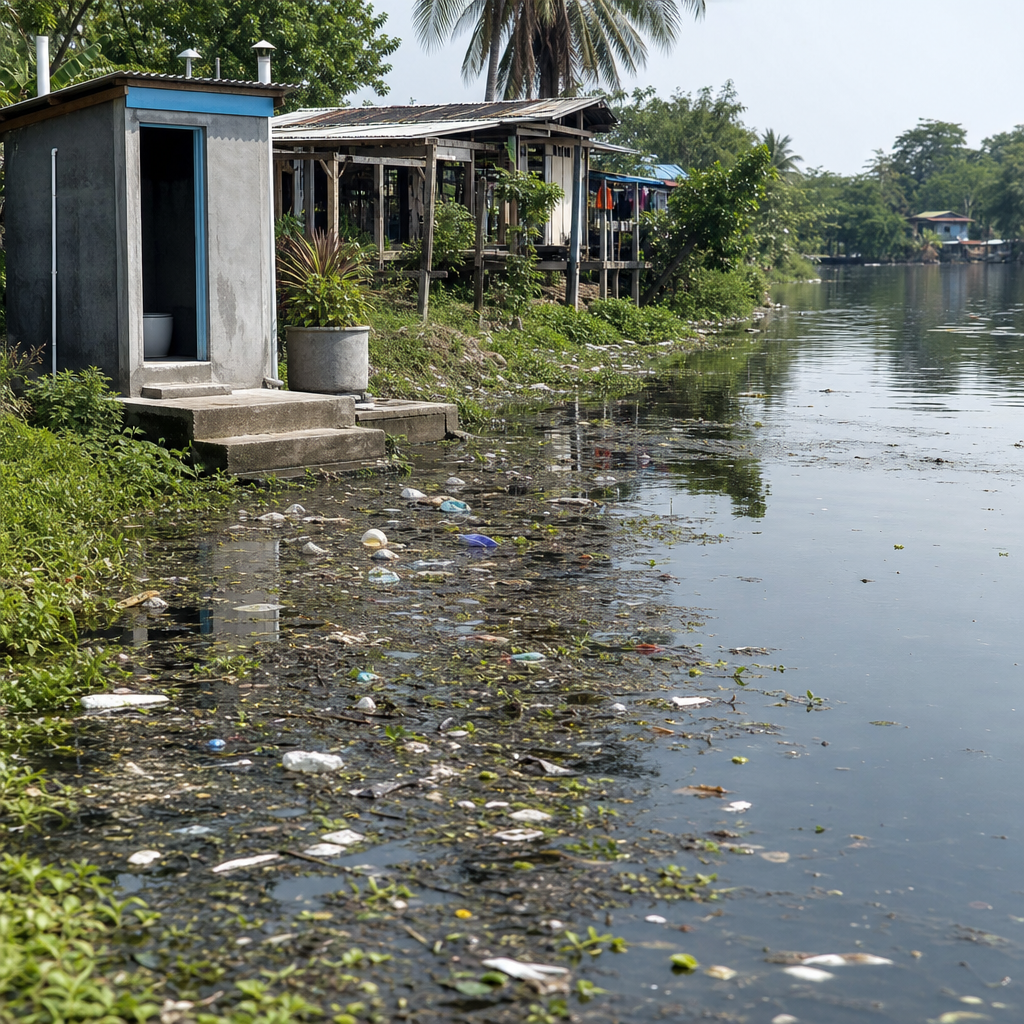
River and lake pollution is often treated as a problem of factories, plastics, and stormwater, yet in many watersheds the largest daily pollutant load comes from human waste that was never safely contained, treated, or reused. Ecological sanitation, commonly shortened to EcoSan, addresses that overlooked source by redesigning sanitation systems so nutrients, water, and organic matter are managed as resources instead of discharged as waste. In practice, EcoSan includes approaches such as urine diversion, composting toilets, dehydrating toilets, container-based sanitation, source separation, greywater reuse, and decentralized treatment that prevents pathogens and excess nutrients from entering rivers and lakes.
This matters because polluted freshwater systems fail in predictable ways. When untreated sewage reaches a lake, nitrogen and phosphorus stimulate algal blooms, dissolved oxygen drops, fish die, and disease risk rises. In rivers, fecal contamination increases diarrheal illness, limits irrigation and recreation, and raises treatment costs for downstream drinking water utilities. The World Health Organization and UNICEF have repeatedly linked inadequate sanitation to major public health burdens, while the United Nations Environment Programme has warned that nutrient pollution is a central driver of freshwater ecosystem decline. I have seen this pattern in sanitation planning work: communities focus on toilet access first, but if the waste chain ends in open drains, leaking pits, or direct discharge, the water body still pays the price.
EcoSan matters within environmental impact discussions because it connects sanitation engineering with watershed restoration, climate resilience, soil health, and circular resource use. Instead of relying only on waterborne sewerage that can be expensive, energy intensive, and difficult to maintain in low-density or water-scarce areas, EcoSan offers site-appropriate alternatives. It is not one technology and it is not anti-sewer by definition. It is a framework: contain excreta safely, separate useful fractions where practical, treat them to appropriate standards, and return nutrients or water to productive use without harming people or ecosystems. For any hub page on EcoSan and the environment, that systems view is the starting point.
How river and lake pollution happens, and where sanitation fits
Freshwater pollution from sanitation usually follows three pathways: pathogen release, nutrient loading, and chemical contamination. Pathogens such as E. coli, Vibrio cholerae, Salmonella, helminth eggs, and protozoa move from feces into water through open defecation, overflowing pits, damaged septic tanks, or untreated effluent. Nutrients enter the same way, particularly when urine and feces are mixed with flush water and conveyed into systems that leak or receive no effective treatment. Chemical contamination can include pharmaceuticals, cleaning agents, and industrial discharges mixed into sewers, though domestic sanitation is most strongly tied to pathogen and nutrient impacts.
Lakes are especially vulnerable because they retain water longer than rivers. When phosphorus accumulates, eutrophication accelerates. Cyanobacterial blooms can produce toxins that threaten drinking water supplies and aquatic life. Rivers can dilute pollutants more quickly, but they also carry contamination across long distances, spreading the impact downstream. In peri-urban areas I have assessed, informal settlements near riverbanks often use pit latrines in flood-prone soils; once floodwater rises, pits inundate, contents disperse, and river water quality collapses within hours. Conventional solutions often fail there because sewers are unaffordable, terrain is difficult, or utilities lack treatment capacity.
EcoSan changes this pollution pathway at the source. By reducing or eliminating water transport, keeping excreta contained, and requiring planned treatment and reuse, it lowers the chance that waste reaches open water. The environmental value is strongest where current sanitation is unmanaged. Replacing a failing pit or direct discharge with a well-operated urine-diverting dry toilet can produce a larger water-quality benefit than expanding a sewer network that still discharges partially treated wastewater. That is why watershed managers increasingly need sanitation data alongside land-use and hydrology data.
Core EcoSan principles that protect freshwater ecosystems
EcoSan works because it follows a few nonnegotiable principles. First, containment must be reliable. A toilet that separates urine but leaks fecal matter into the ground is not environmentally protective. Second, treatment must match the intended end use. Stored urine may be suitable as fertilizer after sufficient storage under recommended conditions, while fecal solids require dehydration, composting, alkaline treatment, thermophilic processing, or another validated pathogen reduction method before reuse. Third, reuse must be agronomically and hygienically sound. Nutrients should be applied at rates crops can absorb, not dumped where runoff carries them back to streams. Fourth, the full service chain matters: user interface, collection, transport, treatment, storage, application, monitoring, and maintenance.
These principles align with established sanitation planning methods, including service chain analysis and risk management approaches used in Sanitation Safety Planning. In real projects, the strongest EcoSan systems are not the most novel; they are the ones with clear operator responsibility, routine inspections, spare parts, user training, and market or farm demand for outputs. A urine-diverting toilet without a collection agreement becomes a storage problem. A composting toilet without carbon cover material becomes an odor and fly problem. EcoSan succeeds when environmental design and service logistics are developed together.
Another key principle is source separation. Urine contains most of the nitrogen and a large share of phosphorus and potassium excreted by humans, while feces contain most pathogens and much of the organic matter. Separating these streams allows targeted treatment. It also reduces the nutrient load entering wastewater and makes reuse more feasible. Source separation is one reason EcoSan can sharply reduce nutrient pollution in sensitive watersheds where phosphorus control is a regulatory priority.
EcoSan technologies and their environmental performance
Different EcoSan technologies suit different environments. Urine-diverting dry toilets are effective in water-scarce areas, rocky terrain, flood-prone settlements, and locations where sewer extension is unrealistic. By separating urine at the pan or pedestal, they prevent dilution and enable nutrient recovery. Double-vault dehydrating toilets allow one chamber to rest while the other is used, improving pathogen die-off. Composting toilets rely on managed aerobic decomposition and need correct moisture balance and bulking material. Container-based sanitation systems use sealed cartridges or containers collected on a schedule, which can work well in dense informal settlements where pits and septic systems fail. Decentralized wastewater treatment with constructed wetlands, anaerobic baffled reactors, or planted drying beds can also fit within EcoSan when designed around safe reuse and local water protection.
Environmental performance depends less on labels than on operation. I have seen a basic urine-diverting toilet outperform a sophisticated package plant simply because the first had trained caretakers and the second had no reliable electricity or sludge management. For river and lake protection, the best systems are those that minimize direct discharge, prevent infiltration from contaminated pits, and create measurable barriers against nutrients and pathogens reaching runoff. In sandy soils near shorelines, lined containment and above-ground systems are often preferable to pits because groundwater travel times are short and attenuation is limited.
| EcoSan option | Main pollution reduction benefit | Best-fit settings | Key limitation to manage |
|---|---|---|---|
| Urine-diverting dry toilet | Reduces nutrient and pathogen discharge at source | Water-scarce, flood-prone, off-grid areas | User training and regular emptying |
| Composting toilet | Stabilizes solids and lowers pathogen risk when managed well | Rural homes, institutions, eco-lodges | Moisture, odor, and carbon balance control |
| Container-based sanitation | Prevents leakage in dense settlements | Informal urban areas with poor access | Dependable collection service required |
| Constructed wetland with reuse | Polishes effluent and reduces runoff to receiving waters | Small communities, schools, peri-urban sites | Land area and maintenance needs |
Nutrient recovery, soil health, and the circular economy benefit
One of EcoSan’s strongest environmental arguments is nutrient recovery. Human urine typically contains the majority of excreted nitrogen and a substantial portion of phosphorus and potassium. When these nutrients are captured and reused in agriculture, they displace some synthetic fertilizer demand and reduce the nutrient burden entering lakes and rivers. That matters because phosphorus is a finite mined resource, and excess fertilizer runoff is a major driver of eutrophication. Closing the loop through sanitation does not solve agriculture’s nutrient problems by itself, but it creates a practical local contribution.
Farm outcomes improve when reuse is controlled and evidence based. Stored urine can perform well as a nitrogen fertilizer for cereals, vegetables, and fodder crops when diluted or applied according to crop and soil conditions. Treated fecal compost or sanitized biosolids can add organic matter, improving soil structure, moisture retention, and microbial activity. In watershed restoration work, this is important because healthier soils infiltrate more water and shed less sediment and nutrient runoff. A sanitation intervention can therefore support both pollution prevention and landscape resilience.
There are tradeoffs. Nutrient content varies, logistics can be costly, and public acceptance is never automatic. Some soils already have high phosphorus levels and should not receive more. Pharmaceutical residues and micropollutants remain an area requiring careful monitoring and context-specific judgment, especially for large-scale reuse. Even so, the direction of travel is clear: where sanitation by-products can be treated to a safe standard and applied responsibly, EcoSan turns a pollution liability into a managed resource stream.
Public health, biodiversity, and climate co-benefits
Cleaner rivers and lakes produce immediate public health gains. Lower fecal contamination means safer bathing water, reduced exposure during irrigation, and less contamination of shallow wells near polluted banks. Health facilities and schools benefit when on-site sanitation no longer overflows into drains. Fisheries benefit when oxygen depletion and toxic blooms decline. Wetlands and riparian habitats also recover more readily when chronic nutrient and organic loading is reduced.
EcoSan can support climate resilience in several ways. Dry or low-water systems reduce demand on scarce freshwater supplies, which is increasingly important in drought-prone regions. Decentralized systems can remain functional when storms disrupt centralized infrastructure. Properly managed nutrient recovery can lower emissions associated with fertilizer manufacture, while avoiding uncontrolled anaerobic decomposition in saturated pits may reduce methane emissions in some contexts. The climate case should not be overstated, but in integrated planning the co-benefits are real.
Biodiversity protection is especially relevant for lakes, reservoirs, and slow-moving rivers. Freshwater ecosystems hold disproportionate biological value yet are declining faster than many terrestrial systems. Pollution-tolerant species often replace sensitive fish, invertebrates, and aquatic plants when sewage inputs persist. By cutting those inputs, EcoSan supports the chemical and ecological conditions that native species need. For communities that depend on fishing, tourism, or cultural use of water bodies, that ecological improvement has direct economic value.
Implementation challenges and what successful programs do differently
EcoSan is not a shortcut, and failed projects usually fail for predictable reasons. Designs are copied without adaptation to climate or culture. Households are given hardware but not service support. Reuse plans are assumed rather than built with farmers, cooperatives, or municipal buyers. Monitoring ends once construction is complete. These mistakes create backlash and can unfairly discredit the entire approach.
Successful programs do the opposite. They begin with a local water pollution diagnosis and a sanitation service map. They choose technologies that fit soil conditions, flood risk, density, water availability, and user preferences. They train users in simple routines such as adding cover material, keeping urine channels clear, and reporting maintenance issues early. They define who empties, transports, treats, and certifies outputs. They use standards and risk-based management, including pathogen reduction targets, crop restrictions where needed, and worker protection protocols. They also budget for behavior change, spare parts, supervision, and data collection.
For municipalities, the practical lesson is that EcoSan should be integrated into fecal sludge management, watershed protection, and agricultural extension rather than treated as an isolated pilot. For NGOs and utilities, the next step is to assess high-risk settlements near rivers and lakes, compare sanitation pathways, and invest where source control will produce the biggest water-quality improvement. Addressing river and lake pollution through EcoSan works when sanitation is planned as environmental infrastructure. Start with the watershed, build the service chain, and measure outcomes in cleaner water.
Frequently Asked Questions
1. How does EcoSan help reduce river and lake pollution?
EcoSan, or ecological sanitation, reduces river and lake pollution by addressing one of the most persistent but underestimated sources of contamination: human waste that is not safely captured, treated, or reused. In many communities, wastewater and excreta enter ditches, drains, groundwater, streams, and lakes either directly or through leaking pits, overflowing septic systems, or poorly treated sewage. This releases nutrients such as nitrogen and phosphorus, disease-causing pathogens, and organic matter that depletes oxygen in water bodies. The result can include algal blooms, foul odors, fish kills, unsafe drinking water, and long-term ecosystem damage.
EcoSan changes that pattern by designing sanitation systems to prevent waste from reaching waterways in the first place. Instead of treating human waste only as something to dispose of, EcoSan systems separate, contain, sanitize, and reuse valuable components such as urine, feces, water, and organic matter. Approaches may include urine-diverting toilets, composting toilets, dehydrating toilets, and systems that recover nutrients for agriculture. By stopping nutrients and pathogens at the household or community level, EcoSan can significantly reduce the pollutant load flowing into rivers and lakes every day.
This is especially important in watersheds where centralized sewer infrastructure is incomplete, overloaded, or unaffordable to expand. In those settings, EcoSan offers a practical pollution prevention strategy rather than a downstream cleanup strategy. It protects public health, improves local water quality, and supports circular resource use at the same time, making it a highly relevant solution for both rural communities and rapidly growing urban and peri-urban areas.
2. What kinds of pollutants from human waste are most harmful to lakes and rivers, and how does EcoSan manage them?
The main pollutants from unmanaged human waste that affect rivers and lakes are nutrients, pathogens, and organic material. Nutrients such as nitrogen and phosphorus are naturally valuable for plant growth, but when they enter water bodies in excess, they trigger eutrophication. That process fuels excessive algae and aquatic weed growth, which can block sunlight, reduce biodiversity, and create oxygen-starved conditions when the organic matter decomposes. In severe cases, entire aquatic ecosystems become stressed or collapse.
Pathogens are another major concern. Bacteria, viruses, protozoa, and intestinal worm eggs can spread through contaminated water and cause serious illness, especially where rivers and lakes are used for drinking, bathing, fishing, or irrigation. Even low-level but constant contamination can create chronic public health risks. Organic matter in untreated waste also contributes to high biological oxygen demand, which means microorganisms use up dissolved oxygen as they break it down. Fish and other aquatic life may not survive in those conditions.
EcoSan manages these pollutants by using source separation and safe treatment. For example, urine-diverting systems keep urine apart from feces, which makes nutrient recovery easier and reduces the volume needing treatment. Urine contains much of the nitrogen and phosphorus and can be reused in agriculture under proper guidelines. Fecal matter can be composted, dehydrated, or otherwise sanitized to reduce pathogens before reuse or safe disposal. Because these systems are designed to keep excreta contained rather than diluted and flushed into water systems, they are often more effective at preventing contamination where conventional sewerage is limited or unreliable. The core principle is simple but powerful: keep pollutants out of water and turn recoverable materials into useful inputs instead of waste streams.
3. Is EcoSan only useful in rural areas, or can it also work in towns and cities?
EcoSan is often associated with rural sanitation, but it can be highly effective in towns, informal settlements, peri-urban communities, and even certain urban developments. Its value is greatest wherever conventional sanitation systems struggle with affordability, water scarcity, poor maintenance, weak treatment capacity, or rapid population growth. In many towns and cities, wastewater infrastructure does not fully cover the population, and even where sewer networks exist, treatment plants may be overloaded or underperforming. That means pollutants still end up in nearby rivers and lakes.
In dense settings, EcoSan can work through decentralized sanitation models that reduce pressure on centralized systems. Urine-diverting dry toilets, container-based sanitation, neighborhood-scale composting, and fecal sludge treatment linked to resource recovery are all examples of EcoSan-inspired approaches that can fit urban conditions when they are professionally managed. These systems can be especially useful in flood-prone areas, rocky ground, water-scarce neighborhoods, and settlements where laying conventional sewer lines is technically difficult or prohibitively expensive.
The key to urban success is not simply the toilet technology itself, but the full service chain: user acceptance, collection, transport where needed, treatment, quality control, and safe reuse or disposal. When these pieces are in place, EcoSan can help cities reduce nutrient pollution, lower freshwater demand, and create useful products such as soil amendments or fertilizers. So while the exact design may differ by location, EcoSan is not limited to rural use. It is a flexible sanitation framework that can support cleaner waterways in a wide range of settlement types.
4. What are the main benefits of reusing nutrients through EcoSan instead of discharging them into waterways?
Reusing nutrients through EcoSan delivers both environmental and economic benefits. Human waste contains significant amounts of nitrogen, phosphorus, potassium, and organic matter, all of which are valuable for soil fertility and crop production when safely treated and properly applied. In conventional sanitation systems, these nutrients are often diluted in water and discharged as pollutants. That creates a double loss: waterways become contaminated, and agriculture misses the chance to recover useful resources locally.
By capturing nutrients at the source, EcoSan turns a pollution problem into a resource opportunity. Recovered urine can serve as a fertilizer input, and treated fecal matter or composted biosolids can improve soil structure, water retention, and organic content. This is particularly important in areas where farmers face high fertilizer costs or declining soil quality. Resource recovery can strengthen local food systems while reducing dependence on imported synthetic fertilizers, some of which are energy-intensive to produce or vulnerable to price volatility.
From a water quality perspective, nutrient reuse also directly supports healthier lakes and rivers. Every kilogram of nitrogen or phosphorus diverted into productive agricultural use is a kilogram less likely to feed harmful algal blooms downstream. In watersheds suffering from eutrophication, this prevention approach can be far more sustainable than trying to restore polluted water bodies after the damage is done. When implemented safely, nutrient reuse under EcoSan principles supports circular economy goals, reduces environmental pressure, and creates a more resilient relationship between sanitation and agriculture.
5. What challenges can affect EcoSan adoption, and how can communities overcome them?
EcoSan offers major advantages, but successful adoption depends on more than installing a new toilet. Common challenges include public perception, cultural preferences, maintenance needs, financing, regulation, and the logistics of safe reuse. In some places, people may be unfamiliar or uncomfortable with the idea of separating or reusing human waste products, even when treatment makes them safe. In others, poor early project design or lack of follow-up has created skepticism. Technical mistakes, inconsistent emptying services, or weak monitoring can also undermine confidence.
Communities can overcome these barriers by treating EcoSan as a complete sanitation service rather than a one-time construction project. That means investing in user education, clear operation and maintenance plans, trained service providers, and reliable treatment standards. Demonstration sites, farmer partnerships, and visible evidence of improved water quality or crop benefits can help build trust. Local governments and development partners also play an important role by creating supportive policies, quality guidelines for reuse, and financing mechanisms that make systems affordable for households and institutions.
Another important factor is choosing the right EcoSan model for the local context. Water availability, climate, soil conditions, settlement density, agricultural demand, and social norms all matter. A system that works well in a dry rural area may need major adaptation in a dense flood-prone settlement. The most effective EcoSan programs are tailored, participatory, and backed by long-term management. When communities align technology choice with local needs and build strong support systems around it, EcoSan can become a durable solution for reducing human waste pollution in rivers and lakes while delivering public health and resource recovery benefits.