EcoSan for elderly and disabled users must be designed around health, dignity, and practical access, because sanitation that cannot be used safely is not truly sanitation at all. EcoSan, short for ecological sanitation, refers to systems that treat human waste as a resource while protecting people, water, and soil from contamination. In practice, that often means urine-diverting dry toilets, composting toilets, container-based systems, and washing arrangements that reduce water use and enable nutrient recovery. For older adults and people with disabilities, however, the success of any EcoSan system depends less on theory and more on everyday usability: Can a wheelchair user transfer safely? Can a person with arthritis open the door, steady themselves, and clean themselves without pain? Can a caregiver assist while maintaining privacy?
I have seen well-intended sanitation projects fail because the toilet was technically efficient but physically inaccessible. A raised threshold stopped walkers. A narrow door blocked wheelchairs. A slippery slab turned a routine visit into a fall risk. These are not small design mistakes. They directly affect hydration habits, bowel health, urinary tract infection risk, skin integrity, caregiver workload, and whether people avoid using the toilet altogether. In households, clinics, schools, and care settings, accessible EcoSan is therefore a health and safety intervention first, and an environmental solution second.
Prioritizing health in EcoSan means addressing infection prevention, safe transfers, continence support, menstrual hygiene, odor control, ventilation, handwashing, cleaning protocols, and emergency access. It also means recognizing that disability is not one condition. Needs differ for users with limited mobility, visual impairment, reduced grip strength, dementia, stroke aftereffects, chronic pain, or incontinence. Aging adds further variation through frailty, slower reaction times, balance changes, and multiple medications. Good design responds with enough space, predictable layouts, supportive fixtures, and maintenance routines that remain reliable over time.
This article serves as a hub for health and safety in EcoSan, bringing together the core principles that should guide system choice, toilet room design, caregiver support, and ongoing management. The aim is straightforward: reduce exposure to pathogens, prevent injuries, preserve independence where possible, and make sustainable sanitation workable for the people who often face the greatest barriers.
Why accessible EcoSan is a health priority
Accessible EcoSan matters because sanitation barriers quickly become medical problems. When users delay toilet visits because the route is unsafe or the pan is too hard to use, they often reduce fluid intake to cope. That can worsen dehydration, constipation, kidney stress, and confusion in older adults. Incontinence may increase when toilets are hard to reach in time. People with limited mobility are also more vulnerable to pressure injuries and skin breakdown if hygiene is delayed after toileting. A safe, nearby, usable toilet reduces these risks immediately.
Infection control is equally important. According to World Health Organization sanitation guidance, the health value of a toilet depends on effective separation between excreta and human contact. For elderly and disabled users, that separation is influenced by seating stability, transfer supports, clear cleaning access, and handwashing placement. A urine-diverting toilet that is difficult to position over can lead to spills, contaminated surfaces, and reluctance to use the system. By contrast, stable seating, splash reduction, and reachable cleaning materials support hygienic use and more consistent maintenance.
Falls are one of the most serious hazards. The U.S. Centers for Disease Control and Prevention has long identified bathrooms as common fall locations because of wet floors, turning movements, and transfer demands. EcoSan settings can add further challenges if there are stairs, uneven paths, raised footrests, or collection chambers that alter floor height. The health priority is therefore simple: eliminate avoidable hazards before focusing on nutrient recovery targets or aesthetic finishes. If users cannot enter, turn, sit, stand, cleanse, and exit with confidence, the design is incomplete.
Core design features for safety and independence
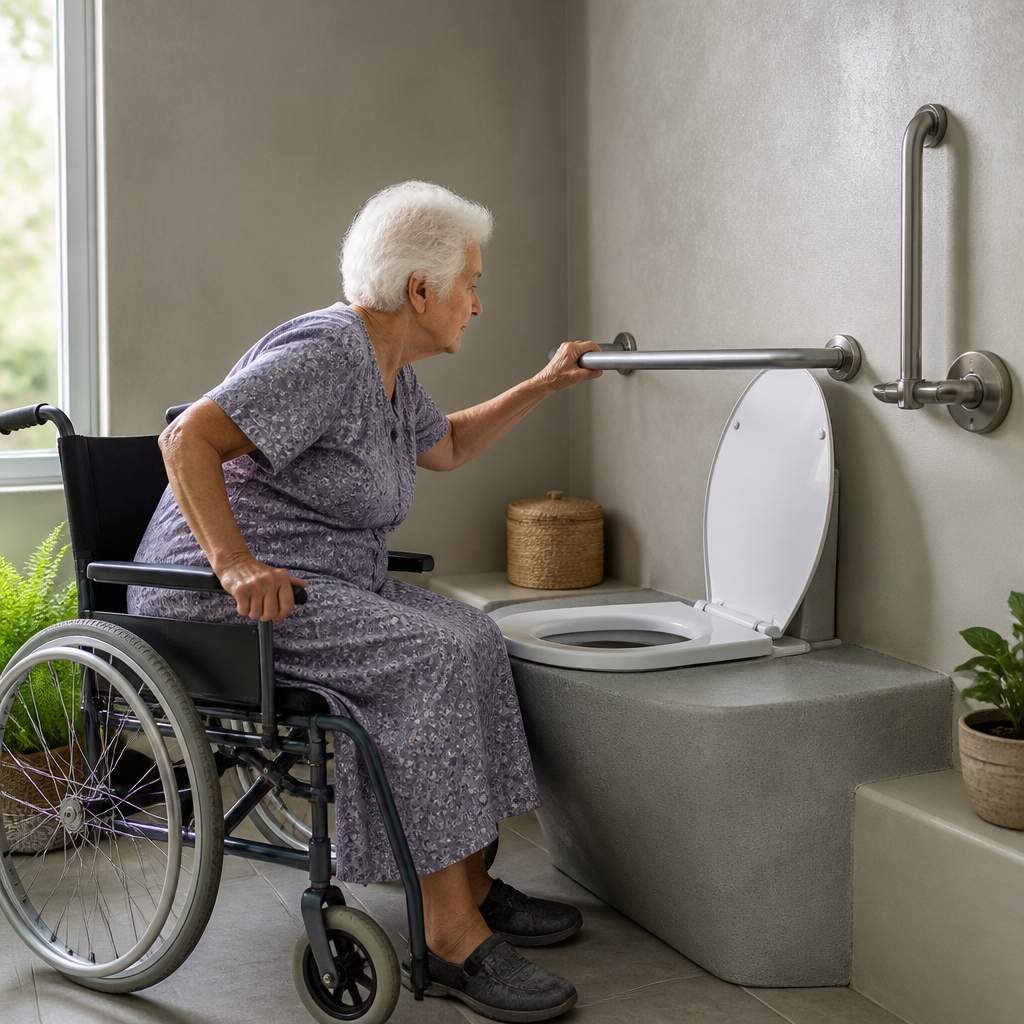
The safest EcoSan toilets for elderly and disabled users share a few non-negotiable features. First is step-free access from the main living area to the toilet, including firm paths, adequate lighting, and door hardware that can be used with weak grip strength. Second is interior maneuvering space. Wheelchair users generally need enough room for a front or side transfer, and caregivers may need access on one or both sides. Third is a seat height that supports standing and sitting without excessive knee or hip flexion. In many retrofit projects, I have found that a slightly raised seat with sturdy arm supports improves usability more than any other single change.
Grab bars must be anchored to structural framing, not thin wall panels. Horizontal bars help with stability, while angled or vertical bars can assist during standing transfers. Surfaces should be slip resistant even when damp, and corners should be easy to clean. Ventilation matters for comfort and respiratory health; composting or dry systems require airflow that controls odor without creating drafts that chill frail users. Lighting should be even, glare controlled, and backed by a nighttime option such as low-level motion lighting for people who wake frequently.
Privacy and dignity are also health features. Doors should lock in a way that can be released from outside during an emergency. Screens or partitions must still leave enough room for assistance. For users with cognitive impairment, high-contrast color around the seat and handholds helps recognition. Simple signs, consistent placement of toilet paper or washing items, and uncluttered layouts reduce confusion. These details may seem minor, but they directly affect whether a person can toilet independently and safely every day.
| Design element | Why it matters | Practical example |
|---|---|---|
| Step-free entrance | Prevents trips and wheelchair blockage | Flush threshold with ramped exterior path |
| Wide doorway | Allows wheelchair or caregiver entry | Outward-opening door with lever handle |
| Raised stable seat | Reduces strain on knees and hips | Seat height matched to user transfer ability |
| Grab bars | Supports balance and transfers | Side and rear bars fixed into framing |
| Slip-resistant floor | Lowers fall risk during cleaning and use | Textured sealed surface with proper drainage |
| Reachable handwashing | Improves hygiene compliance | Basin or tap positioned for seated access |
Choosing the right EcoSan system for different disabilities
No single EcoSan model works for every user group. Urine-diverting dry toilets can perform very well where water is scarce, but the user interface must be intuitive. If precise positioning is required, some users with tremor, spasticity, limited trunk control, or visual impairment may struggle. In those cases, a larger seat opening, splash guards, or adaptive seating can improve results. Composting toilets reduce water demand and can work in off-grid settings, yet they require disciplined maintenance of bulking material, moisture balance, and ventilation. That maintenance burden should be weighed carefully in homes with frail residents or overstretched caregivers.
Container-based sanitation can be a strong option where construction constraints prevent a full accessible superstructure. Sealed containers simplify waste handling when serviced professionally, but transfer safety, odor control, and backup arrangements remain essential. For people with severe mobility limitations, bedside commodes linked to a safe emptying process may be more realistic than expecting independent access to an outdoor unit, especially at night. In rural programs, I often recommend assessing day use and night use separately because the safest solution may involve an accessible primary toilet plus a secondary indoor option for emergencies.
Visual impairment calls for tactile cues, strong contrast, and fixed placement of supplies. Hearing impairment affects communication during assisted transfers and emergencies, so visual alerting methods and clear line of sight can help. For users with dementia, the best system is usually the simplest one: obvious toilet identification, minimal steps, and no confusing operating sequence. The right choice is the one that people can use consistently, hygienically, and without fear.
Hygiene, infection prevention, and safe waste handling
Health-focused EcoSan depends on routines as much as hardware. Handwashing must be available at the point of use, with soap or ash where appropriate and water delivered in a way a seated user can reach. If the facility relies on water containers, they should be light enough to handle safely or supported by dispensers. Cleaning tools should be stored off the floor, easy to grasp, and dedicated to the toilet area to prevent cross-contamination. Frequently touched surfaces such as door handles, grab bars, and seats need regular disinfection based on a clear schedule.
Waste handling is where many systems either protect health or undermine it. Ecological sanitation requires correct storage times, dehydration, composting temperatures, or service-chain containment depending on the technology. Caregivers and operators should use gloves when exposure is possible and wash hands immediately after handling containers or compost chambers. WHO guidance and ISO-aligned sanitation risk management principles both emphasize multiple barriers: safe capture, secure storage, controlled treatment, and protected end use or disposal. For elderly and disabled users, the additional rule is that no maintenance task should require precarious lifting, deep squatting, or carrying loads over slippery ground.
Odor is not just a comfort issue. Persistent smell usually signals moisture imbalance, inadequate venting, poor sealing, or cleaning failures. Those conditions can attract insects and reduce toilet use. I advise treating odor complaints as an operational warning sign, not a nuisance. Fix airflow, review bulking material, inspect urine diversion integrity, and verify that wash water is not entering dry compartments. Good hygiene in EcoSan is always visible in both the user area and the waste pathway.
Supporting caregivers, maintenance teams, and long-term reliability
Accessible EcoSan succeeds when the whole care pathway is designed, not only the cubicle. Caregivers need space to assist with clothing, transfers, cleansing, and continence products without twisting into unsafe positions. Maintenance staff need service access that does not force them through the user area with tools or waste containers. Households need clear instructions for what to add, what not to flush or drop into chambers, how to report faults, and what backup plan to use if the toilet is temporarily out of service.
Training should include transfer technique, cleaning chemistry compatible with the system, vector control, and signs of user distress such as new urgency, repeated nighttime accidents, or avoidance of the toilet. These often indicate a design issue before they become a medical issue. Reliability also improves when spare parts are standardized. A broken latch, missing seat, clogged urine pipe, or failed vent cap can render an otherwise good facility unsafe. Preventive inspections are cheaper than emergency repairs and far less disruptive for vulnerable users.
This hub topic connects closely with related articles on accessible toilet dimensions, handwashing station design, continence-friendly layouts, safer waste reuse practices, menstrual hygiene in dry sanitation, and caregiver-centered maintenance planning. Together, these topics form a practical framework for prioritizing health in EcoSan rather than treating accessibility as an afterthought.
Planning, auditing, and improving existing facilities
Most organizations do not start from a blank slate; they inherit toilets that need adaptation. The best first step is an access and safety audit that follows the user journey from bedroom or living area to handwashing exit. Measure path widths, slopes, thresholds, turning space, seat height, reach ranges, lighting levels, and transfer supports. Observe one real use session, with consent, because drawings rarely reveal where people actually struggle. A toilet can meet nominal dimensions and still fail if the door swing blocks the wheelchair position or the cleansing water sits out of reach.
Prioritize low-cost, high-impact fixes first: improve lighting, add contrasting edges, install secure grab bars, reduce slipperiness, widen door clearances where possible, and move supplies into accessible reach. Then address system-level changes such as relocating the toilet closer to the home, separating urine more effectively, or changing service intervals. Track outcomes that matter to health: falls, near misses, cleaning frequency, odor complaints, independent use rates, caregiver time, nighttime accidents, and user satisfaction. When those indicators improve, the EcoSan system is doing its job.
EcoSan for elderly and disabled users works best when accessibility and safety are treated as the foundation of the design, not optional upgrades added later. The essential lesson is clear: ecological sanitation protects health only when people can use it comfortably, maintain it hygienically, and rely on it every day. Step-free access, stable transfers, reachable handwashing, safe waste handling, and realistic maintenance plans are the pillars that make this possible. Different users need different adaptations, but the goal is constant across homes, clinics, schools, and community facilities: reduce infection risk, prevent injuries, support dignity, and make sustainable sanitation genuinely inclusive.
As you build out your health and safety approach to EcoSan, use this hub as the starting point for design reviews, retrofit plans, caregiver training, and operations checklists. Assess the user journey, fix the highest-risk barriers first, and link each improvement to a measurable health outcome. When EcoSan is accessible, it does more than conserve resources. It protects independence, eases caregiving, and delivers sanitation that is safe enough to trust.
Frequently Asked Questions
1. How can EcoSan toilets be made accessible for elderly and disabled users?
EcoSan toilets can be highly accessible when they are intentionally designed around the physical, sensory, and mobility needs of the people who will use them. For elderly users and people with disabilities, accessibility begins with the route to the toilet. Paths should be level, slip-resistant, well drained, and wide enough for a wheelchair, walking frame, or caregiver assistance. Entrances should avoid steps wherever possible, using ramps with gentle gradients, handrails, and non-slip surfaces. Doors should be wide, easy to open, and fitted with simple locks that can be operated by people with limited hand strength or dexterity.
Inside the toilet, the layout should allow enough turning space for a wheelchair and enough room for transfers from chair to seat. Raised toilet seats are often helpful for older adults and people with limited leg strength, because they reduce the effort needed to sit and stand. Sturdy grab bars on both sides of the seat and near the entrance improve stability and confidence. If the EcoSan system is urine-diverting or composting, the seat, pedestal, and collection arrangement must be positioned in a way that does not force awkward posture or difficult alignment. Clear visual contrast, good lighting, and tactile cues also help users with low vision or cognitive limitations navigate the space safely.
Accessibility also includes ease of operation and maintenance. Containers, ash or cover material, handwashing stations, and cleansing supplies should all be placed within easy reach. Where users cannot independently manage tasks such as adding dry cover material or emptying containers, the system should be adapted so that caregivers can assist without strain or hygiene risks. In short, an accessible EcoSan toilet is not just about the toilet structure itself. It is about creating a complete sanitation environment that supports safety, privacy, dignity, and reliable daily use.
2. What safety features are most important in EcoSan systems for seniors and people with disabilities?
The most important safety features are those that reduce the risk of falls, contamination, overexertion, and confusion during use. Falls are one of the biggest concerns for elderly users, so flooring should always be stable, non-slip, and easy to keep dry. Handrails, grab bars, and secure seating are essential, especially where users have balance limitations, arthritis, stroke-related weakness, or reduced coordination. Adequate lighting, including solar or backup lighting for nighttime use, can dramatically improve safety and reduce anxiety. If a user has low vision, contrast in colors between walls, floors, seats, and handles can make the space much easier to use.
Hygiene safety is equally important. EcoSan systems are designed to protect water, soil, and public health by safely separating, containing, and treating human waste. But for vulnerable users, the system must also minimize direct exposure during everyday use. Urine-diverting pedestals or seats should function reliably, collection chambers should be sealed from living areas, and ventilation should reduce odor and insect access. Handwashing facilities should be immediately nearby, simple to use, and stocked consistently with water, soap, or appropriate alternatives. Where water is scarce, low-water or tippy-tap style solutions can still support safe hygiene if they are set up at a usable height.
Another critical safety factor is maintenance design. If the toilet requires frequent emptying, lifting, or handling of materials, it may not be safe for frail older adults or households with limited caregiving support. Safer systems often include accessible collection points, manageable container sizes, and maintenance schedules that do not place heavy physical demands on users. Clear instructions, visual signs, and routine support from family members, community workers, or service providers can help prevent misuse. A safe EcoSan toilet should never expect users to improvise around barriers; it should anticipate risks and reduce them through thoughtful design.
3. Are composting toilets and urine-diverting dry toilets practical for households with elderly or disabled family members?
Yes, they can be very practical, but only when the specific model and setup match the household’s abilities and support capacity. Composting toilets and urine-diverting dry toilets are often promoted for their environmental benefits, low water use, and ability to recover nutrients safely. Those advantages can be very meaningful in areas with water scarcity, poor sewer infrastructure, or concern about contamination of local water sources. However, practicality for elderly and disabled users depends less on the technology label and more on how easy the system is to use every day.
For example, a urine-diverting dry toilet may work well if the seat height is appropriate, the urine diversion section is easy to align with, and the cover material can be added without bending, lifting, or complicated movement. A composting toilet may be practical if odors are controlled, maintenance is infrequent, and emptying can be done by a caregiver or service provider rather than the user. Container-based EcoSan systems may be especially suitable in some cases because they can be serviced externally, reducing direct handling by the household. The best choice is usually the one that places the lowest operational burden on the user while still maintaining hygiene and environmental protection.
It is also important to think about cognition, not just mobility. Some older adults and disabled users may live with memory loss, dementia, intellectual disabilities, or sensory impairments. In those situations, the toilet should be intuitive, consistent, and easy to understand. If a system requires multiple steps or careful separation of waste streams, additional support, caregiver training, or simplified design may be necessary. Practicality is achieved when the system is not only technically sound, but also reliable, comfortable, and realistic for the people expected to use it every single day.
4. How does EcoSan protect health and dignity for elderly and disabled users?
EcoSan protects health by reducing exposure to untreated human waste and by supporting sanitation systems that do not contaminate groundwater, surface water, or the surrounding home environment. For elderly and disabled people, this matters even more because many are at greater risk from infections, dehydration, skin problems, and injuries linked to poor sanitation. Well-designed EcoSan systems safely contain excreta, separate waste streams where appropriate, and allow treatment processes such as drying, composting, or controlled storage to reduce pathogens before reuse or disposal. This creates a safer sanitation chain from toilet use through final handling.
Dignity is just as important as disease prevention. A toilet that is technically available but difficult to enter, painful to use, or unsafe at night does not provide dignified sanitation. Elderly users and people with disabilities need privacy, comfort, and the ability to manage toileting needs without fear, embarrassment, or dependence whenever possible. Features such as interior space for assistance, secure doors, handrails, appropriate seat height, and nearby washing facilities make a major difference. So does odor control, cleanliness, and a design that allows menstrual hygiene, anal cleansing, incontinence care, or caregiver support when needed.
There is also a psychological side to dignity. When sanitation systems are planned with user input, people feel respected rather than treated as an afterthought. Families and communities should not assume that all disabled users have the same needs. Some may prioritize wheelchair access, others may need support for transferring, low-vision navigation, or easier hygiene management. EcoSan can uphold dignity when it treats users as full participants in design and decision-making. The goal is not only to manage waste sustainably, but to ensure that every person can use the toilet with safety, comfort, and self-respect.
5. What should caregivers, builders, and communities consider when planning an accessible EcoSan toilet?
Caregivers, builders, and community planners should begin by assessing the real needs of the intended users rather than starting with a standard design. Age, disability type, strength, balance, continence status, vision, cognition, and cultural preferences all affect what will work best. A toilet used by an ambulatory older adult with arthritis may need very different adaptations from one used by a wheelchair user or someone who requires full caregiver assistance. Site selection is also critical. The toilet should be as close to the home as possible, especially for people who need to use it at night, move slowly, or face pain and fatigue. The route should be safe in all weather conditions and easy to navigate independently or with support.
Builders should focus on structural reliability, user comfort, and maintenance practicality. That means adequate space, strong handrails, durable materials, good ventilation, effective drainage, and easy-to-clean surfaces. The design should account for transfer space, seat height, door width, and whether the toilet can be entered with a mobility aid. If the system includes urine diversion, composting chambers, or container exchange, those functions should be laid out to minimize error and reduce the physical workload for users and caregivers. Handwashing and personal cleansing arrangements should never be treated as optional extras; they are central to safe and dignified sanitation.
Communities and service organizations should also consider long-term support. Many EcoSan failures happen not because the idea is wrong, but because follow-up is weak. Users and caregivers may need training on operation, cleaning, cover materials, safe handling, and reuse practices. Households may also need help obtaining replacement parts or routine servicing. Inclusive community engagement can identify barriers early and improve acceptance. When planning is thoughtful and support is ongoing, accessible EcoSan can deliver exactly what good sanitation should: health protection, environmental responsibility, and practical dignity for elderly and