Sustainable drainage systems in urban sanitation are the practical foundation of cleaner cities, lower flood risk, and healthier waterways. In simple terms, sustainable drainage systems, often shortened to SuDS, are engineered features that slow, store, filter, and sometimes reuse stormwater close to where rain falls, instead of pushing it immediately into pipes. Urban sanitation includes the management of wastewater, stormwater, fecal sludge, surface runoff, and the public health protections attached to each. When these two fields are planned together, cities can reduce combined sewer overflows, protect treatment plants from hydraulic shock, and cut pollution entering rivers, lakes, and coastal zones.
I have worked on sanitation and drainage planning where one blocked outfall or one hour of intense rain turned routine wastewater operations into a public health emergency. That experience makes one point clear: urban sanitation cannot be sustainable if stormwater is treated as someone else’s problem. Conventional drainage systems move water away fast, but speed alone creates downstream flooding, sewer surcharge, erosion, and contaminated discharges. Sustainable drainage systems aim to mimic natural hydrology through infiltration, detention, evapotranspiration, filtration, and controlled release. Common examples include permeable pavements, swales, rain gardens, detention basins, retention ponds, constructed wetlands, infiltration trenches, and green roofs.
This matters because urbanization seals the ground with asphalt, concrete, and roofs. As impervious cover rises, less rain infiltrates soil, peak flows increase, pollutants wash off streets, and sewer networks face larger volumes than they were designed to handle. Climate change intensifies this pressure by increasing short-duration, high-intensity rainfall in many regions. At the same time, sanitation utilities are under pressure to meet tighter discharge permits, maintain aging assets, reduce operating costs, and improve resilience. A sustainable practices in sanitation strategy therefore needs drainage systems that control quantity and quality together. For a hub article on environmental impact, SuDS connects directly to wastewater treatment efficiency, sludge management, water reuse, decentralized sanitation, urban planning, and climate adaptation.
Well-designed systems deliver several outcomes at once. They reduce runoff volume, flatten peak hydrographs, capture sediments, remove nutrients and metals, create habitat, cool urban neighborhoods, and improve amenity value. They also support regulatory compliance. Frameworks such as the United States Environmental Protection Agency stormwater guidance, the UK CIRIA SuDS Manual, and European Water Framework objectives all push projects toward source control and water-sensitive design. The key terms are straightforward. Source control means managing runoff where it is generated. Attenuation means slowing and storing flows. Water quality treatment means using physical, chemical, and biological processes to remove contaminants before discharge or reuse. In urban sanitation, these are not optional extras. They are core infrastructure choices that shape environmental performance for decades.
Why sustainable drainage belongs at the center of urban sanitation
Urban sanitation systems fail most visibly when rain and wastewater interact badly. In combined sewer systems, stormwater and sewage share the same pipes. During heavy rainfall, capacity is exceeded and untreated mixtures may discharge through combined sewer overflows. In separate systems, stormwater still carries oil, tire particles, litter, nutrients, pathogens from animal waste, and microplastics into receiving waters. In both cases, poor drainage directly undermines sanitation outcomes. Sustainable drainage systems reduce these failures by intercepting runoff before it reaches trunk sewers, by creating treatment trains, and by distributing storage across a catchment instead of relying only on deep pipe upgrades.
From an operations perspective, this integration protects wastewater treatment plants. High wet-weather inflows dilute sewage, disrupt biological treatment, increase pumping energy, and raise bypass risk. I have seen treatment works that met permit limits in dry weather but struggled after intense storms because inflow and infiltration overloaded screens, primary tanks, and secondary clarifiers. Upstream SuDS can reduce the hydraulic load that triggers those problems. They also improve pollutant management by trapping sediments at the surface, where maintenance is simpler and cheaper than removing deposits from buried networks.
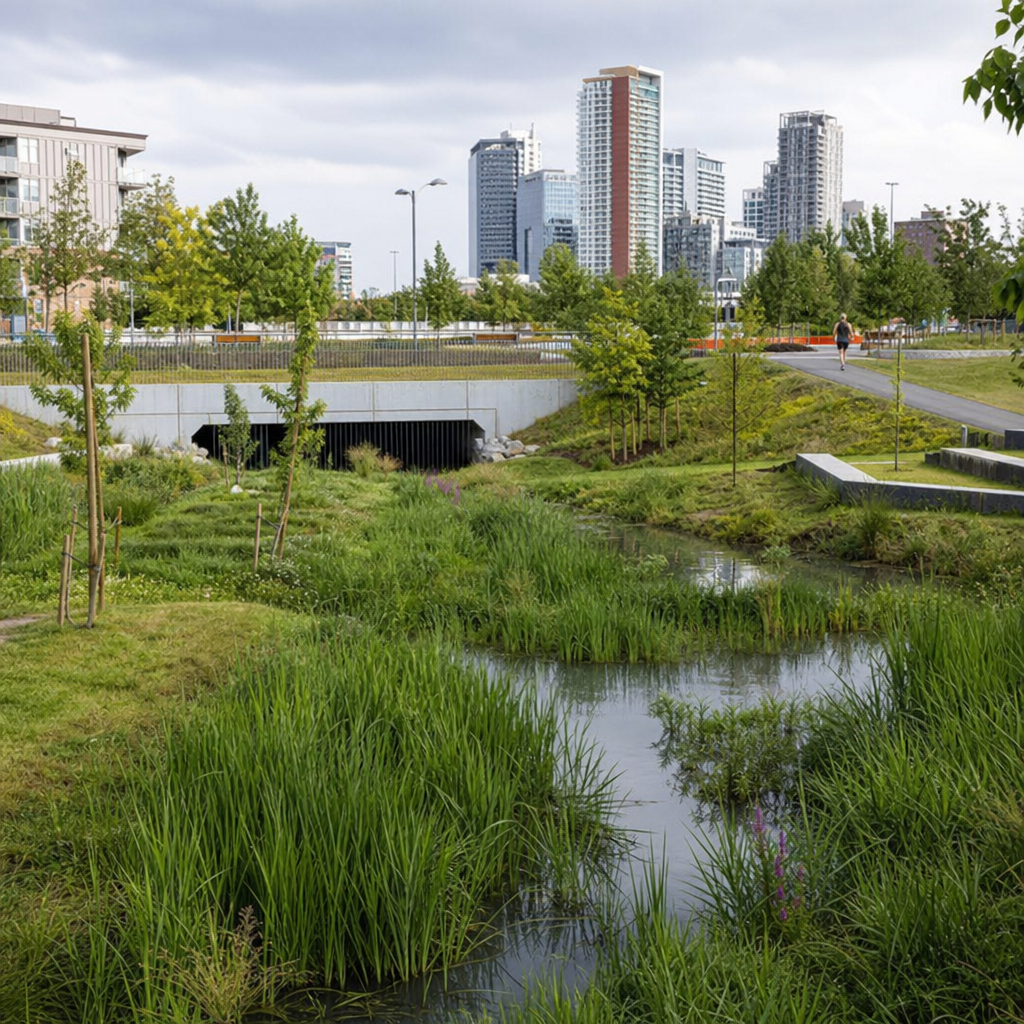
Sustainable practices in sanitation also extend beyond pipes and plants into public space. A bioswale beside a road is drainage infrastructure, but it is also a sanitation asset because it intercepts polluted runoff before it reaches a waterbody used downstream for recreation, abstraction, or fisheries. A constructed wetland polishing effluent or managing stormwater provides ecological treatment while offering landscape value. This multifunctionality is one reason cities such as Copenhagen, Singapore, Portland, and Rotterdam have invested heavily in blue-green infrastructure rather than relying solely on gray expansion.
Core components and how they work in practice
The best SuDS schemes use a treatment train, meaning several controls in sequence. A green roof may reduce roof runoff at source. Water then passes to a rain garden for filtration, into a perforated underdrain or infiltration trench, and finally to a detention basin that controls release to a sewer or stream. Each component has a defined hydraulic and water quality role. Permeable pavements store water temporarily in a sub-base and allow infiltration or slow discharge. Swales convey shallow flows while settling solids. Bioretention cells filter runoff through engineered soil and vegetation. Retention ponds hold a permanent pool that supports sedimentation and biological uptake. Constructed wetlands add longer retention and stronger nutrient removal.
Selection depends on soil permeability, groundwater protection rules, available space, maintenance capacity, and the runoff profile of the site. For example, a dense commercial district with shallow utilities and contaminated ground may favor lined bioretention systems and underground cellular storage rather than deep infiltration. A school campus with open land may use swales, detention basins, and tree pits. Industrial areas need careful source control because runoff may contain hydrocarbons, metals, or process residues requiring pretreatment before infiltration. No single feature is universally best; performance comes from matching the device to the catchment and the sanitation risk.
| SuDS element | Primary function | Typical sanitation benefit | Common limitation |
|---|---|---|---|
| Permeable pavement | Storage and infiltration | Reduces runoff volume and captures sediment | Needs vacuum sweeping to avoid clogging |
| Swale | Conveyance and pretreatment | Slows flow and removes coarse pollutants | Requires land width and vegetation care |
| Rain garden | Bioretention and filtration | Improves water quality near source | Performance depends on soil media design |
| Detention basin | Peak flow attenuation | Protects sewers and treatment plants from surges | Limited pollutant removal without pretreatment |
| Constructed wetland | Polishing and storage | Supports nutrient reduction and pathogen die-off | Needs mosquito and sediment management |
Design standards matter. Engineers usually size systems using local design storms, runoff coefficients, time of concentration, and allowable discharge rates. Water quality design often targets the first flush, since early runoff can carry a high pollutant load. Many authorities require control of the 1-in-1 year and 1-in-30 year events for service performance and safe exceedance routing for larger storms. The details are technical, but the principle is clear: successful drainage is planned for ordinary rain, severe storms, maintenance access, and failure pathways, not just average conditions.
Environmental impact: water quality, carbon, biodiversity, and heat
The environmental value of sustainable drainage systems goes far beyond flood control. Water quality improvement is usually the first measurable gain. Sedimentation removes suspended solids. Filtration through soil media captures fine particles and attached metals. Vegetation and microbial communities can transform or retain nitrogen, phosphorus, and some hydrocarbons. In streets with heavy traffic, runoff often contains zinc from tire wear, copper from brake pads, and polycyclic aromatic hydrocarbons from combustion residues. A conventional storm sewer conveys these pollutants directly to a stream. A bioretention cell or wetland can intercept a meaningful share before discharge.
Carbon performance is another major factor in environmental impact. Gray drainage upgrades typically involve concrete, excavation, pipe replacement, and high embodied carbon. SuDS can reduce that footprint by using shallow landscape-based controls, fewer large pipes, and lower pumping demand. They also support trees and vegetation that provide shading and modest carbon sequestration. The benefit is not automatic, because liners, imported aggregates, and frequent replacement of media can raise impacts. Life-cycle assessment is the right tool for comparing options, and in many projects a hybrid system, not a fully green or fully gray scheme, delivers the strongest result.
Biodiversity and urban heat mitigation are increasingly important co-benefits. Constructed wetlands, vegetated channels, ponds, and rain gardens create habitat for insects, birds, and amphibians when designed with native planting and varied water depths. Green roofs can support pollinators in dense districts where habitat is scarce. Vegetated systems also cool surrounding areas through evapotranspiration and shading, which matters in neighborhoods facing extreme summer heat. This is why water-sensitive sanitation planning often aligns with public health, parks, transport corridors, and urban regeneration budgets, rather than sitting only inside a drainage department.
Planning, governance, and maintenance determine whether systems succeed
The most common reason SuDS underperform is not bad theory but weak governance. Cities approve features without securing inspection budgets, maintenance ownership, or enforceable performance standards. A rain garden filled with sediment and weeds stops functioning as designed. Permeable pavement that is never vacuum swept loses infiltration capacity. A detention basin with a blocked outlet becomes a nuisance rather than protection. In practice, long-term performance depends on an asset register, routine inspection schedules, sediment removal plans, and clear responsibility between municipalities, developers, utilities, and property owners.
Planning should begin at catchment scale. Start with topography, sewer capacity, receiving water sensitivity, soil conditions, groundwater vulnerability, and land use. Then identify where source control will bring the highest sanitation benefit. Around hospitals, markets, dense informal settlements, and industrial zones, runoff management has direct health implications because contaminated flows can reach public spaces quickly. In new developments, requiring runoff rates close to greenfield conditions is achievable. In retrofits, the goal is often targeted reduction at known bottlenecks, such as flood-prone junctions, overflow structures, or overloaded interceptor sewers.
Monitoring is essential. Good programs use flow meters, rainfall gauges, water quality sampling, and maintenance records to verify performance. Digital tools such as EPA SWMM, InfoDrainage, and MIKE URBAN help model catchment behavior, but models need field validation. I recommend cities track at least three indicators: runoff volume reduction, peak flow reduction, and pollutant removal for suspended solids or nutrients. Where sanitation links are strong, add overflow frequency and wet-weather influent to treatment works. Data turns SuDS from attractive landscaping into accountable infrastructure.
How this hub connects sustainable practices in sanitation
As a hub within environmental impact, sustainable drainage systems connect the full sustainable practices in sanitation agenda. They support wastewater treatment by reducing wet-weather overload. They complement fecal sludge management in areas without full sewers by preventing contaminated surface runoff around containment systems and transfer points. They improve water reuse schemes by separating cleaner stormwater from foul flows and by creating opportunities for non-potable reuse in irrigation or street cleaning. They also align with decentralized sanitation, where site-scale drainage and treatment can be planned together for schools, housing estates, transport terminals, and peri-urban growth areas.
The wider lesson is strategic. Sustainable sanitation is not only about toilets, sewers, and treatment plants. It is about the entire movement of water, pollutants, nutrients, and solids through an urban environment. Cities that treat stormwater as a resource and a risk at the same time build more resilient systems. The best next step is to review your drainage standards, map sanitation pressure points, and prioritize projects that deliver source control, water quality treatment, and maintainable long-term performance.
Frequently Asked Questions
What are sustainable drainage systems, and why are they important in urban sanitation?
Sustainable drainage systems, commonly called SuDS, are designed to manage rainwater in a way that more closely reflects how water behaves in nature. Instead of sending stormwater straight into underground pipes as quickly as possible, SuDS slow it down, store it temporarily, allow it to soak into the ground where appropriate, and filter out pollutants before it reaches drains, rivers, or other receiving waters. In cities, this matters because hard surfaces such as roads, roofs, and pavements prevent rain from naturally infiltrating into soil. As a result, runoff volumes increase, drainage systems become overloaded, and pollutants from streets and urban surfaces are washed into waterways.
In the context of urban sanitation, SuDS play a vital public health and environmental role. Urban sanitation is not only about toilets and wastewater treatment; it also includes stormwater management, surface runoff control, and reducing contamination risks in densely populated areas. When drainage is poorly managed, stormwater can mix with sewage, overwhelm treatment systems, cause localized flooding, spread pathogens, and transport oils, sediments, litter, heavy metals, and nutrients into the wider environment. SuDS help reduce those risks by managing water at or near the source.
They are important because they support cleaner cities, lower flood risk, and healthier waterways while also making sanitation systems more resilient. Features such as swales, permeable pavements, rain gardens, detention basins, green roofs, and constructed wetlands can all contribute to better water quality and flow control. In many urban areas, these systems also deliver co-benefits such as improved urban cooling, greener public spaces, biodiversity support, and reduced pressure on aging drainage infrastructure. Put simply, SuDS are a practical foundation for modern urban sanitation because they connect water management, public health, and environmental protection in one integrated approach.
How do SuDS reduce urban flooding and improve water quality?
SuDS reduce urban flooding by controlling the speed, volume, and pathway of stormwater runoff. In conventional drainage systems, rain that falls on impervious urban surfaces is rapidly directed into gullies and pipes. During heavy rainfall, this can cause peak flows that exceed the capacity of drainage networks, resulting in street flooding, sewer surcharging, or overflow events. SuDS interrupt that process. They hold water temporarily in features such as detention ponds, underground storage cells, infiltration trenches, or landscaped basins, and then release it gradually. This delay is critical because it lowers the peak burden on downstream drains, pumping stations, and treatment facilities.
Many SuDS also encourage infiltration or evaporation, which reduces the total volume of water entering the drainage network in the first place. For example, permeable paving allows rainfall to pass through the surface and be stored or infiltrated beneath it. Green roofs absorb and retain part of the rainfall, especially from smaller storm events. Rain gardens and bioretention systems slow runoff while supporting filtration through engineered soil and vegetation. The combined effect is a more balanced, distributed approach to stormwater management that is far better suited to dense urban areas facing intense rainfall and climate-related stress.
Water quality improvement is another major advantage. Stormwater runoff often carries a mixture of contaminants picked up from roads, industrial areas, construction sites, and public spaces. These can include sediment, hydrocarbons, nutrients, pathogens, metals, tire particles, and trash. SuDS improve water quality through several natural and engineered treatment processes, including sedimentation, filtration, biological uptake by plants, microbial breakdown, and adsorption to soils and media. A swale, for instance, can slow runoff enough for sediments to settle out, while vegetation captures particulates and promotes pollutant removal. Constructed wetlands can go further by providing extended treatment and ecological polishing before water is discharged or reused.
From an urban sanitation perspective, this is highly valuable because cleaner runoff reduces the contamination burden on receiving waters and lowers the likelihood of unsafe environmental exposure. In areas with combined sewer systems, SuDS can also reduce the frequency of combined sewer overflows by keeping excess stormwater out of the sewer network. That helps protect bathing waters, urban streams, and communities located downstream. In short, SuDS do not just move water; they manage it intelligently to reduce flood risk and improve environmental health.
What types of sustainable drainage systems are commonly used in cities?
Cities use a wide range of SuDS components, and the best choice depends on land availability, soil conditions, urban density, rainfall patterns, maintenance capacity, and the sanitation goals of the area. One of the most common options is permeable paving, which looks similar to standard paving but is designed to let water pass through joints or porous materials into a storage layer beneath. This is especially effective in parking areas, sidewalks, courtyards, and low-speed streets where runoff can be captured close to where it falls.
Rain gardens and bioretention areas are also widely used. These are shallow planted depressions that collect runoff from roofs, roads, or paved surfaces and treat it through vegetation and soil media. They are particularly useful in urban neighborhoods because they can fit into medians, curb extensions, public landscaping, or building setbacks. Swales are another popular feature. These are shallow vegetated channels that convey water slowly while allowing infiltration and pollutant removal. Compared with concrete drains, swales can be more attractive, multifunctional, and effective in improving runoff quality.
Green roofs are valuable in dense city centers where ground-level space is limited. By placing vegetation and a specialized drainage layer on rooftops, they reduce runoff volume, delay discharge, and provide insulation and cooling benefits. Detention basins and retention ponds are larger systems that temporarily store runoff or hold a permanent pool of water for treatment and flow management. In some urban developments, underground tanks or modular storage systems are used where open space is constrained, although they often provide fewer biodiversity and amenity benefits than surface-based solutions.
Constructed wetlands are especially relevant where cities want both drainage treatment and broader ecological benefits. They can remove pollutants effectively, provide habitat, and create attractive public landscapes when well designed. Infiltration trenches, soakaways, filter strips, and tree pits also play useful roles in distributed stormwater management. Increasingly, cities combine several of these measures into a treatment train, where water passes through multiple stages of control and treatment before final discharge or reuse. That layered approach is often the most effective because it addresses flow, storage, and water quality together rather than relying on a single device. In urban sanitation planning, the strongest results usually come from integrating multiple SuDS elements across streets, buildings, and public spaces.
Can SuDS be integrated with existing urban sanitation infrastructure and older city drainage networks?
Yes, and in many cases integration with existing infrastructure is where SuDS provide the greatest practical value. Most cities cannot replace their entire drainage or sanitation network overnight, especially where systems are old, undersized, or already built into dense urban fabric. SuDS offer a flexible way to improve performance incrementally by reducing the amount of stormwater entering conventional sewers and drains. That means cities can retrofit neighborhoods, transport corridors, schools, public facilities, commercial sites, and housing developments without waiting for large-scale network reconstruction.
In older areas with combined sewers, one of the most important integration benefits is source control. If rainwater from roofs, courtyards, parking lots, and streets can be intercepted, stored, filtered, or infiltrated before it reaches the sewer, the overall load on the system drops significantly. This helps reduce sewer overflows, basement backups, and treatment plant hydraulic stress during storms. In separated systems, SuDS can still improve performance by limiting downstream flooding and treating runoff before it reaches storm drains, canals, rivers, or coastal waters.
Retrofitting can take many forms. A city might replace sections of conventional pavement with permeable surfaces, install curbside rain gardens, convert unused grass areas into detention features, or disconnect roof downpipes from combined sewers and route them into soakaways or planted basins. Public realm upgrades, road redesigns, and park improvements are often excellent opportunities to embed SuDS without major land acquisition. Even small distributed interventions can have meaningful cumulative effects when applied across a catchment.
That said, successful integration requires careful planning. Engineers and sanitation planners need to understand existing pipe capacities, groundwater conditions, contamination risks, utility conflicts, maintenance responsibilities, and local rainfall characteristics. In some locations, infiltration may not be suitable because of poor soils, high groundwater, or polluted land, so lined systems or controlled discharge solutions may be more appropriate. Monitoring and maintenance are also essential to ensure long-term performance. When integrated thoughtfully, SuDS can extend the life of older drainage assets, improve urban sanitation outcomes, and provide a cost-effective pathway toward more resilient infrastructure.
What are the main challenges and long-term benefits of implementing SuDS in urban areas?
The main challenges of implementing SuDS in urban areas usually involve space, governance, design coordination, funding, and maintenance. Space can be limited in dense city centers where land values are high and streets are already crowded with utilities, traffic, and buildings. In such places, fitting visible drainage features into the urban landscape may require trade-offs and creative design. Governance can be equally challenging because responsibility for stormwater, roads, parks, sanitation, housing, and environmental protection is often divided across multiple agencies. Without clear ownership and coordination, SuDS projects may stall or underperform.
Another common