Wetlands are among the most effective natural systems for protecting water, cycling nutrients, and supporting sanitation that does not damage the environment. In sustainable sanitation, wetlands are engineered or conserved landscapes that use soil, plants, microbes, and controlled water flow to remove pollutants from wastewater and fecal sludge. I have seen projects fail when sanitation was designed only as a pipe-and-discharge problem, and I have seen them succeed when treatment was planned as part of a living ecosystem. That is why the role of wetlands in sustainable sanitation matters so much for EcoSan’s role in environmental protection: they connect toilets, reuse systems, wastewater treatment, biodiversity, climate resilience, and public health into one workable framework.
Sustainable sanitation means managing human waste in ways that protect health, conserve resources, and avoid transferring pollution from one place to another. Ecological sanitation, often shortened to EcoSan, follows that principle by treating urine, feces, and wastewater as resource streams rather than useless waste. Depending on the system, outputs can include treated water for irrigation, stabilized biosolids, compost, or recovered nutrients such as nitrogen and phosphorus. Wetlands support that approach because they provide low-energy treatment, buffer hydraulic shocks, and reduce organic matter, suspended solids, pathogens, and nutrients when they are properly designed and maintained.
This topic matters because conventional sanitation still leaves large environmental gaps. Centralized sewers are expensive, energy intensive, and often unavailable in peri-urban settlements and rural areas. Poorly managed pits and septic tanks can contaminate groundwater. Untreated discharge degrades rivers, lakes, and coastal waters, causing eutrophication, fish kills, and disease risk. At the same time, climate change is increasing flood damage and stressing infrastructure. Wetland-based sanitation addresses several of these pressures at once. It can polish effluent from septic tanks, anaerobic baffled reactors, biodigesters, and fecal sludge treatment plants. It can also help communities meet stricter discharge targets while creating habitat, storing carbon, and improving landscape resilience.
As the hub page for EcoSan’s role in environmental protection, this article explains how wetlands function in sanitation systems, where they fit in the treatment train, what environmental benefits they provide, and what limits decision-makers need to respect. It also points toward related subtopics such as nutrient recovery, water reuse, decentralized treatment, biodiversity protection, and climate adaptation. If you are comparing sanitation options, the key question is not whether wetlands replace all other technologies. The right question is where wetlands add the greatest environmental value in a complete sanitation strategy.
How wetlands treat wastewater in practical sanitation systems
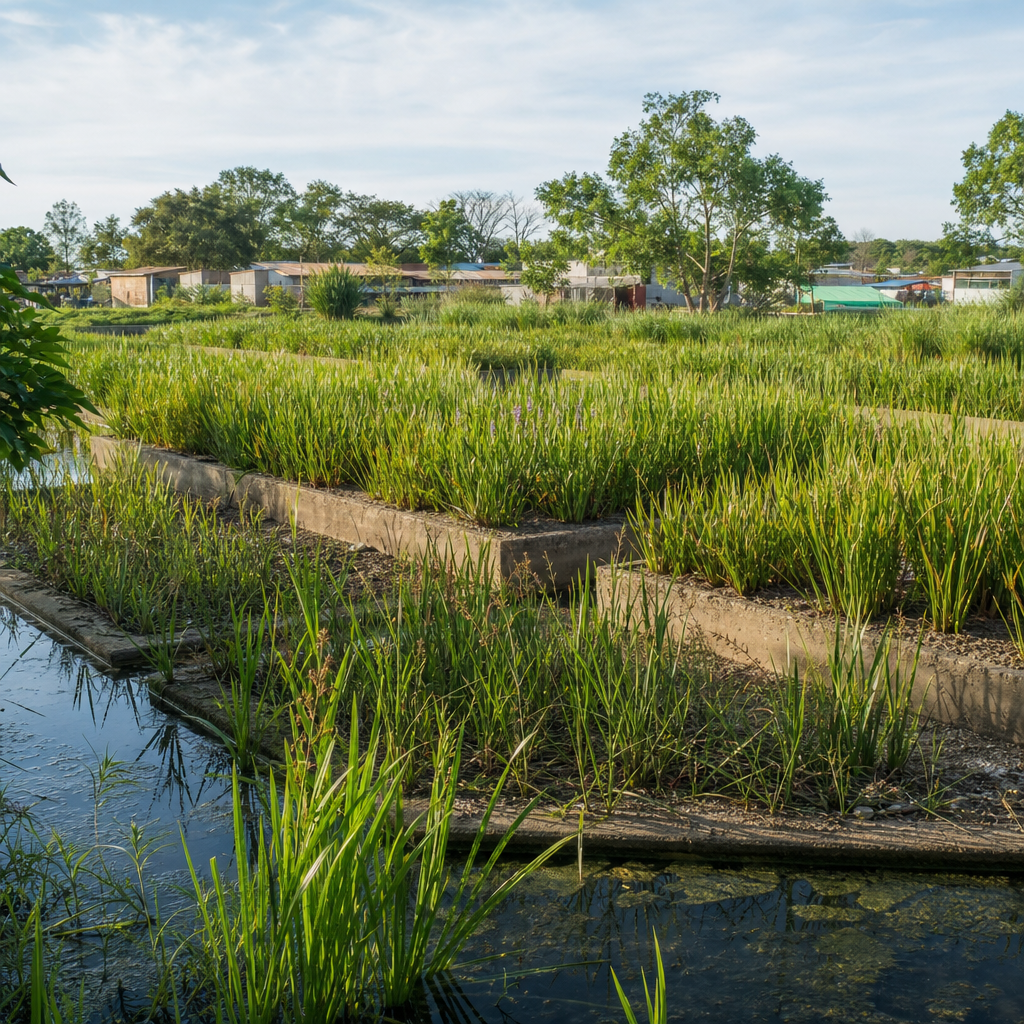
Constructed wetlands are designed treatment units that mimic the pollutant-removal functions of natural wetlands under controlled conditions. The main configurations are free water surface wetlands, horizontal subsurface flow wetlands, and vertical flow wetlands. In practice, most successful systems use pretreatment first, because wetlands are not meant to receive raw wastewater full of grit, grease, and large solids. A septic tank, settler, anaerobic baffled reactor, or screening chamber removes settleable matter before flow reaches the planted bed. That protects the media from clogging and gives the wetland a stable loading rate it can handle.
The treatment mechanisms are biological, physical, and chemical working together. Suspended particles are filtered or settle out. Biofilms on gravel, sand, and plant roots break down organic matter, commonly measured as biochemical oxygen demand and chemical oxygen demand. Nitrogen can be transformed through ammonification, nitrification, and denitrification when oxygen conditions are managed across different zones. Phosphorus may be adsorbed onto media containing iron, aluminum, or calcium, though this capacity declines over time. Pathogens are reduced by sedimentation, predation, natural die-off, ultraviolet exposure in surface systems, and filtration in subsurface systems. No single process does all the work. Performance comes from the combined ecology of water, media, plants, and microbes.
In the field, I have found that hydraulic design is what separates a wetland that performs reliably from one that becomes a shallow swamp with odor complaints. Designers look at hydraulic retention time, hydraulic loading rate, porosity, depth, inlet and outlet distribution, and seasonal temperature. For example, vertical flow wetlands usually provide better oxygen transfer and stronger nitrification, while horizontal subsurface flow wetlands are often good for denitrification and pathogen reduction. Hybrid systems combine both, using one stage to oxidize ammonia and another to remove nitrate. This is one reason wetlands fit EcoSan so well: they can be tailored to resource recovery and reuse goals rather than used as generic landscaping.
Where wetlands fit within EcoSan and circular resource management
EcoSan is not a single toilet model. It is a sanitation philosophy and system design approach focused on safe separation, treatment, and reuse of waste streams. Wetlands support EcoSan in several distinct ways. They can treat greywater from households so that water can be reused for landscaping or agriculture. They can polish blackwater effluent after anaerobic treatment. They can receive leachate or liquid fractions from fecal sludge management processes. They can also integrate with urine-diverting and composting sanitation in institutions, housing projects, and ecotourism sites where minimizing discharge is a core environmental objective.
A simple example is a school campus using urine-diverting dry toilets for nutrient capture, a septic or baffled reactor for kitchen and washwater, and a subsurface wetland for final treatment before irrigating nonfood trees. In that setup, each unit handles the stream it is best suited for. The dry toilet reduces water use and preserves nutrients. The anaerobic unit reduces solids and organic load. The wetland cuts the remaining pollutants and produces a safer effluent. Compared with a conventional flush-and-discharge arrangement, the site uses less water, releases fewer nutrients to nearby streams, and keeps treatment visible and manageable on site.
This hub topic also connects wetlands to broader environmental protection outcomes across the sanitation chain. Toilets influence what enters the treatment system. Collection affects leakage and methane losses. Treatment determines whether nutrients become pollution or productive inputs. Reuse determines whether water and soil benefits are realized locally. Wetlands sit at the intersection of these choices. They are not only treatment devices; they are ecological infrastructure that helps close loops. That makes them highly relevant for internal topic clusters on water reuse, decentralized systems, fecal sludge treatment, nutrient recovery, and low-carbon sanitation planning.
Environmental protection benefits wetlands deliver
The strongest environmental benefit of wetland-based sanitation is water quality protection. When wastewater rich in nitrogen, phosphorus, and organic matter reaches rivers without treatment, algae blooms increase, dissolved oxygen drops, and aquatic ecosystems decline. Wetlands reduce those loads before discharge or reuse. This matters especially in lakeside settlements, coastal communities, and agricultural catchments already under nutrient pressure. In several municipal and decentralized projects, wetland polishing has been used specifically to meet tighter effluent targets for total suspended solids, BOD, ammonia, and fecal indicators where primary treatment alone was inadequate.
Wetlands also support biodiversity when they are designed as part of the landscape instead of fenced-off utility corners. Emergent macrophytes such as Phragmites australis, Typha latifolia, Schoenoplectus, and Cyperus create habitat for insects, amphibians, and birds. That ecological value is not automatic; mosquito control, invasive species management, and safe human access must be planned carefully. Still, compared with bare concrete treatment units, a planted wetland can provide habitat while performing sanitation functions. For EcoSan projects seeking visible environmental benefits, that multifunctionality is a major advantage.
Climate resilience is another important benefit. Wetlands can buffer peak flows, slow runoff, and reduce erosion in storm-prone areas. Because they are passive systems, they continue operating during power outages that disable energy-dependent treatment units. Their operating costs are often lower than those of fully mechanized plants, particularly for small towns, institutions, and decentralized developments. They can also contribute to climate mitigation by reducing the need for high-energy aeration and by supporting biomass growth, although methane emissions from saturated zones must be considered honestly in the carbon balance. The environmental case is strongest when wetlands are well maintained, hydraulically sound, and paired with pretreatment that limits anaerobic overload.
Design choices, performance factors, and common tradeoffs
Wetlands are not plug-and-play solutions. Performance depends on wastewater characteristics, climate, land area, operation, and effluent objectives. The table below summarizes practical choices I evaluate when selecting a wetland system for sustainable sanitation projects.
| Design factor | Why it matters | Typical implication for EcoSan projects |
|---|---|---|
| Pretreatment quality | Removes solids and grease before the wetland | Better reliability, less clogging, lower maintenance frequency |
| Wetland type | Controls oxygen transfer and flow path | Vertical flow for nitrification; horizontal flow for denitrification and polishing |
| Media selection | Affects filtration and phosphorus adsorption | Special media can improve nutrient removal but may cost more |
| Hydraulic loading | Determines residence time and treatment contact | Overloading causes short-circuiting, odors, and weak effluent quality |
| Plant species | Influences rooting, maintenance, and local suitability | Native plants usually establish better and support local ecology |
| Climate and season | Temperature changes microbial activity | Cold conditions may require larger area or hybrid staging |
| End use of effluent | Sets the treatment target | Irrigation reuse needs a different risk approach than surface discharge |
Land requirement is the tradeoff most decision-makers notice first. Wetlands usually need more space than compact mechanical systems. In dense urban sites, that can be a decisive limitation. However, the comparison should include whole-life costs, energy demand, operator skill requirements, and resilience. A small activated sludge plant may fit on less land, but if spare parts are unreliable or electricity supply is erratic, the environmental performance on paper may not match real operation. I have repeatedly seen passive systems outperform sophisticated plants simply because the passive system was maintained and understood locally.
Another tradeoff is that nutrient removal, especially phosphorus removal, is not infinite. Media can saturate, and treatment efficiency can decline if loading exceeds design assumptions. Pathogen reduction is substantial but may not be sufficient alone for unrestricted reuse, so post-treatment, storage, or crop restrictions may still be needed under the World Health Organization’s Sanitation Safety Planning framework. Odor and mosquitoes are manageable but only with correct water levels, vegetation management, and avoidance of stagnant exposed pockets. In short, wetlands are robust, but they are not maintenance free.
Implementation lessons, governance needs, and the path forward
The most durable wetland sanitation projects share four traits: clear influent control, realistic operation plans, local ownership, and monitoring tied to actual reuse or discharge goals. Influent control means households or facilities do not dump oils, trash, industrial chemicals, or shock loads into a system sized for domestic wastewater. Operation plans include sludge removal from pretreatment tanks, inlet inspection, vegetation harvesting when needed, and periodic sampling for parameters such as BOD, TSS, ammonia, nitrate, and fecal contamination. Local ownership matters because wetlands are visible systems; if nobody feels responsible, blocked inlets and damaged outlets can go unnoticed for months.
Governance and regulation are just as important as engineering. Permits should match the intended function, whether polishing septic effluent, treating greywater, or producing irrigation water. Health authorities need to be involved when reuse is planned. Environmental agencies should recognize wetlands as treatment infrastructure, not empty land awaiting development. Financing models also need to account for long service life and low operating energy, because standard procurement often favors the cheapest upfront construction rather than the best environmental outcome over twenty years. For this hub under Environmental Impact, that is the larger lesson: EcoSan protects ecosystems best when design, operation, reuse, and regulation are aligned.
Wetlands play a central role in sustainable sanitation because they turn ecological processes into reliable environmental protection. They reduce pollution, support reuse, improve resilience, and make sanitation visible as part of watershed stewardship rather than an isolated utility task. For organizations building an EcoSan knowledge base, wetlands are the bridge topic linking decentralized treatment, nutrient recovery, biodiversity, water reuse, and climate adaptation. Use this page as your starting point, then map each sanitation decision back to its environmental effect. When wetlands are properly planned within the full sanitation chain, they do more than treat wastewater: they help communities protect water, soil, and ecosystems for the long term.
Frequently Asked Questions
What role do wetlands play in sustainable sanitation?
Wetlands play a central role in sustainable sanitation by treating wastewater and fecal sludge in a way that works with natural processes instead of against them. Whether they are protected natural wetlands or carefully engineered constructed wetlands, these systems rely on a combination of wetland plants, porous soils, microbial communities, and managed water flow to capture solids, break down organic matter, reduce pathogens, and remove excess nutrients such as nitrogen and phosphorus. In practical terms, this means wetlands can help turn contaminated water into a much safer effluent before it is released, reused, or allowed to infiltrate into the environment.
What makes wetlands especially valuable is that they connect sanitation to the wider landscape. A sanitation system should not end at the pipe, tank, or discharge point. If wastewater is simply moved from one place to another without proper treatment, the result is often polluted water bodies, nutrient overload, unsafe living conditions, and damage to ecosystems downstream. Wetlands address that gap by functioning as living treatment systems. They slow water down, increase contact time with beneficial microbes and plant roots, and create conditions where pollutants can be transformed, filtered, or stored safely.
From a sustainability perspective, wetlands are important because they can reduce dependence on energy-intensive treatment technologies, lower operating costs, and provide co-benefits such as habitat creation, flood buffering, and groundwater protection. When properly designed and maintained, they offer a resilient sanitation approach that aligns public health goals with ecological protection. That is why wetlands are increasingly recognized not just as environmental assets, but as core infrastructure in sustainable sanitation planning.
How do constructed wetlands treat wastewater and fecal sludge?
Constructed wetlands treat wastewater and fecal sludge through a layered set of physical, biological, and chemical processes. First, as water moves slowly through the wetland, heavier particles settle out and suspended solids become trapped within the substrate and plant root zones. This basic filtration effect already removes a significant portion of the visible and particulate pollution. At the same time, the wetland environment supports dense microbial communities that feed on organic matter, helping reduce biochemical oxygen demand and other pollutant loads that would otherwise deplete oxygen in rivers, lakes, or groundwater.
The plants in a constructed wetland do more than provide a green surface. Their roots stabilize the media, create pathways for water movement, and support biofilms of bacteria and other microorganisms that are responsible for much of the treatment work. Some wetland plants also transfer small amounts of oxygen into the root zone, which helps create alternating aerobic and anaerobic conditions. These varied conditions are critical because different pollutants are removed under different environmental states. For example, one set of microbes may convert ammonia into nitrate, while another set may transform nitrate into nitrogen gas, effectively removing nitrogen from the system.
Pathogen reduction happens through several mechanisms as well, including sedimentation, filtration, natural die-off, predation by other organisms, exposure to sunlight in some wetland designs, and unfavorable conditions for pathogen survival over time. Phosphorus may be removed through adsorption to soils or media, plant uptake, and chemical binding, though its long-term removal performance depends heavily on the chosen substrate and loading rates. In fecal sludge management, wetlands are also used for sludge drying and dewatering, where planted drying beds help separate liquids from solids and improve stabilization. The key to success is matching the wetland type, hydraulic loading, and maintenance plan to the actual wastewater characteristics rather than assuming one design fits every context.
Why are wetlands considered more environmentally sustainable than conventional wastewater treatment in some settings?
Wetlands are often considered more environmentally sustainable because they can achieve meaningful wastewater treatment with lower energy inputs, fewer mechanical components, and stronger integration with local ecosystems. Conventional treatment plants can be highly effective, especially in dense urban areas with strong institutional capacity, but they often depend on continuous electricity, skilled operators, chemical inputs, and expensive maintenance. In contrast, many wetland-based systems use gravity flow, natural biological activity, and passive treatment processes, which can make them especially appropriate in rural areas, peri-urban settlements, small towns, and decentralized sanitation projects.
Another major sustainability advantage is that wetlands support circular thinking. Rather than treating wastewater as a waste to be rapidly discharged, wetlands frame sanitation as part of a broader resource and water management system. They can reduce nutrient release into receiving waters, support water reuse strategies, protect downstream fisheries and aquatic habitats, and in some designs contribute to biomass production or landscape restoration. They also help build resilience by buffering shocks such as variable flows, seasonal changes, and limited infrastructure budgets, provided they are sized and managed correctly.
That said, sustainability does not mean wetlands are automatically the best option everywhere. They require land, thoughtful design, and routine maintenance to avoid clogging, short-circuiting, overloading, or mosquito concerns. Poorly designed systems can fail just as badly as poorly designed conventional systems. The real environmental benefit appears when wetlands are planned as part of the sanitation chain, from collection and conveyance to treatment, reuse, and safe discharge. In those situations, they can provide a practical balance of public health protection, ecosystem conservation, and long-term affordability.
What are the biggest design and management challenges when using wetlands for sanitation?
One of the biggest challenges is underestimating the complexity of the sanitation problem. Wetlands are sometimes presented as simple, low-maintenance solutions, but in reality they need careful engineering and management. The first major issue is matching the system to the waste stream. Domestic wastewater, greywater, septage, and fecal sludge all have very different characteristics. If designers treat everything as ordinary wastewater and ignore solids content, hydraulic variation, or shock loading, the wetland can quickly become overloaded. That often leads to clogging, odors, poor treatment performance, and premature system failure.
Hydraulic design is another critical challenge. Water must be distributed evenly across the wetland and retained long enough for treatment to occur. If flow short-circuits through just one portion of the system, much of the wetland area becomes ineffective. Site conditions also matter enormously, including soil type, slope, climate, flood risk, groundwater depth, and seasonal rainfall patterns. In some regions, wetlands must be designed to handle intense wet seasons without washing out, while in drier climates they may need protection against drying and vegetation stress. The choice of media and plant species must reflect those local conditions rather than relying on generic templates.
Management and maintenance are just as important as design. Inlet structures need inspection, vegetation may need periodic harvesting or control, sediments and accumulated solids must be removed on schedule, and operators need to monitor water levels and effluent quality. Community acceptance also affects success, especially if people associate wetlands with stagnant water or assume natural systems require no oversight. The most successful projects usually emerge when wetlands are treated as essential treatment infrastructure, supported by realistic budgets, operator training, and long-term institutional responsibility. In other words, wetlands work best when sanitation is planned as a system embedded in a living landscape, not merely as a pipe-and-discharge exercise.
Can wetlands be used in both urban and rural sanitation systems?
Yes, wetlands can be used in both urban and rural sanitation systems, but the form they take and the role they play may differ significantly by context. In rural areas and small communities, constructed wetlands are often well suited to decentralized treatment because land is more available, flows are lower, and there may be strong demand for systems that are robust, affordable, and easy to operate without advanced machinery. They can be connected to septic tanks, simplified sewers, community treatment systems, schools, health centers, or fecal sludge treatment sites, providing effective polishing or primary biological treatment depending on the design.
In urban and peri-urban areas, wetlands can still be valuable, although space constraints usually require more careful planning. They may be used as part of hybrid systems, for example after preliminary settling, anaerobic treatment, or mechanical pre-treatment. In dense settings, wetlands often serve as secondary or tertiary treatment units that improve effluent quality before discharge or reuse. They can also be integrated into green infrastructure networks, combining wastewater treatment with stormwater management, flood control, heat reduction, and urban biodiversity benefits. This multifunctional role is one reason cities are paying growing attention to wetland-based sanitation solutions.
The main point is that wetlands are not limited to one scale or one geography. Their usefulness depends on whether they are adapted to the local sanitation chain, land availability, regulatory framework, maintenance capacity, and treatment goals. In both urban and rural settings, the strongest results come from realistic design and proper operation, not from assuming that a natural-looking system will perform well on its own. When planned carefully, wetlands can help communities protect water resources, manage nutrients responsibly, and build sanitation systems that are both effective and environmentally sound.