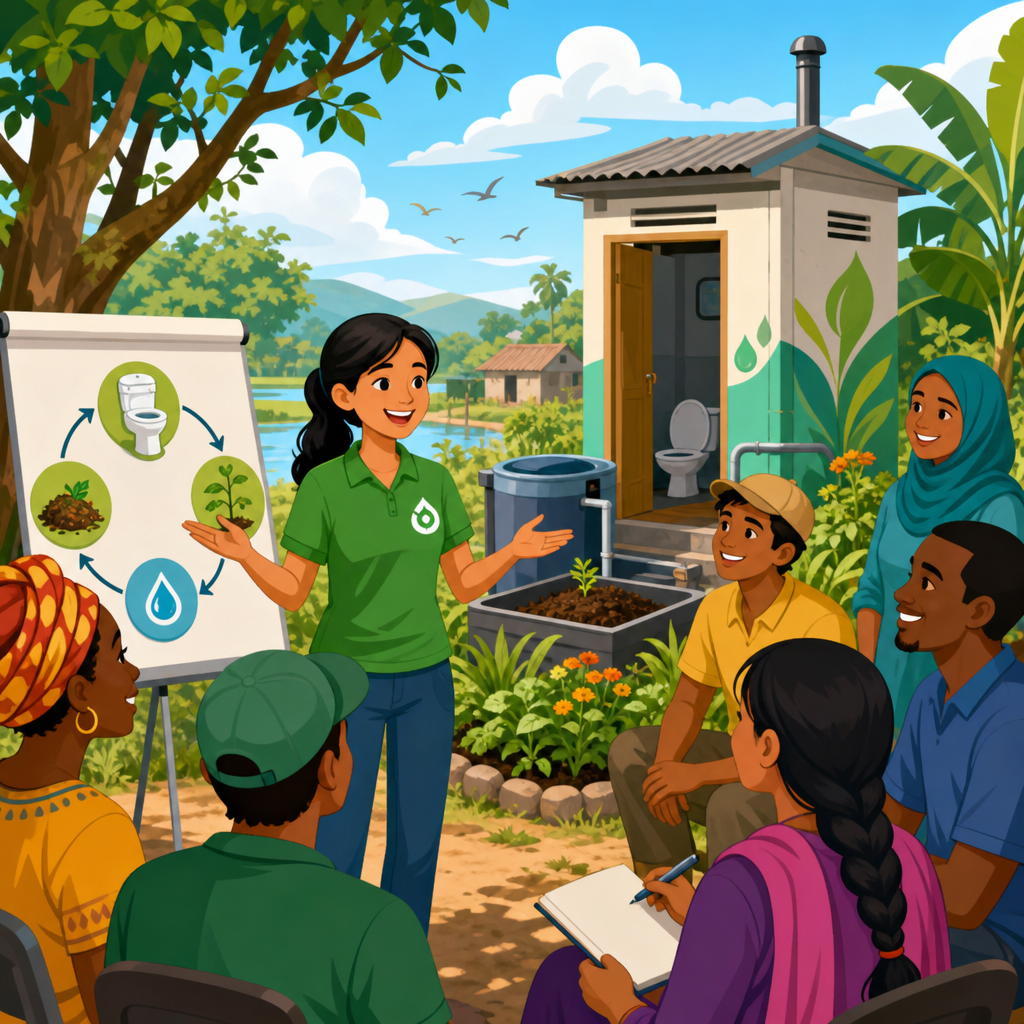
Understanding community dynamics in EcoSan projects is essential because ecological sanitation succeeds or fails long before a toilet is built, at the point where people decide whether a new system fits local habits, values, risks, and expectations. In practice, EcoSan refers to sanitation approaches that safely separate, treat, and reuse nutrients, water, and organic matter from human waste rather than treating excreta only as something to dispose of. Community dynamics means the patterns of trust, leadership, conflict, inclusion, learning, and collective decision-making that shape how a group responds to change. This matters because EcoSan projects depend on daily user behavior: correct separation, maintenance, safe handling, and acceptance of reuse. I have seen technically sound systems underperform because households were not involved early, while modest designs worked well when residents understood the purpose, trusted facilitators, and felt ownership.
As a hub within community engagement and education, this article explains how to foster participation and learning across the full life of an EcoSan project. It covers why communities adopt or reject sanitation innovations, how participation should be structured, which education methods actually change practice, and how local institutions sustain results. The central point is straightforward: community engagement is not an awareness campaign added after engineering decisions. It is the operational core of implementation, influencing design choices, uptake, safety, financing, and long-term performance. When participation is meaningful and learning is continuous, EcoSan can improve public health, protect water resources, recover nutrients for agriculture, and strengthen local capacity instead of becoming another abandoned pilot.
Why community dynamics determine EcoSan outcomes
EcoSan projects are unusually sensitive to social context because users interact with the system every day. A sewer connection usually hides treatment from households; an EcoSan system often asks people to separate urine and feces, add cover material, monitor vault filling, arrange emptying, or apply treated products in agriculture. That means adoption depends on convenience, dignity, perceived cleanliness, and social legitimacy as much as on engineering. The first question communities ask is practical: will this make life easier or harder? The second is social: will others see this as acceptable? The third is economic: who pays, who benefits, and who carries the labor?
In fieldwork, the strongest predictor of success is rarely initial enthusiasm at a launch event. It is whether local norms and institutions support routine behavior over months and years. For example, if women are responsible for cleaning but men control budgets, design discussions must include both groups. If tenant households cannot modify compounds, landlords must be engaged. If farmers are expected to use sanitized compost or urine, they need evidence about crop response, safety protocols from World Health Organization guidance, and a reliable distribution model. Community dynamics also influence rumor control. Misunderstandings about odor, disease, or religious acceptability can spread quickly unless trusted local voices address them early.
Power relations matter. Village chiefs, elected councilors, teachers, health workers, religious leaders, savings groups, and informal youth leaders each influence adoption differently. A project that consults only formal leaders can miss the people who actually shape daily behavior. Social stratification matters too. Caste, class, ethnicity, disability status, migrant status, and land tenure can determine whose needs are reflected in siting, design, and training. EcoSan projects that ignore these dynamics often produce low usage, unsafe handling, or quiet resistance. Projects that map them clearly can tailor engagement, reduce conflict, and create shared accountability.
Participation that goes beyond consultation
Meaningful participation means communities influence decisions, not just attend meetings. In successful EcoSan work, participation starts with diagnosis: who lacks sanitation, what practices are already in use, what seasonal constraints affect water and access, and what reuse opportunities exist. Tools such as stakeholder mapping, social mapping, transect walks, focus group discussions, and household interviews are effective because they reveal lived experience instead of assumptions. I have found transect walks especially useful; residents point out flood-prone zones, informal dumping spots, routes children take at night, and compounds where disabled family members need easier access. Those observations directly shape design.
Participation should continue through option selection. Communities need plain-language comparisons between urine-diverting dry toilets, arborloo variants, composting systems, and hybrid approaches. They should understand space requirements, user tasks, cost profiles, odor risks, maintenance demands, and the timeline for safe reuse. When choices are presented transparently, households can select what they are willing and able to manage. This is where many projects go wrong: they present one preferred technology and call the meeting participatory. Real participation accepts that some households may need different models or phased adoption.
| Project stage | Participation objective | Practical methods | Common risk if skipped |
|---|---|---|---|
| Assessment | Understand needs, norms, and constraints | Social mapping, interviews, transect walks | Designs that ignore daily realities |
| Option selection | Match technology to user capacity | Demonstrations, cost comparisons, Q&A sessions | Low adoption and misuse |
| Construction | Build ownership and transparency | Labor planning, local procurement review, site supervision committees | Distrust over quality or spending |
| Operation | Support correct routine use | User training, caretaker coaching, reminder materials | Odor, contamination, abandonment |
| Reuse and scale-up | Normalize benefits and spread learning | Farmer trials, peer visits, public results sharing | Recovered resources remain unused |
Participation also needs defined roles. Community sanitation committees can help, but only if their mandate is clear: grievance handling, fee oversight, maintenance scheduling, and liaison with service providers. Vague committees often become symbolic. Effective ones include women, youth, and marginalized residents, keep basic records, and meet on a known schedule. In urban settlements, resident associations and compound managers may be more relevant than village committees. The principle is constant: people support what they help shape, monitor, and improve.
How learning changes sanitation behavior
Education in EcoSan projects must move beyond one-off hygiene talks. People need practical learning that connects sanitation behavior to visible outcomes. Adults rarely change routines because of abstract messaging alone; they change when they understand the reason, see the method, practice the skill, and trust the result. For that reason, the most effective learning sequence is explain, demonstrate, rehearse, and follow up. If users must add ash or dry cover material after defecation, training should include a live demonstration at the facility, not just a poster. If urine is reused in agriculture, farmers should see dilution practices, application timing, and crop performance in a local plot.
Social learning is especially powerful. Households are more likely to adopt unfamiliar sanitation practices when they see neighbors using them without smell, flies, or embarrassment. Peer educators, school sanitation clubs, and model households help convert a technical idea into a normal social practice. In one program I supported, adoption improved only after experienced users hosted compound-level visits. New households asked practical questions they would never raise in a public meeting: what happens during menstruation, how do children use the system, what if guests are confused, and how often does emptying happen? Honest peer answers did more than polished presentations.
Learning should be segmented by audience. Caretakers need operational detail. Community leaders need governance and accountability information. Farmers need evidence on nutrient value, handling safety, and market implications. Teachers need age-appropriate sanitation content linked to science and health curricula. Children need simple routines and supervision, not long lectures. Messaging should also reflect literacy levels and languages used locally. Visual instructions, color coding, and tactile demonstrations often outperform text-heavy materials. Where mobile phone use is common, short reminder messages or WhatsApp groups can reinforce correct practice, but digital tools should support, not replace, face-to-face engagement.
Building trust, inclusion, and local leadership
Trust is the currency of community participation. People are asked to change intimate habits, contribute money or labor, and sometimes handle products derived from human waste. Without trust, even accurate information will be discounted. Trust grows when projects are transparent about costs, responsibilities, safety measures, and limitations. If a system requires regular emptying, say so clearly. If reused products need a storage period or restricted crop application, explain why. Overpromising damages credibility. Communities respect honesty, especially when facilitators acknowledge tradeoffs and invite local problem-solving.
Inclusion is not a moral add-on; it is a technical requirement. Sanitation systems used by elderly residents, people with disabilities, pregnant women, children, and night-shift workers must reflect their needs. Features such as handrails, wider doors, child-friendly seats, lighting, privacy screens, and nearby handwashing points affect whether facilities are actually used. Social inclusion also means ensuring that lower-income households, tenants, and minority groups can participate in decisions and access benefits. Subsidy design matters here. Poorly targeted subsidies can create resentment or exclude vulnerable families who lack upfront cash. Transparent eligibility criteria and community validation reduce conflict.
Local leadership should be cultivated deliberately. Strong EcoSan programs identify respected individuals who can bridge technical guidance and community concerns. These may be natural leaders rather than office holders. Training them as facilitators, operators, or demonstration hosts creates continuity after external teams leave. However, leadership must not become gatekeeping. I have seen projects stall because one influential person controlled information and access. Distributed leadership works better: trained masons, women’s group representatives, school champions, health volunteers, and farmer leaders each carry part of the effort. This spreads knowledge, reduces dependency, and makes the project more resilient.
Linking participation to operation, maintenance, and reuse
The real test of community engagement comes after construction. EcoSan systems require clear routines for cleaning, supply of cover material, inspection of urine diversion components, safe emptying, and management of treated outputs. If these responsibilities are not agreed in advance, facilities degrade quickly. Household systems need user checklists and periodic follow-up. Shared or school systems need assigned caretakers, budgets for consumables, and escalation paths when repairs are needed. A maintenance plan should specify who does what, when, with which tools, and using which safety precautions. General encouragement is not enough.
Resource recovery is where learning and participation can create visible value. Urine contains readily available nitrogen and some phosphorus and potassium, while properly treated fecal matter can contribute organic matter and nutrients to soil. But reuse only works when quality control and risk management are credible. Communities need guidance aligned with recognized sanitation safety planning principles: storage time, personal protective equipment, restricted crop use where relevant, hand hygiene, and recordkeeping. Demonstration plots are especially useful because they translate theory into observed results. When farmers compare treated inputs on maize, vegetables, or trees and see cost savings against commercial fertilizer, acceptance often rises.
Economic participation also matters. Some communities can sustain EcoSan better with user fees, savings groups, revolving funds, or microenterprise models for emptying and reuse product distribution. Others need municipal support because incomes are too low or settlement tenure is insecure. There is no universal financing model. What matters is that the community understands the cost structure and agrees on a fair mechanism. Hidden subsidy dependence is risky. A project should know how spare parts, repairs, and labor will be paid for in year two, not just during donor funding. Long-term functionality depends on this realism.
Measuring what communities are actually learning
Many projects measure attendance at meetings and call that engagement. That is inadequate. The better question is whether people can use the system correctly, explain why certain steps matter, and solve routine problems without external intervention. Good monitoring includes adoption rates, correct usage observations, maintenance records, cleanliness scores, queue times for shared facilities, handwashing availability, and user satisfaction disaggregated by gender, age, and disability. For reuse, it should include storage compliance, application practices, and farmer feedback. These indicators reveal whether learning has translated into safe behavior.
Qualitative feedback is just as important as numeric metrics. Regular reflection meetings, complaint logs, and structured follow-up interviews uncover barriers that dashboards miss. A latrine may be technically functional but avoided at night because lighting is poor. A school system may be clean in inspections yet misused by younger children who were never properly trained. A reuse scheme may underperform because transport containers are inconvenient, not because farmers reject the concept. Adaptive management depends on listening for these details and adjusting quickly.
As the hub for fostering participation and learning in EcoSan projects, this article makes one point clear: sanitation change is social before it is technical. Successful programs understand community dynamics, create genuine participation, teach practical skills, build trust through transparency, and connect operation and reuse to local institutions and incentives. They recognize diversity within communities instead of treating residents as one audience. They monitor behavior and confidence, not just infrastructure counts. Most importantly, they design engagement as an ongoing system, not a launch activity.
If you are planning or improving an EcoSan initiative, start by mapping stakeholders, daily sanitation practices, and decision-making patterns before finalizing technology choices. Then build a participation and learning plan that continues through construction, operation, and reuse. Done well, this approach increases adoption, safety, and long-term value for households and institutions alike. Use this hub as your foundation for deeper work on facilitation methods, training design, inclusion strategies, and community-led maintenance systems.
Frequently Asked Questions
Why are community dynamics so important in EcoSan projects?
Community dynamics are central to EcoSan success because sanitation systems are never purely technical. Even the best-designed ecological sanitation model can fail if it does not align with local routines, beliefs, social relationships, and decision-making patterns. In EcoSan projects, people are being asked to use sanitation differently, often by separating urine and feces, adopting new cleaning or maintenance habits, or accepting the idea of treated waste as a resource. These changes affect privacy, gender roles, labor distribution, cultural norms, and trust in local institutions. If project planners focus only on infrastructure, they can miss the social realities that determine whether people will consistently use, maintain, and value the system.
Community dynamics also shape who participates, who benefits, and who carries the burden of operation. In many communities, women, tenants, elders, people with disabilities, and lower-income households experience sanitation differently, yet their voices are often underrepresented in planning meetings. Understanding community dynamics means identifying both formal leaders and informal influencers, recognizing possible conflicts, and understanding how people make household and collective decisions. It also means paying attention to local perceptions of dignity, cleanliness, safety, smell, convenience, and agricultural reuse. When a project is designed around these realities, adoption is stronger, maintenance is more reliable, and long-term ownership becomes much more likely.
What social and cultural factors most influence whether an EcoSan system will be accepted?
Acceptance of an EcoSan system is strongly influenced by daily habits, cultural beliefs, and local definitions of what is clean, safe, respectable, and practical. One of the most important factors is whether the system fits established toilet-use behavior. If a design requires users to sit differently, separate waste streams, add ash or cover material, or manage composted outputs, those actions must feel realistic within local routines. Cultural attitudes toward handling human waste are especially important. In some places, treated excreta reuse in agriculture may be seen as practical and valuable; in others, it may be viewed as taboo regardless of the treatment process. These perceptions cannot be assumed, and they often vary by age, occupation, religion, and social status.
Gender and household roles are also major influences. Women may care most about privacy, menstrual hygiene management, child usability, and safety at night, while men may focus more on construction costs or agricultural benefits. Caregivers may worry about how children, older adults, or people with limited mobility will use the system. Social status can matter as well, because some households may resist a technology they perceive as “for the poor,” while others may adopt it if respected local figures publicly support it. Trust is another critical factor. If communities do not trust the organization promoting the project, the local government, or the claims being made about treatment and reuse safety, skepticism can quickly undermine uptake. Successful EcoSan programs therefore engage with community values directly, test assumptions early, and adapt both messaging and design to local social realities.
How can project teams effectively engage communities during EcoSan planning and implementation?
Effective community engagement in EcoSan projects starts well before construction and continues long after installation. The strongest approach is participatory rather than purely instructional. Instead of presenting a fixed design and asking for approval, project teams should begin by listening: mapping current sanitation practices, identifying pain points, understanding seasonal challenges, and learning how people perceive waste, water use, farming inputs, and household responsibilities. This process should include a broad cross-section of the community, not only officials or vocal leaders. Women, youth, renters, farmers, school staff, sanitation workers, and marginalized groups often have insights that are essential to practical system design but are frequently overlooked.
Good engagement also means making the technology understandable and visible. Demonstrations, pilot units, user visits to successful sites, and open discussions about odor, maintenance, health safety, and costs help build informed consent rather than passive compliance. Project teams should clearly explain what users will need to do, what support will be available, and what happens if something goes wrong. It is also important to create feedback mechanisms that allow concerns to surface early, such as user committees, household visits, and regular follow-up meetings. During implementation, teams should train users and caretakers in operation and maintenance using accessible language and practical demonstrations. Most importantly, engagement must be iterative. If monitoring shows that people are not using the system as intended, the response should not be to blame the community, but to learn which social or design assumptions were wrong and adjust accordingly.
What are the most common community-related challenges in EcoSan projects, and how can they be addressed?
One of the most common challenges is mismatch between the system design and everyday user behavior. A toilet may be technically sound but difficult to use in practice, especially if instructions are unclear or if the design does not work well for children, elderly users, or people with disabilities. Another frequent issue is resistance to handling or reusing treated by-products. Even when treatment is safe, communities may reject the idea if communication has been weak or if local beliefs make reuse unacceptable. There can also be disagreements over responsibility for cleaning, emptying, transport, and long-term maintenance. If no one is clearly accountable, systems often fall into disrepair. In shared or institutional settings, disputes around fees, labor, and enforcement are especially common.
Power imbalances create additional problems. Local elites may dominate decision-making, leaving others with systems that do not meet their needs. Tenants may be excluded because landlords make sanitation decisions. Women may be expected to maintain systems without having had a voice in design choices. Addressing these challenges requires both technical flexibility and social process discipline. Project teams should conduct inclusive assessments, pilot designs before scaling, and discuss maintenance roles openly from the start. They should also establish realistic service arrangements for monitoring, repairs, and safe management of outputs. Communication should be honest and specific, not overly promotional. When concerns are raised about smell, labor, cost, safety, or social stigma, they should be treated as legitimate implementation issues, not as ignorance. In many cases, the solution is not simply more awareness raising, but redesigning the system or the management model so that it fits community capacity and expectations.
How can communities build long-term ownership and sustainability in EcoSan projects?
Long-term ownership develops when community members see EcoSan not as an external experiment, but as a useful system that they understand, trust, and can manage. This requires more than initial acceptance. Users need clear benefits, whether those are improved sanitation access, lower water use, safer containment, fertilizer value, reduced flooding impacts, or lower long-term costs. They also need confidence that the system is reliable and that support exists for maintenance and troubleshooting. Training is crucial, but it must be ongoing and practical. Households, caretakers, artisans, local officials, and service providers all need to know their roles. Where possible, local supply chains for spare parts, cover materials, emptying services, and treatment support should be developed so the system does not depend indefinitely on outside organizations.
Strong ownership also depends on governance and accountability. Communities are more likely to sustain EcoSan systems when responsibilities are clearly defined, costs are transparent, and users have a say in how decisions are made. Local committees can help, but only if they are representative and active rather than symbolic. Monitoring should include not just whether toilets were built, but whether they are being used correctly, maintained safely, and perceived positively over time. Celebrating local success, sharing user experiences, and building peer learning across neighborhoods or villages can reinforce confidence and normalize adoption. Ultimately, sustainable EcoSan is achieved when social systems and technical systems are designed together. The infrastructure must fit the community, and the community must be equipped, organized, and motivated to keep the infrastructure working well for years to come.