Water quality monitoring in EcoSan systems is the practical foundation of prioritizing health in EcoSan, because every sanitation decision eventually affects what people drink, wash with, irrigate with, and release back into the environment. Ecological sanitation, often shortened to EcoSan, is a sanitation approach that treats human waste as a resource to be safely managed, processed, and reused rather than simply discarded. In field projects I have supported, the health conversation always becomes concrete when teams start asking measurable questions: Is stored urine microbiologically safe for reuse? Has composted fecal material reached adequate stabilization? Are nearby shallow wells protected from nitrate leaching? Can household greywater be reused without increasing pathogen exposure? Water quality monitoring gives direct answers to those questions.
In EcoSan, water quality monitoring means routinely testing physical, chemical, and microbiological indicators at points where contamination could occur. That includes drinking water sources near sanitation units, stored reuse products, drainage channels, greywater reuse systems, handwashing stations, and soil water in intensive agricultural settings. Key terms matter. Pathogens are disease-causing organisms such as bacteria, viruses, protozoa, and helminths. Indicator organisms, especially Escherichia coli, are used to signal fecal contamination. Nutrients such as nitrogen and phosphorus can be beneficial in agriculture but harmful in groundwater or surface water when concentrations become excessive. Turbidity, pH, electrical conductivity, dissolved oxygen, and biochemical oxygen demand all help describe whether water is suitable for a particular use and whether a system is operating safely.
This topic matters because EcoSan succeeds only when resource recovery and public health protection advance together. A urine-diverting dry toilet can reduce water use, conserve nutrients, and lower pressure on sewers, but poor storage, leakage, or unsafe handling can still create infection risks. A decentralized greywater garden can support local food production, yet if soap residues, sodium, grease, or pathogens are not monitored, the result can be soil degradation and exposure. Communities, regulators, NGOs, and households need a clear health-centered framework. This article serves as the hub for prioritizing health in EcoSan by explaining what to monitor, where to monitor, how often to monitor, and how to use results to improve system design, operation, training, and risk communication.
Why water quality monitoring is central to health protection in EcoSan
Water quality monitoring protects health by identifying hazards before they become outbreaks, chronic exposures, or silent environmental failures. In conventional sewered systems, contamination pathways are often hidden underground and managed by utilities. In EcoSan, many treatment and reuse steps happen at household, school, farm, or community scale, so the margin for operator error is narrower. Monitoring confirms whether barriers are working. If a urine storage tank has cracked seals, conductivity may remain high but nearby groundwater nitrate can start rising. If fecal composting temperatures never exceed recommended levels, helminth eggs can survive. If handwashing stations are poorly maintained, the sanitation system can technically function while still increasing disease risk through inadequate hygiene support.
The most useful way to think about health in EcoSan is as a chain of barriers. Source separation reduces cross-contamination. Containment prevents leakage. Storage and treatment reduce pathogens. Safe transport prevents occupational exposure. Controlled reuse protects users and consumers. Monitoring checks each barrier. The World Health Organization sanitation safety planning approach is especially valuable here because it links hazards, exposure routes, control measures, and verification. In practice, that means not only testing treated outputs but also checking whether diversion pans are intact, vaults stay dry, users follow ash or cover-material instructions, and runoff from the site is prevented during storms.
Real-world failures usually involve combinations of small weaknesses rather than one dramatic breakdown. I have seen community systems where the toilet superstructure was well built, but children urinated into the feces vault, raising moisture and reducing pathogen die-off. I have also seen school EcoSan toilets with excellent separation, yet cleaning water was dumped into an adjacent soak pit too close to a handpump. Water quality monitoring catches these linkages. It shifts health protection from assumptions to evidence, which is exactly what a health-and-safety hub page should emphasize.
What to monitor: priority indicators, thresholds, and health meaning
The right monitoring plan starts with intended water use and likely contamination routes. For drinking water sources near EcoSan systems, the priority parameters are E. coli, nitrate, turbidity, and sometimes conductivity and ammonium. E. coli should be absent in 100 milliliters of drinking water. Nitrate is commonly assessed against a limit of 50 milligrams per liter as nitrate, equivalent to about 11.3 milligrams per liter as nitrate-nitrogen, because higher levels are associated with infant methemoglobinemia risk. Turbidity matters because cloudy water can shield microbes from disinfection and often signals surface intrusion.
For treated urine intended for agricultural reuse, the priority issues are storage time, pH, ammonia conditions, and application controls rather than only end-point lab tests. Urine is typically low in enteric pathogens compared with feces, but cross-contamination can occur. Where guidelines allow reuse, monitoring should confirm effective separation, proper storage, and restricted application timing before harvest. For composted or dehydrated fecal products, indicator testing may include E. coli, helminth eggs in high-risk settings, moisture content, temperature logs, and pH where alkaline treatment is used. In regions with endemic helminths, egg inactivation is often the decisive health metric, not odor or appearance.
Greywater linked to EcoSan systems requires a different lens. If reused for subsurface irrigation, sodium adsorption concerns, surfactants, fats, oils, grease, and suspended solids can affect both health and performance. If greywater is discharged to the environment, biochemical oxygen demand and pathogen indicators matter more. Because many decentralized sites cannot afford full laboratory panels every month, a tiered strategy works best: frequent field checks for pH, conductivity, turbidity, and residual chlorine where relevant, backed by periodic accredited laboratory testing for microbiology and nutrients.
| Monitoring target | Primary indicators | Why it matters for health | Typical action if results are poor |
|---|---|---|---|
| Nearby drinking water source | E. coli, nitrate, turbidity | Shows fecal contamination and groundwater impact | Inspect setbacks, repair leaks, disinfect, provide alternate water |
| Stored urine for reuse | Separation quality, storage time, pH | Confirms pathogen reduction assumptions | Extend storage, prevent fecal mixing, restrict crop use |
| Fecal compost or dehydrated material | E. coli, helminth eggs, moisture, temperature | Determines whether handling and reuse are safe | Continue treatment, improve drying, retrain operators |
| Greywater reuse stream | Turbidity, BOD, sodium-related parameters, E. coli | Protects users, crops, and soil function | Improve pretreatment, change detergents, modify irrigation method |
Where and when to monitor across the EcoSan system
Sampling location determines whether data are actually useful. A strong EcoSan monitoring plan includes upstream, process, and downstream points. Upstream samples establish the baseline quality of the original water supply. Process samples show whether treatment barriers are performing. Downstream samples reveal whether the wider environment is being protected. For example, if a rural school uses urine-diverting toilets and a greywater soak bed, I would sample the handpump used for drinking, the urine storage container, the compost vault output before handling, and any shallow monitoring point or nearby well downgradient during wet weather if groundwater vulnerability is high.
Timing matters just as much as location. One-off testing is not monitoring. Seasonal variation, occupancy shifts, and rainfall change risk patterns. In many decentralized systems, the highest contamination risk appears during the first heavy rains after a dry period, when accumulated residues are mobilized. Schools often show different water quality profiles during term time versus holidays. Agricultural reuse risk changes with planting and harvest cycles. A practical schedule usually combines routine checks, event-based checks, and verification after repairs or user complaints. Monthly sanitary inspections, quarterly microbiological tests for nearby water points, and annual broader chemistry panels are often more useful than expensive but irregular campaigns.
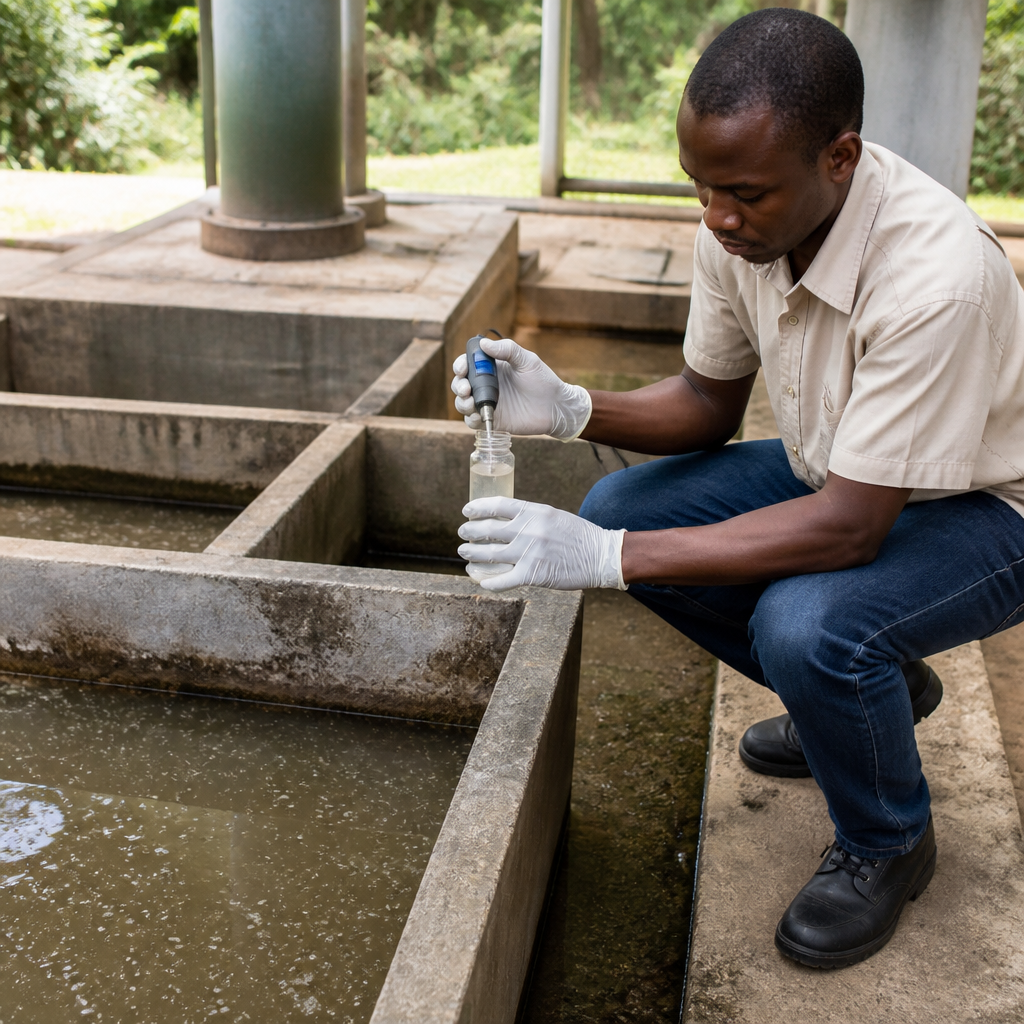
Good sampling discipline is non-negotiable. Containers must match the analysis, chain of custody should be documented, and holding times must be respected. Microbiological samples collected in non-sterile bottles or left in the sun can invalidate the whole exercise. When budgets are limited, fewer high-quality samples beat many poor ones. Low-cost field kits from providers such as Hach, Palintest, and Wagtech can support routine work, but confirmation through accredited laboratories is still important, especially when results trigger public health decisions, regulatory reporting, or changes in reuse permissions.
Interpreting results and responding to common health risks
Monitoring only protects health when results lead to action. The first question is whether the result indicates immediate human exposure. E. coli in a drinking water point near an EcoSan installation requires urgent response, because it means fecal contamination has occurred through source intrusion, handling failures, runoff, or sample point contamination. Immediate steps include restricting use, providing interim treatment or alternate supply, inspecting the water point apron and drainage, checking toilet setbacks, and tracing whether stormwater flow paths connect the sanitation area to the source. Do not assume the toilet is automatically the cause; animal access, broken well seals, and unsafe storage containers are frequent contributors.
Nitrate trends need a different response. A single mildly elevated result may reflect agricultural fertilizer, livestock areas, or natural background conditions, but a rising pattern after EcoSan installation deserves investigation. I look first at infiltration pathways, overflow events, and whether urine or leachate is being stored on permeable ground. Corrective measures may include tank replacement, secondary containment, relocation, lining improvements, or revised application rates. For compost outputs, the common mistake is judging safety by smell, texture, or the time since vault closure. Pathogen reduction depends on temperature, moisture, pH, and time together. If tests show insufficient reduction, the answer is more treatment and better process control, not wishful reuse.
Communication is part of interpretation. Households and operators need simple, direct explanations: what was tested, what the result means, what behavior should change, and when follow-up testing will happen. Color-coded dashboards can help, but clarity matters more than graphics. In community projects, transparent reporting builds trust. People are more willing to maintain separation toilets and storage protocols when they see evidence that these actions protect water and make reuse safer.
Building a practical monitoring program for households, schools, and communities
An effective program balances risk, cost, and local capacity. Start with a sanitary risk assessment before writing the sampling plan. Map toilets, storage vessels, composting areas, gardens, drainage, wells, handpumps, boreholes, flood zones, and neighboring plots. Note soil type, groundwater depth, and seasonal runoff. Then define the decisions the monitoring program must support. A household system may need only periodic verification that the well remains uncontaminated and that reuse materials meet safe handling criteria. A school or market facility needs a more formal schedule because user turnover is high and accountability is diffuse. A community-scale reuse scheme supplying agriculture may require documented standard operating procedures, laboratory contracts, and traceable records.
Roles must be explicit. Operators inspect structure and cleanliness. Health officers review microbiology and incident reports. Agricultural extension staff advise on reuse restrictions. Local laboratories validate methods. Community leaders help enforce safe handling and child protection around treatment areas. In well-run EcoSan programs, monitoring is linked to maintenance triggers: repair a diversion pedestal if moisture rises, retrain users if fecal contamination appears in stored urine, remove sludge from grease traps if greywater turbidity climbs, and investigate setbacks if groundwater indicators deteriorate.
This hub article connects the wider health-and-safety subtopic. The next level of detail should include safe urine reuse, pathogen die-off in composting and dehydration, groundwater protection distances, greywater treatment options, operator personal protective equipment, child-safe toilet design, hand hygiene integration, and outbreak response planning. Together, those topics turn monitoring data into daily health protection practices.
Water quality monitoring in EcoSan systems works because it turns a broad health goal into routine, verifiable actions. The main lesson is simple: safe ecological sanitation is never achieved by design alone. It depends on checking whether source separation, containment, treatment, storage, handling, and reuse controls are functioning in real conditions, across seasons, with real users. When monitoring is done well, it protects drinking water, reduces pathogen exposure, supports safer nutrient recovery, and gives communities confidence that EcoSan delivers environmental benefits without shifting risk onto households or farms.
The most reliable programs focus on a manageable set of indicators tied to actual decisions. Test nearby water sources for fecal contamination and nitrate. Verify that urine and fecal by-products have been stored or treated under conditions known to reduce pathogens. Monitor greywater according to its reuse or discharge pathway. Sample at meaningful locations, repeat testing over time, and respond quickly when results fall outside acceptable limits. Pair laboratory data with sanitary inspections, operator logs, and user education, because numbers without context can mislead, while inspections without measurements can miss hidden failures.
If you are building or improving an EcoSan program under a health-and-safety framework, start by mapping exposure points and creating a monitoring plan for each one. Set clear thresholds, assign responsibilities, document actions, and review results regularly. Then use this hub as your base for the deeper topics that make prioritizing health in EcoSan practical, measurable, and sustainable.
Frequently Asked Questions
Why is water quality monitoring so important in EcoSan systems?
Water quality monitoring is essential in EcoSan systems because it connects sanitation practice directly to human health, environmental protection, and long-term system performance. EcoSan is built on the idea that human waste can be safely treated and reused as a resource, but that promise only holds when the system is consistently preventing contamination of groundwater, surface water, stored household water, and irrigation supplies. In practical terms, every sanitation decision affects the quality of the water people drink, cook with, bathe in, use for cleaning, and apply to crops. Monitoring is the way communities, operators, and project teams verify that the system is actually doing what it is designed to do.
It also helps identify problems early. A toilet, urine-diversion unit, composting chamber, soak pit, infiltration area, or reuse pathway may appear to be working well on the surface while still allowing nutrients, pathogens, or solids to move into nearby water sources. Regular testing can reveal warning signs such as elevated fecal contamination, rising nitrate levels, increased turbidity, or shifts in pH before they become a full public health issue. That matters especially in rural and peri-urban settings where a single contaminated shallow well or storage tank can affect many households.
Beyond safety, monitoring supports trust. Communities are much more likely to support reuse practices and maintain EcoSan infrastructure when they can see evidence that treated outputs are being handled responsibly and that local water remains safe. For planners and implementers, water quality data also improves design decisions, maintenance schedules, and user education. In short, monitoring is not an optional add-on. It is the practical foundation that allows EcoSan systems to protect health while delivering environmental and agricultural benefits.
What water quality indicators should be monitored in an EcoSan system?
The most useful indicators depend on the design of the EcoSan system, local hydrogeology, intended reuse of treated products, and how nearby water is used, but several core parameters are commonly important. Microbial indicators are usually at the top of the list because they tell you whether there may be fecal contamination and pathogen risk. Testing for indicators such as E. coli, fecal coliforms, or enterococci is often a practical way to assess whether sanitation processes are effectively protecting water sources. If people rely on wells, springs, tanks, or nearby surface water for drinking or household use, these indicators are especially important.
Nutrient-related parameters also matter. EcoSan systems are designed to recover nutrients, but if the system is poorly managed, nitrogen and phosphorus can migrate into water bodies. Nitrate and ammonia are key measurements, particularly where infiltration, leaching, or groundwater recharge is possible. High nitrate in drinking water is a serious concern, especially for infants, and excess nutrients in surface waters can contribute to algal growth and ecosystem imbalance. Phosphate may also be relevant where runoff or discharge reaches ponds, canals, rivers, or wetlands.
Physical and chemical indicators help complete the picture. Turbidity can indicate suspended matter or treatment failure. pH affects treatment conditions and influences microbial survival and chemical stability. Electrical conductivity or total dissolved solids can show whether salts are building up, which may be relevant for irrigation reuse. In some contexts, testing for residual chlorine, dissolved oxygen, biochemical oxygen demand, chemical oxygen demand, or heavy metals may be justified depending on local risks and system inputs. The most effective monitoring plans focus on a manageable set of indicators tied to real exposure pathways, rather than testing everything without a clear purpose.
How often should water quality be tested around EcoSan installations?
There is no single testing schedule that fits every EcoSan project, but monitoring should be frequent enough to detect risk before people are exposed. A sensible approach is to begin with a baseline assessment before or at the start of system operation, then increase testing during the early months when user behavior, maintenance routines, and seasonal conditions are still being established. New systems often benefit from closer observation because many water quality issues are linked to startup mistakes, poor separation of urine and feces, inadequate storage times, overflowing chambers, or misunderstanding of reuse practices.
After the initial phase, the testing interval should reflect local conditions. If households depend on a nearby shallow well, if the water table is high, if soils drain quickly, or if treated products are reused near food crops, more frequent monitoring is justified. Monthly or quarterly testing may be appropriate for higher-risk points, while lower-risk locations may be monitored seasonally or semiannually. Rainy seasons deserve particular attention because runoff, flooding, and infiltration can rapidly change contamination patterns. In many field settings, the worst water quality results appear not during normal operation but after storms, blockages, leaks, or periods of neglected maintenance.
The most important principle is consistency. A modest monitoring program carried out reliably is more valuable than an ambitious plan that stops after a few rounds. Repeated sampling from the same points over time allows trends to be detected, and those trends are often more informative than a single isolated result. If results show contamination, testing should become more frequent until the source is identified and corrected. In practice, the best schedule balances technical rigor, cost, local capacity, and the seriousness of the possible exposure.
What are the most common causes of water contamination in EcoSan systems?
Water contamination in EcoSan systems usually happens not because the concept is flawed, but because one or more barriers in the sanitation chain fail. One common cause is poor containment. Cracked chambers, leaking pipes, damaged seals, overflowing storage units, and badly constructed infiltration areas can all allow untreated or partially treated material to enter soil and water. Siting errors are another frequent issue. When toilets, pits, chambers, or reuse areas are placed too close to wells, springs, drainage channels, or flood-prone ground, the risk of contamination increases significantly.
User practice also plays a major role. EcoSan systems often require specific behaviors such as keeping urine and feces separated, adding dry cover material, allowing adequate storage time, managing moisture, and applying treated products correctly. When users are not well trained or when maintenance responsibilities are unclear, treatment performance can drop quickly. For example, if fecal material remains too wet, composting or dehydration may be incomplete, and pathogens may survive longer than expected. If urine or treated sludge is overapplied to land, nutrients can leach into groundwater or wash into nearby surface water.
Environmental conditions add another layer of risk. High rainfall, shallow groundwater, permeable soils, and flooding can carry contaminants beyond the intended treatment boundary. In some locations, contamination may also come from outside the EcoSan system, such as animal waste, greywater discharge, open defecation, or damaged water storage and distribution infrastructure. That is why good monitoring does not assume the source in advance. It looks systematically at the full sanitation and water use environment. The most successful EcoSan programs combine sound design, careful siting, user education, regular inspection, and targeted water testing to prevent these common failures from becoming health hazards.
How can communities improve water safety when using EcoSan systems?
Communities can improve water safety in EcoSan systems by treating monitoring, maintenance, and safe reuse as shared responsibilities rather than one-time project activities. The first step is to make sure the system is used exactly as intended. That means clear household guidance on separation, cleaning, addition of cover material where required, storage times, emptying procedures, and how treated outputs should be transported and applied. Even a well-designed system can become unsafe if daily use does not match the treatment assumptions built into the design.
Routine inspection is equally important. Communities should regularly check for leaks, standing water, broken slabs, blocked drainage, overflowing chambers, strong odors, insect breeding, and signs that runoff is reaching wells or water collection points. Water sources near EcoSan installations should be mapped and prioritized, especially those used for drinking. Simple protection measures such as sealing wellheads, improving drainage around pumps, fencing recharge areas, keeping animals away from water points, and separating reuse zones from household water collection areas can dramatically reduce risk. During rainy periods, it is wise to increase vigilance because contamination pathways become more active.
Finally, communities benefit from a practical monitoring and response plan. This can include periodic testing of key water sources, keeping records of results, identifying who to contact if contamination is suspected, and agreeing on immediate actions such as stopping use of a water source, boiling or treating water, repairing infrastructure, or adjusting reuse practices. Local ownership makes a major difference. When users understand why water quality matters and can connect testing results to real decisions, EcoSan becomes not just a sanitation technology but a health-protective system. That is the goal: to safely recover resources while ensuring the water people depend on remains fit for its intended use.